IMA问答汇总  IMA Q&A Summary
生死书注:IMA问答结果仅供参考。从问题列表中选择问题、点击定位到问题答案,再点击问题答案的绿色链接,即可浏览IMA问答结果。每个问题下面的【参考答案】,都是摘自IMA问答结果;每个问题下面的灰色表格,则是相关问答内容的扩展链接,以作呼应。 页底部
Note on Life and Death: The IMA Q&A results are for reference only. Select a question from the list, click to locate the answer, and then click the green link on the answer to browse the IMA Q&A results. The [Reference Answer] under each question is extracted from the IMA Q&A results; the gray table under each question provides extended links to related Q&A content for further reading.
- 为什么说佛是“正遍知”?Why is the Buddha called "Perfectly Enlightened"?
- 贤劫千佛出世之时,对应的人寿分别是多少岁?为什么只有释迦牟尼佛选择在人寿百岁时出世?
When the thousand Buddhas of the Kalpa of Virtuousness appeared, what were the corresponding human lifespans? Why did only Shakyamuni Buddha choose to appear when the human lifespan was 100 years?- 天竺迦毗罗卫国,三世诸佛为什么都在这个地方出生?
In the kingdom of Kapilavastu in India, why were the Buddhas of the three times all born in this place?
- 天竺迦毗罗卫国,三世诸佛为什么都在这个地方出生?
- 请从大到小、从远到近,详细描述:一真法界、十方世界海(请给出名字)、华藏庄严世界海、普照十方炽然宝光明世界种(请给出二十重世界的名字,以及佛名)、娑婆世界、大千世界、中千世界、小千世界、一世界、四大部洲、南瞻部洲。
Please describe in detail, from largest to smallest and from farthest to nearest: the One True Dharma Realm, the Sea of Ten Thousand Worlds (please provide the names), the Sea of the Flower Adornment World, the Seed of the Radiant Jewel Light World Illuminating the Ten Directions (please provide the names of the twenty layers of worlds and the Buddhas), the Saha World, the Great Thousand World, the Middle Thousand World, the Small Thousand World, a Single World, the Four Great Continents, and the Southern Continent of Jambudvipa. - 阿弥陀佛的西方极乐世界,与《大方广佛华严经》描述的华藏世界,是一种什么样的关系?
What is the relationship between Amitabha's Western Pure Land and the Flower Adornment World described in the *Avatamsaka Sutra*? - 佛教 如何看待 时间?How does Buddhism view time?
- 《妙法莲华经》中的 大通智胜如来,与《悲华经》中的 宝藏如来,从时间上讲,哪尊佛更早更久远?
Between the Tathagata of Great Universal Wisdom Victory in the *Lotus Sutra* and the Tathagata of Treasured Store in the *Sutra of the Lotus Flower of Compassion*, which Buddha is earlier and more ancient in terms of time? - 请详细描述时间概念“劫”,以及“劫初”、“劫末”、“火、水、风”三大灾的情形。
Please describe in detail the concept of time known as a "kalpa", as well as the conditions of the "beginning of the kalpa", the "end of the kalpa", and the three great disasters of "fire, water, and wind".- 请依据《大威灯光仙人问疑经》,说一说 劫末大火 的原因、佛菩萨有哪些作为?由此,再衍推 劫末大水、劫末大风。
Based on the *Sutra of the Great Radiant Light Sage's Inquiries*, please explain the causes of the Great Fire at the end of a kalpa and the actions of Buddhas and Bodhisattvas. From this, further deduce the Great Flood and the Great Wind at the end of a kalpa. - 在增劫时,有转轮圣王出世、没有佛陀化身出世;在减劫时,没有转轮圣王出世,可能有佛化身出世。——请分析这种说法。
During the expansion of a kalpa, a Wheel-Turning King is born, but no Buddha incarnation appears; during the contraction of a kalpa, no Wheel-Turning King is born, but a Buddha incarnation may appear. —Please analyze this statement.
- 请依据《大威灯光仙人问疑经》,说一说 劫末大火 的原因、佛菩萨有哪些作为?由此,再衍推 劫末大水、劫末大风。
- 劫初,有几个太阳几个月亮?安置在什么位置?是谁造就了日月?
At the beginning of the kalpa, how many suns and moons are there? Where are they positioned? Who created the sun and the moon?- 太阳、月亮,以及 金星、木星、水星、火星、土星、天王星、海王星等,分别是哪尊佛菩萨的道场或驻所?
The Sun, the Moon, and the planets Venus, Jupiter, Mercury, Mars, Saturn, Uranus, and Neptune—which Buddhas or Bodhisattvas are their respective dharamas or abodes?
- 太阳、月亮,以及 金星、木星、水星、火星、土星、天王星、海王星等,分别是哪尊佛菩萨的道场或驻所?
- 太阳、月亮为什么看起来是圆形的?实际上是什么形状?太阳光、月光是怎样产生的?请依佛经回答。
Why do the sun and the moon appear to be round? What is their actual shape? How are sunlight and moonlight produced? Please answer based on the Buddhist scriptures. - 在世界成住坏空的过程中,佛菩萨起了什么作用?What role do Buddhas and Bodhisattvas play in the process of the world's formation, stability, destruction, and emptiness?
- 从忉利天看日月运转,会是什么样的体验?请给出具体的经文段落。(基于 CBETA)
What would it be like to watch the sun and moon move from the Trayastrimsa Heaven? Please provide specific passages from the scriptures. (Based on CBETA) - 从忉利天看日月运转,会是什么样的体验?请给出具体的经文段落。(基于 中华佛典宝库)
What would it be like to watch the sun and moon move from the Trayastrimsa Heaven? Please provide specific passages from the scriptures. (Based on the Chinese Buddhist Canon) - 佛教 如何看待 日食月食?How does Buddhism view solar and lunar eclipses?
- 阿修罗所处的位置在哪呢Where is the Asura located?
- 基于须弥山,从所处位置的高度上讲,星辰 比 日月 高吗?
Based on Mount Meru, in terms of the altitude of one's location, are the stars higher than the sun and moon? - 请解释“南赡部洲”的来历Please explain the origin of "Jambudvipa".
- 佛经中有个故事,说一个名叫“长胫”的人想去看“剡浮树”。请给出那个经文段落。
There is a story in the Buddhist scriptures about a person named "Changjing" who wanted to see the "Shanfu tree". Please provide that passage from the sutra. - 请详细描述 南赡部洲(南阎浮提) 的形状,若隐去山丘海河湖等凹凸部分,大地表面是平面还是曲面?
Please describe in detail the shape of Jambudvipa (Namyandvipa). If the uneven parts such as hills, seas, rivers, and lakes are removed, is the surface of the earth flat or curved? - 佛经中是怎样解释下面这个问题的:“我们人类的天空为什么是蓝色的?”
How do Buddhist scriptures explain the following question: "Why is the sky of our human world blue?" - 佛经中对微观世界有哪些描述?What descriptions of the microscopic world are found in Buddhist scriptures?
- “满阎浮人福,不及西瞿耶尼一人福”,请按照这样的对比方式、思维方式,逐个分析四大部洲、六欲天、色界天、八地菩萨、十地菩萨、佛的福德或功德。
"The merit of all the people of Jambudvipa cannot equal the merit of a single person from the Western Qutraya," please analyze the merit or virtues of the Four Great Continents, the Six Desire Heavens, the Form Realms, the Eight Bhumis Bodhisattvas, the Ten Bhumis Bodhisattvas, and the Buddhas one by one, following this method of comparison and reasoning.- 《释迦牟尼大传》写到:其他诸神也来到阎浮提洲,鼓动那里的独觉者们说:「十二年之后菩萨要在这里住世,你们弃离这个世界吧!」王舍城变尾山中的独觉者听到这句话后,在岩石上留下自己的一双大脚印后圆寂了。波罗奈国的五百独觉者也都入灭,他们的舍利掉落在大地,于是那里称为落仙(鹿野苑)。——请分析:为什么天神鼓动独觉者们入灭?
The *Life of Shakyamuni Buddha* records: Other gods also came to Jambudvipa and urged the Pratyekabuddhas there, saying, "In twelve years, the Bodhisattva will dwell in this world. You should leave this world!" Upon hearing this, the Pratyekabuddha in the Bianguan Mountain of Rajgir left his large footprints on the rock and attained Parinirvana. The five hundred Pratyekabuddhas of the kingdom of Varanasi also passed away, and their sarira fell to the earth, so the place was named Luoxian (Sarnath). —Please analyze: Why did the gods urge the Pratyekabuddhas to pass away?
- 《释迦牟尼大传》写到:其他诸神也来到阎浮提洲,鼓动那里的独觉者们说:「十二年之后菩萨要在这里住世,你们弃离这个世界吧!」王舍城变尾山中的独觉者听到这句话后,在岩石上留下自己的一双大脚印后圆寂了。波罗奈国的五百独觉者也都入灭,他们的舍利掉落在大地,于是那里称为落仙(鹿野苑)。——请分析:为什么天神鼓动独觉者们入灭?
- 请说说 佛陀诞生从母亲右胁出生的情形,佛陀为什么要这样示现?
Please describe the circumstances of the Buddha's birth from his mother's right side, and why did the Buddha manifest in this manner? - 请依据《大花严长者问佛那罗延力经》生成对比表格,以显示佛的力量。
Please generate a comparison table based on the "Narayana Power Sutra" to demonstrate the Buddha's power. - 请先找到“一个洛叉”相当于多少,然后将《大方广佛华严经 卷第四十五》中佛使用的数字换算成现代写法(数学指数),按顺序编号、汇总成表。
Please first determine the value of "one laksha", then convert the numbers used by the Buddha in "Avatamsaka Sutra, Volume 45" into modern notation (mathematical exponents), number them in order, and summarize them into a table. - 请生成《大方广佛华严经》的拓扑结构,并与 AI高维向量空间 进行比对。
Please generate the topological structure of the "Avatamsaka Sutra" and compare it with the high-dimensional vector space of AI. - 佛的声音有哪些特色?请依《大方广佛华严经》、《佛说如来不思议秘密大乘经》给出总结。
What are the characteristics of the Buddha's voice? Please provide a summary based on the *Avatamsaka Sutra* and the *Sutra of the Inconceivable Secret Mahayana of the Tathagata*. - 请依《妙法莲华经》,为我们讲讲多宝佛塔的精彩故事。
Please tell us the wonderful story of the Stupa of Prabhutaratna based on the *Lotus Sutra*.- 在《法华经》中,随 多宝佛 而来的智积菩萨对多宝佛说该回去了,被释迦佛挽留。——请讲述龙女献珠与龙女成佛的故事。龙女献给释迦佛的宝珠,是出自金翅鸟的心吗?
In the Lotus Sutra, the Bodhisattva Jñānaketu, who came along with Prabhutaratna Buddha, told Prabhutaratna Buddha that it was time to return, but was detained by Shakyamuni Buddha. — Please tell the story of the Dragon Girl offering the pearl and the Dragon Girl attaining Buddhahood. Was the precious pearl offered by the Dragon Girl to Shakyamuni Buddha from the heart of a Garuda?
- 在《法华经》中,随 多宝佛 而来的智积菩萨对多宝佛说该回去了,被释迦佛挽留。——请讲述龙女献珠与龙女成佛的故事。龙女献给释迦佛的宝珠,是出自金翅鸟的心吗?
- 请讲讲 智者大师 亲见“灵山一会俨然未散”的故事,以及慧思禅师转生为日本太子的故事。
Please tell the story of Master Zhiyi personally witnessing that "the assembly at Vulture Peak had not yet dispersed," as well as the story of Zen Master Huisi reincarnating as the Japanese Prince. - 《妙法莲华经》中的 药王菩萨,与《大佛顶首楞严经》中的 药王菩萨,是同一个人吗?
Is the Medicine King Bodhisattva in the *Lotus Sutra* the same person as the Medicine King Bodhisattva in the *Shurangama Sutra*? - 请依据《妙法莲华经》,讲讲药王菩萨的故事。一切众生喜见菩萨(药王菩萨的前世)见佛灭度,为什么会懊恼?
Please tell the story of the Medicine King Bodhisattva based on the *Lotus Sutra*. Why was the Bodhisattva who rejoices in seeing all sentient beings (the previous life of the Medicine King Bodhisattva) distressed upon seeing the Buddha's passing? - 在《妙法莲华经》中,是不是因为“一切众生喜见菩萨白佛言:世尊,世尊犹故在世。”,才导致“一切众生喜见菩萨见佛灭度,悲感、懊恼。”?
In the *Lotus Sutra*, is it because "The Bodhisattva Xishen of All Beings said to the Buddha: World-Honored One, World-Honored One, you are still in the world," that it led to "The Bodhisattva Xishen of All Beings seeing the Buddha's passing, feeling sorrow and regret"? - 请依据下列经文说一说佛的涅槃:《妙法莲华经》中说:“是故如来虽不实灭,而言灭度。”《佛说大乘无量寿庄严清净平等觉经》中说:“于此中下,而现灭度。”《中阴经》中说:“如来舍身寿命现取灭度,入于中阴教化众生。”——另外,下面这样理解是否正确:“虽然释迦牟尼佛化身示现入涅槃了,但是,即使经过无数劫之后,称念 南无释迦牟尼佛 的功德 与 释迦佛在世时称念 是同样的。”请用 妙法莲华经如来寿量品 的义理进行阐释。
Please explain the Nirvana of the Buddha based on the following scriptures: The *Lotus Sutra* states: "Therefore, although the Tathagata does not truly perish, he is said to attain Nirvana." The *Sutra of the Buddha's Great Vehicle on the Infinite Life, Solemnity, Purity, and Equality of Enlightenment* states: "He manifests Nirvana while remaining in the midst of the world." The *Bardo Sutra* states: "The Tathagata abandons his physical body and lifespan to manifest Nirvana, entering the Bardo to teach and save sentient beings." —Furthermore, is the following understanding correct: "Although Shakyamuni Buddha has manifested his physical body to enter Nirvana, even after countless eons, the merit of reciting 'Namo Shakyamuni Buddha' is the same as when Shakyamuni Buddha was alive." Please explain this using the principles from the "Chapter on the Life Span of the Tathagata" in the *Lotus Sutra*. - 释迦牟尼佛涅槃后,留给世人的有佛舍利、佛衣、佛钵,请讲讲这三种圣物的情况。
After Shakyamuni Buddha's Parinirvana, he left behind the Buddha's relics, robes, and alms bowl for the world. Please explain the circumstances of these three sacred objects.- 请讲解 佛涅槃后 佛钵的去向情况。Please explain the whereabouts of the Buddha's bowl after his Parinirvana.
- 小乘涅槃 vs 大乘涅槃Hinayana Parinirvana vs. Mahayana Parinirvana
- 诸佛光明,能令众生得到哪些利益?What benefits can sentient beings obtain from the light of all Buddhas?(2026年10月5日诺贝尔生理学或医学奖表彰在光控离子通道及光遗传学相关成果的发现)
(The 2026 Nobel Prize in Physiology or Medicine recognizes the discovery of light-controlled ion channels and related achievements in optogenetics)- 请对比 佛光 与 太阳光。
Please compare the Buddha's light with sunlight. - “佛光如千日”,会否灼伤人眼?请解释佛陀的常光、放光,以及放光的机缘。
"The Buddha's light is like a thousand suns"—will it burn human eyes? Please explain the Buddha's constant light, his radiating light, and the circumstances under which he radiated light.
- 请对比 佛光 与 太阳光。

- 耶稣 与 佛教 有什么关联?
What is the connection between Jesus and Buddhism?- 圣经中记载耶稣放光的情景有几次?佛经中记载佛陀放光的情景有多少次?
How many times does the Bible record Jesus emitting light? How many times do Buddhist scriptures record the Buddha emitting light?
- 圣经中记载耶稣放光的情景有几次?佛经中记载佛陀放光的情景有多少次?
- 佛教 如何看待 犹太教?How does Buddhism view Judaism?
- 佛教 如何看待 天主教?How does Buddhism view Catholicism?
- 佛教 如何看待 伊斯兰教?How does Buddhism view Islam?
- 佛教如何看待印度教?How does Buddhism view Hinduism?
- 佛教 如何看待 日本的神道教?神道教 与 佛教 有什么关联?
How does Buddhism view Japanese Shinto? What is the connection between Shinto and Buddhism? - 佛教 如何看待 古代的东方神话、西方神话?How does Buddhism view ancient Eastern and Western mythologies?
- 佛教怎样看待轩辕黄帝等华夏始祖?How does Buddhism view the Chinese ancestors like Xuanyuan Huangdi?
- 佛教中是怎样说老子、孔子的?How are Laozi and Confucius described in Buddhism?
- 请讲讲 昙鸾大师 从 追求仙道 到 专修净土 的故事。
Please tell the story of how Master Tanluan transitioned from pursuing the Way of Immortality to exclusively practicing Pure Land Buddhism.
- 请讲讲 昙鸾大师 从 追求仙道 到 专修净土 的故事。
- 请从佛教角度分析一下“易中天对儒家的评论”Please analyze "Yi Zhongtian's comments on Confucianism" from a Buddhist perspective.
- 有多个名人说:道家的许多经典是抄袭了佛家经典编造而成的。——这种说法有没有根据?
Several celebrities have claimed that many Taoist classics were plagiarized and fabricated from Buddhist scriptures. Is there any basis for this claim?- 有哪些 道藏中的经典 是明显地抄袭了佛经而成?Which classics in the Daoist Canon are clearly plagiarized from Buddhist scriptures?
- 历史中,佛道两家辩论情况是怎样的?What was the nature of the historical debates between Buddhism and Daoism?
- 道教阴阳鱼符号☯ vs 佛教万字符号卍,前者代表太阳系(一个小世界),后者代表银河系(三千大千世界)。——这样理解有没有道理?
The Daoist Yin-Yang symbol ☯ vs the Buddhist Swastika symbol 卍: the former represents the solar system (a small world), while the latter represents the Milky Way (the three thousand great thousand worlds). Does this understanding make sense?
- 如来藏到底是不是梵我的翻版?Is Tathagatagarbha ultimately just a version of Atman?
- 佛教 怎样看待 科学?How does Buddhism view science?
- “佛系不能让社会进步,只有科学才能推动一切文明向前!”——请分析一下这种说法。
"A Buddhist-style mindset cannot make society progress; only science can drive all civilizations forward!" — Please analyze this statement.
- “佛系不能让社会进步,只有科学才能推动一切文明向前!”——请分析一下这种说法。
- 佛教 如何看待 数学?How does Buddhism view mathematics?(2026年7月23日 王虹 获 菲尔兹奖)
(July 23, 2026, Wang Hong awarded the Fields Medal)- 佛教 如何看待 黎曼猜想?How does Buddhism view the Riemann Hypothesis?
- 佛教 如何看待 熵增?(2026年7月23日 邓煜 获 菲尔兹奖)
How does Buddhism view entropy increase? (July 23, 2026, Deng Yu wins the Fields Medal) - 佛教 如何看待 宇宙大爆炸理论?How does Buddhism view the Big Bang theory?
- 佛教 如何看待 人工智能?How does Buddhism view artificial intelligence?
- 佛教 如何看待 量子理论?How does Buddhism view quantum theory?
- 第43届国际高能物理大会宣布证实了胶球的存在,请从佛教义理角度,对此科研成果做出评论。
The 43rd International Conference on High Energy Physics has announced the confirmation of the existence of glueballs. Please comment on this scientific research achievement from the perspective of Buddhist doctrine. - 佛教 如何看待 心理学?How does Buddhism view psychology?
- 佛教 如何看待 爱情?How does Buddhism view love?
- 佛经中、历史中,都有 男转女 或是 女转男 的记载吧?知道了这个轮回事实,对情爱的认知会产生什么影响?
There are records of men turning into women or women turning into men in Buddhist scriptures and history, right? Knowing this fact of reincarnation, what impact will it have on our understanding of love and romance?
- 佛经中、历史中,都有 男转女 或是 女转男 的记载吧?知道了这个轮回事实,对情爱的认知会产生什么影响?
- 佛教如何看待哲学?How does Buddhism view philosophy?
- 佛教 如何看待 进化论?How does Buddhism view the theory of evolution?
- 佛教如何看待唯物主义?How does Buddhism view materialism?
- 佛教 如何看待 托梦现象?请给出一些具体案例。How does Buddhism view the phenomenon of dreams sent by deities or spirits? Please provide some specific examples.
- 佛教 如何解释 天空中的闪电雷声?How does Buddhism explain lightning and thunder in the sky?
- 佛教 如何看待 自然灾害,比如 大洪水、夏季飞雪下冰雹、山崩海啸、大地震、泥石流、龙卷风 等等?
How does Buddhism view natural disasters, such as great floods, summer hailstorms, landslides, tsunamis, major earthquakes, mudslides, tornadoes, and so on?- 佛教 怎样解释 火山爆发?How does Buddhism explain volcanic eruptions?
- 在微信中见到下面说法“这个社会就是一个死局,几乎每一个平凡人都不能被善待,几乎每一个成功者都不得善终,兜兜转转几千年,一直在反复和轮回。”——请用减劫、增劫、十善的理念分析破局之道。
I saw the following statement on WeChat: "This society is a dead end. Almost every ordinary person is not treated well, and almost every successful person meets a bad end. After circling for thousands of years, it is always repeating and reincarnating." — Please use the concepts of reducing karma, increasing karma, and the Ten Good Deeds to analyze the way to break this deadlock. - 佛教 如何看待 UFO,与 转宝 有没有关联?
How does Buddhism view UFOs, and is there any connection to the turning of the Wheel of Dharma? - 《大般涅槃经 卷第三》中说道:世间…虽有善法皆是如来正法之余。——请更加深入、综合、分析、论证此观点。
"The good dharmas in the world... are but the remnants of the Tathagata's true Dharma." — Please provide a more in-depth, comprehensive, analytical, and argumentative discussion of this view. - 善财童子五十三参,参访的都是什么样的善知识?有没有外道?
Sudhana's fifty-three visits: What kind of spiritual teachers did he visit? Were there any non-Buddhist teachers among them?- “所有的宗教,都包括在佛教裡,沒有一個宗教能脫離佛教的範圍之外。”——请分析一下此说。
"All religions are included within Buddhism; no religion can exist outside the scope of Buddhism." — Please analyze this statement. - 经文:邪师说法,如恒河沙。——产生这种现象的原因是什么?怎样减少或避免?
Scripture: The teachings of evil masters are as numerous as the sands of the Ganges. — What is the cause of this phenomenon? How can it be reduced or avoided?
- “所有的宗教,都包括在佛教裡,沒有一個宗教能脫離佛教的範圍之外。”——请分析一下此说。
- 大乘是佛说Mahayana is the word of the Buddha
- 请从佛经的数次结集,说一说“大乘是佛说”。Please discuss "Mahayana is the word of the Buddha" in the context of the multiple Buddhist councils.
- “大乘非佛说”究竟错在哪?请层层拆解“大乘非佛说”的根本谬误。
What exactly is wrong with the claim that "Mahayana is not the word of the Buddha"? Please deconstruct the fundamental fallacy of this claim layer by layer. - 请从小乘经典中找出一些经文片段,证明“大乘是佛说”。
Please find some scriptural passages from the Theravada canon to prove that "Mahayana is the word of the Buddha".
- 佛教的 判教 有哪几种?请对比 智者大师的 五时 与 唯识宗 的 三时。
What are the different systems of Buddhist doctrinal classification? Please compare Vasubandhu's Five Periods with the Three Periods of the Yogacara school. - 动物会变成植物吗?Can animals turn into plants?
- 请依据《分别业报略经》,对经中提到的各种动物做一个汇总表。
Please create a summary table of the various animals mentioned in the sutra based on the "Brief Sutra on the Differentiation of Karmic Retribution".
- 请依据《分别业报略经》,对经中提到的各种动物做一个汇总表。
- 根据“望夫石”的传说,说说人会变成石头吗?According to the legend of the "Waiting-for-Husband Stone", can humans turn into stones?
- “生公说法,顽石点头”,请讲述这个故事。"The stone nods at Shengong's teaching." Please tell this story.
- 请详细解释“十二类生命”。Please explain the "twelve types of beings" in detail.
- 一念三千Three Thousand Realms in a Single Thought
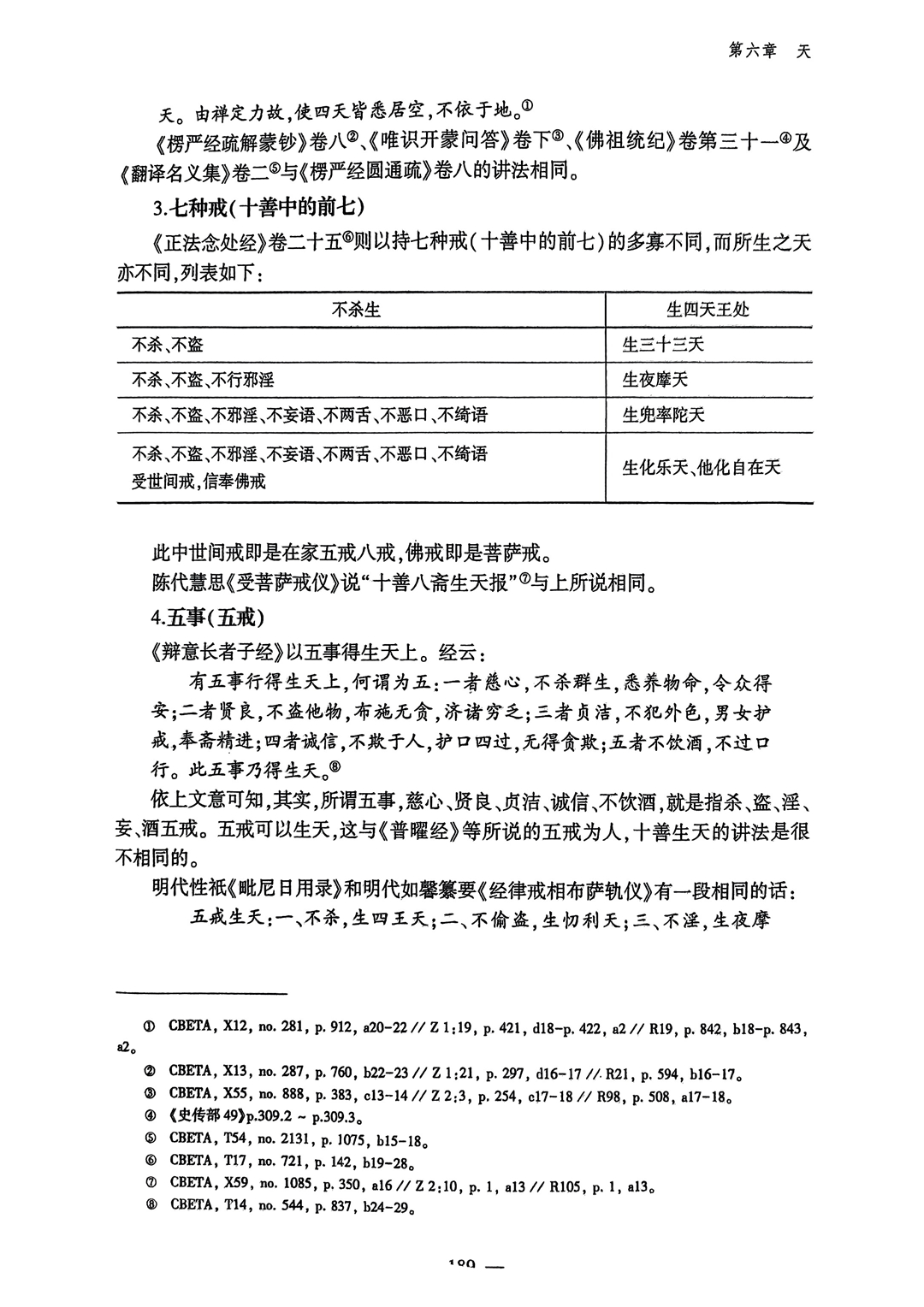
- 就“修持十善”而言,可以分别往生为日天子、月天子、星宿、四天王天、忉利天等等,请分析修持程度与往生的对应情况。
Regarding the "practice of the ten wholesome deeds," one can be reborn as the Sun Deity, Moon Deity, Star Deities, the Four Heavenly Kings, Trayastrimsa Heaven, and so on. Please analyze the correspondence between the degree of practice and the corresponding rebirth. - 中秋节 与 佛教 有什么关联吗?请尽量详细讲述。
Is there any connection between the Mid-Autumn Festival and Buddhism? Please explain in as much detail as possible.- 月亮上的兔子形象,与 释迦牟尼佛 的前世有关吗?
Is the image of the rabbit on the moon related to the previous lives of Shakyamuni Buddha?
- 月亮上的兔子形象,与 释迦牟尼佛 的前世有关吗?
- 请根据 hyjqs_01.txt 这个文件,总结出四大天王的名字,种类(比如东方持国天王是乾闼婆王),特长,以及管辖的八部众生。
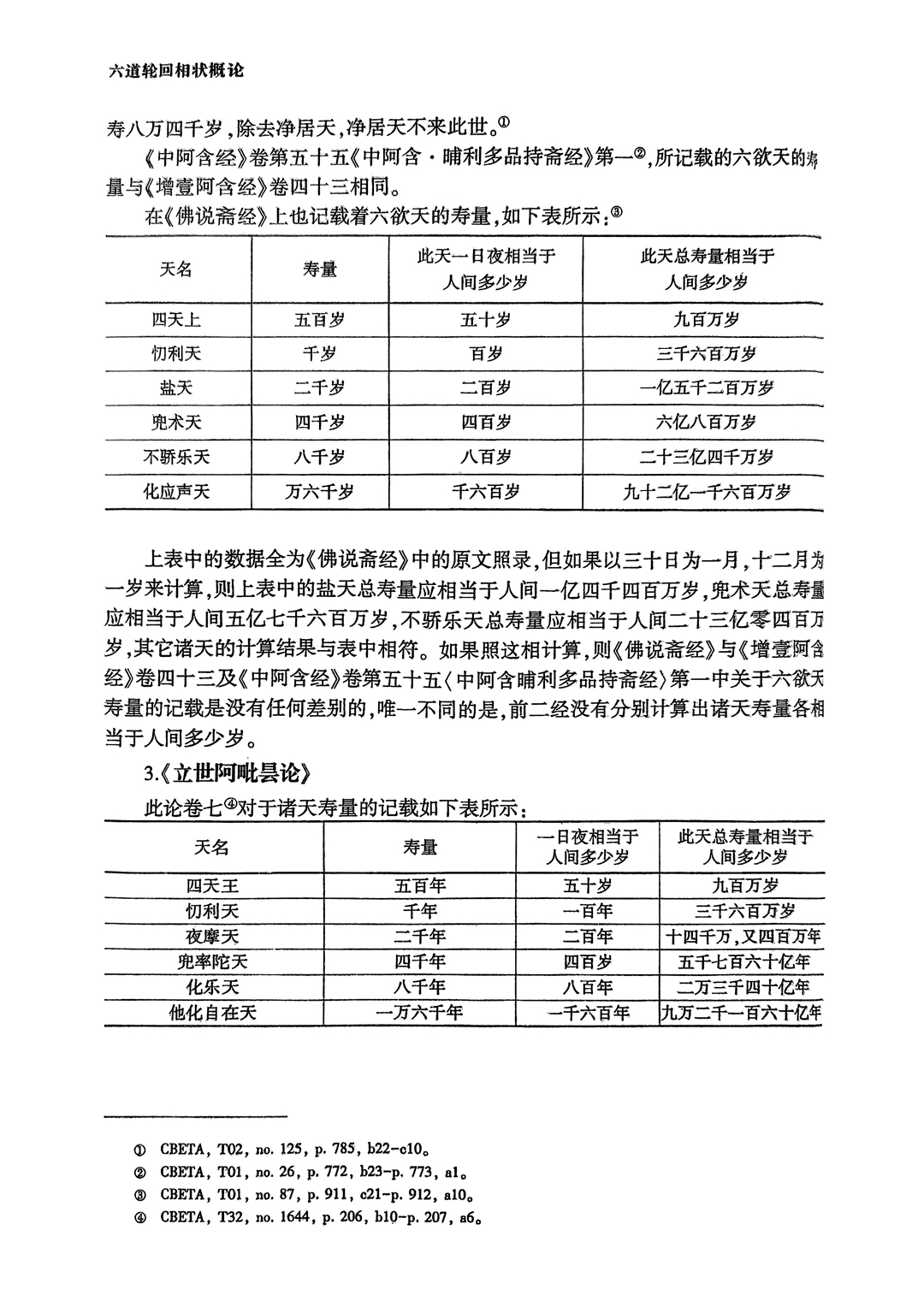
Based on the file hyjqs_01.txt, please summarize the names of the Four Heavenly Kings, their types (for example, the Eastern Heavenly King is the Gandharva King), their specialties, and the eight classes of beings they govern. - 请根据 hyjqs_01.txt 这个文件,分析四天王天 天人的寿命,相当于人间多少岁?请给出计算步骤。
Based on the file hyjqs_01.txt, please analyze the lifespan of the heavenly beings in the Heaven of the Four Heavenly Kings and determine how many human years it is equivalent to. Please provide the calculation steps. - 四天王天的天人身上有光吗?Do the heavenly beings in the Heaven of the Four Heavenly Kings have light on their bodies?
- 色界天的天人们有没有男根?Do the heavenly beings in the Form Realm have male genitalia?
- 大迦叶指责阿难的八种罪过是什么?What are the eight faults that Mahakasyapa accused Ananda of?
- 观世音菩萨是女的吗?Is Guanyin Bodhisattva female?
- 请依据《正法念处经 卷第四十七》汇总报表:哪层天,天主名(若有),堕落成什么,堕落的原因。
Please summarize the report based on "The Discourse on the Establishing of Mindfulness in the Four Foundations of Mindfulness, Volume 47": which heavenly realm, the name of the heavenly lord (if any), what they fell into, and the reason for their fall. - 光音天的天人来到南赡部洲,是怎样从”光明化生”的天人身逐渐变成骨肉胎生的人身?
When the heavenly beings of the Abhasvara heaven came to the Southern Continent, how did they gradually transform from their "birth by light" heavenly bodies into human bodies born of flesh and bone? - 请依据 阿含经 、起世经、大楼炭经 等,描述人类的起源,重点描述恶业开始出现的情形。
Please describe the origin of humanity based on the Agamas, the Sutra on the Origin of the World, the Sutra on the Great Charcoal, etc., with a focus on describing the circumstances under which evil karma first appeared. - 人投胎时,会看到光芒吗?When a human is reborn, will they see a light?
- 有人抱怨父母生下了自己,请用 胎生有三缘 拆解这种怨气。
Some people complain about being born to their parents; please use the "Three Causes of Live Birth" to dismantle this resentment.- 佛教怎样解释“肌肉萎缩性侧索硬化症(ALS、渐冻症)”,比如霍金。
How does Buddhism explain "Amyotrophic Lateral Sclerosis (ALS, Lou Gehrig's disease)", such as that of Stephen Hawking?
- 佛教怎样解释“肌肉萎缩性侧索硬化症(ALS、渐冻症)”,比如霍金。
- 天人是怎样生小孩的?How do the Devas reproduce?
- 请依据《僧伽吒经》,说一说 少众生 是什么样的?从何而来?为什么无知无觉之树能生出少众生?
According to the *Samyukta Agama*, please describe what the "few sentient beings" are like. Where do they come from? Why can a tree without consciousness and sensation give birth to a few sentient beings? - 若是让我们人类听天人的音乐,会有何后果?What would be the consequences if we humans were to listen to the music of the Devas?
- 佛教 如何看待 借尸还魂?How does Buddhism view the concept of a soul returning to a corpse?
- 呼吸停止对应几禅?心跳停止对应几禅?从初禅到四禅,相应的生理现象是什么?
Which jhana corresponds to the cessation of breathing? Which jhana corresponds to the cessation of the heartbeat? From the first to the fourth jhana, what are the corresponding physiological phenomena? - 眼耳鼻舌身意,六根的前五根各有明确所指:眼睛、耳朵、鼻子、舌头、身体。那么,意根在哪里,是心脏吗?
The six sense bases—eyes, ears, nose, tongue, body, and mind—have clear referents for the first five: eyes, ears, nose, tongue, and body. So, where is the mind-base located? Is it the heart? - 肉身千年不腐,比如六祖,这是什么原因?Why do some physical bodies remain uncorrupted for a thousand years, such as that of the Sixth Patriarch?
- 请说说 高僧道昂讲《华严经》夜晚为听众手掌放光照明 的故事。
Please tell the story of the eminent monk Dao'ang, who recited the Avatamsaka Sutra at night, emitting light from his palms to illuminate the audience. - 在没有骨肉身体的情况下,能否发出声音?Can a sound be made without a physical body?
- 天龙八部 各属于 胎卵湿化四类生命形式 中的哪一类?这八部众生各自 在世界上居住的位置 都是在哪里?
Which of the four categories of life forms (oviparous, viviparous, moist, or transformative) do the Eight Legions belong to? Where do these eight types of beings reside in the world? - 大鹏金翅鸟 吃龙 的描述,在哪部佛经中,请给出相关的经文段落。
In which Buddhist sutra is the description of the Garuda eating dragons found? Please provide the relevant passage.- 迦楼罗所处的位置在哪呢 迦楼罗 = 金翅鸟
Where is Garuda located? Garuda = Golden-winged Bird
- 迦楼罗所处的位置在哪呢 迦楼罗 = 金翅鸟
- 海市蜃楼 与 乾闼婆 有什么关系?
What is the relationship between mirages and Gandharvas? - 鬼压床的,是哪种鬼?What kind of ghost causes sleep paralysis?
- 佛经中的 罗刹(鬼)国 在哪里?Where is the Rakshasa (ghost) kingdom mentioned in the Buddhist sutras located?
- 吃肉的人,鬼会对其怎样?What will ghosts do to those who eat meat?
- 在哪部佛经中有说:天人来南赡部洲听佛讲法,请佛允许天人在空中驻足聆听,只因为受不了人的体味?
In which Buddhist sutra is it mentioned that devas came to Jambudvipa to listen to the Buddha's teachings, and asked the Buddha for permission to stop in mid-air to listen, simply because they could not bear the human body odor? - 动物的颜色与其业障有关联吗?比如狗,是不是白狗比黑狗的业障要浅一些,变成人身相对更快更容易一些?
Is there a connection between an animal's color and its karmic obstacles? For example, with dogs, do white dogs have lighter karmic obstacles than black dogs, making it relatively faster and easier for them to be reborn in human form?- 一般来说,堕入畜生道,需要轮回多久(或者多少次)才能重得人身?
Generally speaking, how long (or how many times) must one reincarnate in the animal realm before regaining a human body?
- 一般来说,堕入畜生道,需要轮回多久(或者多少次)才能重得人身?
- 佛教 如何看待 瘟疫或疫情?How does Buddhism view plagues or epidemics?
- 请讲讲 小三灾 的情形。Please explain the circumstances of the Three Minor Calamities.
- 请以真实案例解释四句偈:“千百年来碗里羹,冤深似海恨难平;欲知世上刀兵劫,但听屠门夜半声。”
Please explain the four-line verse with a real-life case: "For thousands of years, the soup in the bowl is the flesh of the innocent; the injustice is as deep as the sea, and the resentment is hard to appease. If you wish to know the calamities of war in this world, just listen to the sounds of the slaughterhouse at midnight." - 佛教 如何看待 英年早逝现象?How does Buddhism view the phenomenon of dying young?
- 佛经中说的 正法时期、像法时期、末法时期 各有多少年?
How many years are specified in the Buddhist scriptures for the True Dharma Age, the Image Dharma Age, and the Degenerate Dharma Age? - 法华经中,佛陀的大弟子们何时成佛?请根据佛陀对大弟子们的授记做出总结。
In the Lotus Sutra, when do the Buddha's chief disciples attain Buddhahood? Please summarize based on the predictions made by the Buddha for his chief disciples.- 《大般若波罗蜜多经 卷第五百七十》说“此最胜天已曾过去无量无数无边大劫,于诸佛所修行一切波罗蜜多,为诸菩萨守护般若波罗蜜多”,为何仍然需要 “于未来世复经无量无数大劫,修习无上菩提资粮”,然后才能成佛?
The *Mahaprajnaparamita Sutra, Volume 570* states: "In this supreme heaven, countless and infinite kalpas have already passed, where all paramitas practiced by the Buddhas are guarded as Prajna Paramita for the Bodhisattvas." Why is it still necessary to "endure countless and infinite kalpas in the future world, cultivating the supreme resources of Bodhi" before one can attain Buddhahood?
- 《大般若波罗蜜多经 卷第五百七十》说“此最胜天已曾过去无量无数无边大劫,于诸佛所修行一切波罗蜜多,为诸菩萨守护般若波罗蜜多”,为何仍然需要 “于未来世复经无量无数大劫,修习无上菩提资粮”,然后才能成佛?
- 世尊在涅槃之前选定了十六位弟子,要求他们不入涅槃,留在娑婆世界上宏扬佛法,护持正教。——这十六位弟子都是谁呢?有没有转世记载?
Before entering Nirvana, the World-Honored One selected sixteen disciples, requesting them not to enter Nirvana but to remain in the Saha world to propagate the Buddha's teachings and uphold the true faith. Who were these sixteen disciples? Are there any records of their reincarnations? - 寒山、拾得、丰干 是哪位圣者的化现?历史上他们出现在哪个寺院?
Hanshan, Shide, and Fenggan are the incarnations of which holy being? In history, which temple did they appear in? - 智者大师的“六即佛”,与禅宗的“三关”,怎样对应?
How do Master Zhiyi's "Six Attainments of Buddhahood" correspond to the "Three Gates" of Zen Buddhism?- 禅宗的所有祖师,从 拈花微笑 对应的大迦叶,到所有的(中国)禅宗祖师,有谁被授记在贤劫乃至其他劫成佛了呢?
Among all the patriarchs of Zen Buddhism, from Mahakasyapa (who received the transmission at the Flower Sermon) to all the (Chinese) Zen patriarchs, who has been prophesied to attain Buddhahood in the Kalpa of the Virtuous or in other kalpas?
- 禅宗的所有祖师,从 拈花微笑 对应的大迦叶,到所有的(中国)禅宗祖师,有谁被授记在贤劫乃至其他劫成佛了呢?
- 写开经偈的武则天,她的前世与佛教有什么因缘?Wu Zetian, who composed the Sutra Opening Verse, had what karmic connection with Buddhism in her past lives?
- 一切万有都是法身的显现,那法身超越时空之外而存在吗?
If all things are manifestations of the Dharmakaya, does the Dharmakaya exist beyond time and space? - 有天眼的人,去看“正在念诵佛菩萨咒语的人”,会看到什么景象?
What would a person with the divine eye see when looking at "someone chanting Buddhist mantras"? - 请说说护法神,比如诵经念佛人躲过灾难等等。Please talk about the Dharma Protectors, such as how sutra chanters and Buddha practitioners avoid disasters, etc.
- 释迦牟尼佛出世之前,南赡部洲有没有其他佛菩萨余存的佛法,比如“般若波罗蜜多心经”。
Before the birth of Shakyamuni Buddha, were there any other Buddhas or Bodhisattvas in Jambudvipa who left behind the Dharma, such as the "Heart Sutra"? - 请从大藏经的历史、版本、介质、所传国度、护法神等多角度,分析佛经的真实无伪。
Please analyze the authenticity and lack of falsification of Buddhist scriptures from multiple perspectives, including the history, versions, media, countries of transmission, and guardian deities of the Tripitaka.- 中国最初(早期)的大藏经,与隋炀帝有关吗?Is the earliest (initial) Chinese Tripitaka related to Emperor Yang of Sui?
- 哲学中的三观即世界观、人生观、价值观。佛教对此三观有何建议?请给出尽可能详细的指导。
The "Three Views" in philosophy refer to the worldview, outlook on life, and values. What are the Buddhist perspectives on these three views? Please provide as detailed guidance as possible. - 《大佛顶首楞严经》说到:不知色身,外洎山河虚空大地,咸是妙明真心中物……此见及缘,元是菩提妙净明体……一切世间诸所有物,皆即菩提妙明元心。——请依此分析“心物一元”。
The "Shurangama Sutra" states: "Not knowing the physical body, but extending outward to the mountains, rivers, void, and the earth, all are objects within the wonderful, bright, and true mind... This perception and its conditions are originally the wonderful, pure, and bright essence of Bodhi..." —Please analyze the concept of "the unity of mind and matter" based on this. - 人们死亡后,火化成一堆骨灰,再过一些岁月,骨灰也会消散。来过了,又消失了,就像时空中鼓起过一个泡泡。所以,佛经中说:“色如聚沫、受如浮泡、想如阳焰、行如芭蕉、识如幻化”。请详细解释这五种比喻。
After people die, they are cremated into a pile of ashes, and after some years, even the ashes will dissipate. They come and then vanish, just like a bubble that once swelled in space and time. Therefore, the Buddhist scriptures say: "Form is like a cluster of foam, feeling is like a floating bubble, perception is like a mirage, mental formations are like a banana tree, and consciousness is like a magical illusion." Please explain these five metaphors in detail. - 既然一切都是空,那烦恼从哪里来?轮回又是谁在承受?修行依靠什么?成佛的根基又在哪里?
Since everything is empty, where do afflictions come from? Who is enduring the cycle of rebirth? What does spiritual practice rely on? And where is the foundation for attaining Buddhahood? - 如果山河大地都是心识变现,为什么大家看见的景象是一样的?为什么时空有稳定的规则?为什么因果报应丝毫不差?
If the mountains, rivers, and the earth are all manifestations of consciousness, why do we all see the same scenes? Why are there stable rules of time and space? Why is the law of cause and effect never wrong? - 请对佛法做一个简单精要的概括总结。Please provide a simple and concise summary of the Buddha's teachings.
- 佛教的最顶峰思想是什么?What is the ultimate thought in Buddhism?
- 佛经中有哪些净土可以往生?佛弟子们常见的可往生的净土有哪些?请比较 弥勒菩萨兜率天净土 与 阿弥陀佛极乐净土。
Which Pure Lands are mentioned in the Buddhist sutras for rebirth? Which Pure Lands are commonly known to Buddhist disciples for rebirth? Please compare Bodhisattva Maitreya's Tushita Pure Land with Amitabha Buddha's Sukhavati Pure Land. - 为什么 昙鸾大师 被日本净土宗尊为初祖,而不是 慧远大师?
Why is Master Tanluan revered as the first patriarch of the Japanese Pure Land school, rather than Master Hu Yuan? - 佛陀开示了八万四千法门。在末法时代的人们,如何在此生一生之中超越三界的生死轮回、并一直到成佛?
The Buddha taught eighty-four thousand dharmas. In the age of Dharma Decline, how can people transcend the cycle of birth and death of the Three Realms within a single lifetime and ultimately attain Buddhahood?- 什么是三昧?什么是念佛三昧?《华严经》讲了哪些三昧?为什么说念佛三昩是三昧中的王?
What is Samadhi? What is the Samadhi of Buddha-remembrance? What Samadhis are mentioned in the Avatamsaka Sutra? Why is the Samadhi of Buddha-remembrance called the king of all Samadhis? - 有个别推崇参禅的人,瞧不起念佛人,说念佛人是“人肉复读机”。——请分析一下这种情况。
Some people who favor Zen meditation look down on those who practice Buddha-remembrance, calling them "human repeaters." — Please analyze this situation.
- 什么是三昧?什么是念佛三昧?《华严经》讲了哪些三昧?为什么说念佛三昩是三昧中的王?
▍为什么说佛是“正遍知”? ▲▍ Why is the Buddha called "Perfectly Omniscient"? ▲
【参考答案】佛被称为“正遍知”,是因为他不仅彻底断除了无明与颠倒(正),而且其智慧能普遍、无碍、同时地了知一切法的真实相(遍)。佛的智慧不仅能了知世间一切可数、可量、可称的事物,更能了知出世间不可数、不可量、不可称的真理(如涅槃、法性)。这是佛陀区别于一切凡夫、外道、声闻、缘觉乃至菩萨的独特功德,也是学佛者追求的最终目标。
[Reference Answer] The Buddha is called "Perfectly Omniscient" because he has not only completely eradicated ignorance and delusion (Perfect), but his wisdom can also universally, unimpededly, and simultaneously know the true nature of all phenomena (Omniscient). The Buddha's wisdom can not only know all countable, measurable, and nameable things in the world, but also know the incalculable, immeasurable, and unnamable truths beyond the world (such as Nirvana and the nature of reality). This is the unique merit that distinguishes the Buddha from all ordinary beings, heretics, Sravakas, Pratyekabuddhas, and even Bodhisattvas, and it is the ultimate goal pursued by practitioners of Buddhism.
问曰:恒河中沙,为有几许?答曰:一切算数所不能知,唯有佛及法身菩萨能知其数。佛及法身菩萨,一切阎浮提中微尘生灭多少,皆能数知,何况恒河沙?如佛在祇桓外林中树下坐,有一婆罗门来到佛所问佛:“此树林有几叶?”佛即时便答:“有若干数。”婆罗门心疑:“谁证知者?”婆罗门去至一树边,取一树上少叶藏,还问佛:“此树林定有几叶?”即答:“今少若干叶。”如其所取语之。婆罗门知已,心大敬信,求佛出家,后得阿罗汉道。以是故,知佛能知恒河沙数。
——龙树菩萨《大智度论》 |
【天降大雨的雨滴数量,佛菩萨知道】《大方广佛华严经 卷第五十》节选:复次,佛子!譬如大云降霔大雨,大千世界一切众生,无能知数,若欲算计,徒令发狂;唯大千世界主——摩醯首罗,以过去所修善根力故,乃至一滴无不明了。佛子!如来、应、正等觉亦复如是,兴大法云,雨大法雨,一切众生、声闻、独觉所不能知,若欲思量,心必狂乱;唯除一切世间主——菩萨摩诃萨,以过去所修觉慧力故,乃至一文一句,入众生心,无不明了。佛子!是为如来、应、正等觉出现第四相,菩萨摩诃萨应如是知。 |
【拍手弹指之顷,三十二亿百千念,念念成形,形形皆有识,识念极微细不可执持。佛之威神入彼微识皆令得度】《大正新修大藏经第 12 册 No. 384 菩萨从兜术天降神母胎说广普经》节选:佛即问弥勒:“心有所念,几念、几想、几识耶?”弥勒言:“拍手弹指之顷,三十二亿百千念,念念成形,形形皆有识,识念极微细不可执持。佛之威神入彼微识皆令得度,此识教化非无识也。复次,微识极微细过于微尘,此微尘识不可睹见,如来威神入彼教化皆令得度。弥勒当知未有狐疑,此微尘识亦受四气亦有四生。何以故?众生无边,边亦无边,如来亦无边,道亦无边,一切言有,有亦无有,无界、无处、无住,亦无教授化众生者,此名逆顺三昧。不住不不住一相无相,不着不缚亦无真际,修治道场净佛境界,权变无数非下劣所及。” |
《大方广佛华严经 卷第四十四》节选:佛子!菩萨摩诃萨以他心智通,知一三千大千世界众生心差别,所谓:善心、不善心、广心、狭心、大心、小心、顺生死心、背生死心、声闻心、独觉心、菩萨心、声闻行心、独觉行心、菩萨行心、天心、龙心、夜叉心、乾闼婆心、阿修罗心、迦楼罗心、紧那罗心、摩睺罗伽心、人心、非人心、地狱心、畜生心、阎魔王处心、饿鬼心、诸难处众生心,如是等无量差别种种众生心悉分别知。如一世界,如是百世界、千世界、百千世界、百千亿那由他世界,乃至不可说不可说佛刹微尘数世界中所有众生心悉分别知。是名:菩萨摩诃萨第一善知他心智神通。佛子!菩萨摩诃萨以无碍清净天眼智通,见无量不可说不可说佛刹微尘数世界中众生,死此生彼,善趣、恶趣,福相、罪相,或好或丑,或垢或净。如是品类无量众生,所谓:天众、龙众、夜叉众、乾闼婆众、阿修罗众、迦楼罗众、紧那罗众、摩睺罗伽众、人众、非人众、微细身众生众、广大身众生众、小众、大众,如是种种众生众中,以无碍眼悉皆明见;随所积集业、随所受苦乐、随心、随分别、随见、随言说、随因、随业、随所缘、随所起,悉皆见之,无有错谬。是名:菩萨摩诃萨第二无碍天眼智神通。 |
六即佛:理即佛、名字即佛、观行即佛、相似即佛、分证即佛、究竟即佛 五十二位:十信、十住、十行、十回向、十地、等觉、妙觉 |
▍贤劫千佛出世之时,对应的人寿分别是多少岁?为什么只有释迦牟尼佛选择在人寿百岁时出世? ▲
▍ At the time of the birth of the thousand Buddhas of the Kalpa, what were the corresponding human lifespans? Why did only Shakyamuni Buddha choose to be born when the human lifespan was a hundred years? ▲
【参考答案】释迦牟尼佛选择在人寿百岁时出世,并非被动地“选择”,而是其“悲愿”与“智慧”在观察众生“根机成熟”后的主动“回应”。 他选择在最黑暗、最苦难的“五浊恶世”示现成佛,是为了以“寿命短促”激发众生的“稀有难遭想”,以“劫末苦逼”唤醒众生的“厌离心”,从而“度化”最难度化的众生。这正体现了佛陀“为一大事因缘出现于世”的根本使命——开示悟入佛之知见,令众生离苦得乐。
[Reference Answer] Shakyamuni Buddha's choice to be born when the human lifespan was a hundred years was not a passive "choice," but an active "response" of his "compassionate vow" and "wisdom" after observing the "ripening of sentient beings' capacities." He chose to manifest as a Buddha in the darkest and most suffering "Five-Turbidities Evil Age" to use the "short lifespan" to inspire the "rarity and difficulty of encountering the Dharma" in sentient beings, and to use the "suffering at the end of the Kalpa" to awaken their "mind of renunciation," thereby "liberating" the most difficult-to-save beings. This exactly embodies the Buddha's fundamental mission of "appearing in the world for one great cause and condition"—to teach the realization of the Buddha's wisdom and view, enabling sentient beings to leave suffering and attain happiness.
海尘心生一念:我已于如来前劝无数眷属皆发菩提心,众人均发广大愿住持各自刹土,所有菩萨皆舍弃浊世众生,唯除遍入风。故我当为浊世众生发愿。如是发愿必有利于人天众生,诸佛菩萨亦必赞叹。将来有大悲心之菩萨会行此道,十方菩萨亦将度化浊世可怜众生。我涅槃后过不可思议劫,十方诸佛定赞叹我今日所发之愿,听闻后也当发愿住持浊世刹土。——《释迦牟尼佛广传·白莲花论》释迦牟尼佛的前世海尘菩萨所发的五百大愿 |
在贤劫的第九住劫(减劫)中,有四佛相继出世:拘留孙佛、拘那含牟尼佛、迦叶佛、释迦牟尼佛。现在贤劫千佛名经(亦名集诸佛大功德山) |
尔时,世尊举金色臂,又摩地藏菩萨摩诃萨顶,而作是言:“地藏!地藏!汝之神力不可思议,汝之慈悲不可思议,汝之智慧不可思议,汝之辩才不可思议。正使十方诸佛赞叹宣说汝之不思议事,千万劫中不能得尽。地藏!地藏!记吾今日在忉利天中,于百千万亿不可说不可说一切诸佛菩萨、天龙八部大会之中,再以人天诸众生等,未出三界在火宅中者,付嘱于汝。无令是诸众生,堕恶趣中一日一夜,何况更落五无间及阿鼻地狱,动经千万亿劫,无有出期。地藏,是南阎浮提众生,志性无定,习恶者多,纵发善心,须臾即退,若遇恶缘,念念增长。以是之故,吾分是形,百千亿化度,随其根性而度脱之。地藏,吾今殷勤以天人众,付嘱于汝。未来之世,若有天人,及善男子、善女人,于佛法中,种少善根,一毛一尘、一沙一渧,汝以道力,拥护是人,渐修无上,勿令退失。复次,地藏,未来世中,若天若人,随业报应,落在恶趣。临堕趣中,或至门首,是诸众生,若能念得一佛名、一菩萨名、一句一偈大乘经典。是诸众生,汝以神力,方便救拔,于是人所,现无边身,为碎地狱,遣令生天,受胜妙乐。”——《地藏菩萨本愿经》 |
天竺迦毗罗卫国,三世诸佛为什么都在这个地方出生?问题缘起
Why were the Buddhas of the three past times all born in the Kingdom of Kapilavastu in India? Question Origin
随着众佛发出催生的光芒,菩萨为证明不是由父母的精卵所生,特别是为了展示洁净和殊胜,特意从母体的右肋,随着威武而又温柔的光芒,于半夜鬼宿之辰合衣而诞生。菩萨诞生时,帝释为了实现昔日的祈愿和众神成为其侍从,手戴皮套,用仙衣迎接。但菩萨为了抑平帝释的骄慢,将身体化为金刚之身,毫无准备的帝释未能接住,双手不由得颤抖起来。这时,菩萨开口说出了他来到人世间的第一句话:「帝释走开,放手!」——《释迦牟尼大传》第三章 从母亲的右肋出世 |
▍请从大到小、从远到近,详细描述:一真法界、十方世界海(请给出名字)、华藏庄严世界海、普照十方炽然宝光明世界种(请给出二十重世界的名字,以及佛名)、娑婆世界、大千世界、中千世界、小千世界、一世界、四大部洲、南瞻部洲。 ▲
▍ Please describe in detail, from largest to smallest and from farthest to nearest: the One True Dharma Realm, the Sea of Ten-Direction Worlds (please provide the names), the Sea of the Flower-Adorned Majestic World, the Seed of the Blazing Jewel-Light World Illuminating the Ten Directions (please provide the names of the twenty-fold worlds and the Buddha's name), the Saha World, the Great Thousand World, the Middle Thousand World, the Small Thousand World, a Single World, the Four Great Continents, and the Southern Jambudvipa. ▲
《大方广佛华严经 华藏世界品》节选:诸佛子!彼一切世界种,或有作须弥山形,或作江河形,或作回转形,或作漩流形,或作轮辋形,或作坛墠形,或作树林形,或作楼阁形,或作山幢形,或作普方形,或作胎藏形,或作莲华形,或作佉勒迦形,或作众生身形,或作云形,或作诸佛相好形,或作圆满光明形,或作种种珠网形,或作一切门闼形,或作诸庄严具形……。如是等,若广说者,有世界海微尘数。 |
华藏庄严世界海(一览表) 华藏庄严世界海(思维导图) 佛说世界安立图解 |
▍阿弥陀佛的西方极乐世界,与《大方广佛华严经》描述的华藏世界,是一种什么样的关系? ▲
▍ What kind of relationship exists between Amitabha Buddha's Western Pure Land and the Flower-Adorned World described in the "Avatamsaka Sutra"? ▲
【参考答案】西方极乐世界是进入华藏世界(即毗卢遮那佛的全体法界)的最方便、最殊胜的阶梯与大门。 阿弥陀佛的愿力与华藏世界的全体功德是一体的。求生极乐,并非舍弃华藏,而是以最快速、最稳妥的方式,契入华藏世界的全体实相。正如清凉澄观国师所判:“极乐全具华藏,故同一涅槃。” 两者是“一而二,二而一”的圆融法界。
[Reference Answer] The Western Pure Land is the most convenient and supreme ladder and gateway to enter the Avatamsaka World (the complete Dharma realm of Vairocana Buddha). The vows of Amitabha Buddha and the complete merits of the Avatamsaka World are one and the same. Seeking rebirth in the Pure Land is not about abandoning the Avatamsaka World, but rather about entering the complete reality of the Avatamsaka World in the fastest and most reliable way. As Master Qingliang Chengguan judged: "The Pure Land fully possesses the Avatamsaka World, and thus they are the same Nirvana." The two are a perfectly integrated Dharma realm that is "one yet two, and two yet one."
【我此索诃世界,释迦牟尼佛土一劫,于极乐世界无量光佛土,为一昼夜。】 《显无边佛土功德经》大唐三藏法师 玄奘 译 如是我闻。一时薄伽梵,在摩揭陀国闲寂法林,坐妙菩提金刚坚固无量妙宝共所庄严红莲华台师子座上,与十不可说俱胝那庾多百千佛土极微尘数大菩萨俱。及诸天人,阿素洛等,无量大众,前后围绕。 尔时会中,有一菩萨摩诃萨,名不可思议光王。承佛威神,从坐而起,顶礼佛足,合掌恭敬,而白佛言:世尊。诸佛国土,时分庄严,有胜劣不?佛言:善男子!
善男子!如诸世界,昼夜渐增。如是诸佛,寿量身相。菩萨世界,庄严亦尔。由彼有情,福转增故。 若有善男子、善女人,闻此显示无边佛土功德法门,欢喜信重,受持读诵,如理思惟,广为他说。临命终时,十方佛土,无量诸佛,皆现其前,慰喻赞美,令其增进无量善根,随愿往生诸佛净国,乃至无上正等菩提。于生生中,常忆宿命,修菩萨行,速得圆满。 时薄伽梵,说此经已。不可思议光王菩萨摩诃萨,并诸天人,阿素洛等,一切众会,闻佛所说,皆大欢喜,信受奉行。 显无边佛土功德经Sutra on Manifesting the Merit of the Boundless Buddha-lands |
【释迦牟尼佛刹一劫。于极乐世界阿弥陀佛刹。为一日一夜。】《大方广佛华严经 寿量品》节选: 尔时心王菩萨摩诃萨。于众会中。告诸菩萨言。佛子。此娑婆世界。释迦牟尼佛刹一劫。于极乐世界阿弥陀佛刹。为一日一夜。极乐世界一劫。于袈裟幢世界金刚坚佛刹。为一日一夜。袈裟幢世界一劫。于不退转音声轮世界善胜光明莲华开敷佛刹。为一日一夜。不退转音声轮世界一劫。于离垢世界法幢佛刹。为一日一夜。离垢世界一劫。于善灯世界师子佛刹。为一日一夜。善灯世界一劫。于妙光明世界光明藏佛刹。为一日一夜。妙光明世界一劫。于难超过世界法光明莲华开敷佛刹为一日一夜。难超过世界一劫。于庄严慧世界一切神通光明佛刹。为一日一夜。庄严慧世界一劫。于镜光明世界月智佛刹。为一日一夜。佛子。如是次第。乃至过百万阿僧祇世界。最后世界一劫。于胜莲华世界贤胜佛刹。为一日一夜。普贤菩萨。及诸同行大菩萨等。充满其中。 |
▍佛教 如何看待 时间? ▲
▍ How does Buddhism view time? ▲
【参考答案】时间在唯识学中被归为“心不相应行法”之一。它既不是色法(物质),也不是心法(精神),而是依于色心诸法的生灭变化而建立的“分位差别”。离开色心诸法,没有独立的时间自体。佛法将时间分为过去、现在、未来三世。这是为了说明因果相续、业报轮回而建立的“假名”。佛教建立了极为精细的时量体系,从极短的“刹那”到极长的“大劫”。
[Reference Answer] In Yogacara, time is classified as one of the "mental non-associated dharmas." It is neither a material dharma (rupa) nor a mental dharma (citta), but rather a "positional distinction" established based on the arising, ceasing, and changing of material and mental dharmas. Independent of material and mental dharmas, there is no independent entity of time. Buddhism divides time into the three worlds: past, present, and future. This is a "conventional name" established to explain the continuity of cause and effect, karmic retribution, and the cycle of rebirth. Buddhism has established an extremely precise system of time measurement, ranging from the extremely short "ksana" to the extremely long "kalpa".
如来以无尽大悲,矜哀三界,所以出兴于世。光阐道教,欲拯群萌,惠以真实之利。难值难见。如优昙花,希有出现。汝今所问,多所饶益。阿难当知:如来正觉,其智难量。无有障碍。能于念顷,住无量亿劫。身及诸根,无有增减。所以者何?如来定慧,究畅无极。于一切法,而得最胜自在故。——佛说大乘无量寿庄严清净平等觉经 |
【自在音天王,得一念中普現無邊劫一切衆生福德力解脫門。】這位自在音天王,能在一念之中,普現三世無邊的劫。能使過去世成為現在世,把現在世變為未來世,未來世又可以當作為過去世。過去、現在、未來三世同時在一念中顯現,所謂:「攝無量劫為一念,放一念為無量劫」。在無量劫中又有無量的衆生,修福修慧修成佛。修福就有福的力量,修慧就有慧的力量。換言之,福慧修圓滿,力量也成就了,這樣便離成佛不遠。這位天王,他得到這種解脫門。——大方廣佛華嚴經淺釋 |
▍《妙法莲华经》中的 大通智胜如来,与《悲华经》中的 宝藏如来,从时间上讲,哪尊佛更早更久远? ▲
▍ Between the Tathagata of Great Wisdom and Victory in the Lotus Sutra and the Tathagata of Treasure in the Mahayana Sutra of the Lotus Flower, which Buddha is earlier and more ancient in terms of time? ▲
【参考答案】大通智胜佛的十六王子之一(第九王子)即是阿弥陀佛的因地之一,而宝藏佛所授记的无诤念王(轮王)也是阿弥陀佛的因地之一。但法华经中明确说大通智胜佛的"无量无边不可思议阿僧祇劫"远超过"恒河沙等阿僧祇劫"——因为大通佛的时间是用"尘点劫"来喻示的,尘点劫的基数本身已是"无量无边不可思议"级别,远大于一恒河沙。大通智胜如来比宝藏如来更早、更久远。大通佛的"尘点劫"是佛经中描述时间久远的极限比喻,其规模远超"恒河沙数阿僧祇劫"。但在诸佛"法身常住、无古无今"的究竟义上,久近之别也只是方便之说。
[Reference Answer] One of the sixteen princes of the Tathagata of Great Wisdom and Victory (the ninth prince) is one of the causal grounds of Amitabha Buddha, and the Non-Contention Thought King (Wheel-Turning King) prophesied by the Treasure Buddha is also one of the causal grounds of Amitabha Buddha. However, the Lotus Sutra explicitly states that the "immeasurable, boundless, inconceivable asankhyeya kalpas" of the Tathagata of Great Wisdom and Victory far exceed the "asankhyeya kalpas equal to the sands of the Ganges" — because the time of the Great Wisdom Buddha is illustrated by the "dust-point kalpa", and the base number of the dust-point kalpa itself is already at the "immeasurable, boundless, inconceivable" level, far greater than a single Ganges sand. The Tathagata of Great Wisdom and Victory is earlier and more ancient than the Tathagata of Treasure. The "dust-point kalpa" of the Great Wisdom Buddha is the ultimate metaphor for describing the longevity of time in Buddhist scriptures, and its scale far exceeds the "asankhyeya kalpas equal to the number of Ganges sands". However, in the ultimate sense that the "Dharmakaya of all Buddhas is eternally abiding, without past or present", the distinction of being long or short is merely a skillful teaching.
佛告诸比丘:‘乃往过去无量无边不可思议阿僧祇劫,尔时有佛,名大通智胜如来、应供、正遍知、明行足、善逝世间解、无上士、调御丈夫、天人师、佛、世尊,其国名好城,劫名大相。诸比丘,彼佛灭度已来,甚大久远,譬如三千大千世界所有地种,假使有人、磨以为墨、过于东方千国土、乃下一点,大如微尘,又过千国土、复下一点,如是展转尽地种墨,于汝等意云何,是诸国土,若算师,若算师弟子,能得边际、知其数否?’‘不也、世尊。’‘诸比丘,是人所经国土,若点不点,尽抹为尘,一尘一劫,彼佛灭度已来,复过是数无量无边百千万亿阿僧祇劫,我以如来知见力故,观彼久远、犹若今日。’——《妙法莲华经 化城喻品第七》 |
阿僧祇 = 10^(7.1*10^31) 也称作「无数」——“华严数字体系”漫谈;尔时,心王菩萨白佛言∶『世尊,诸佛如来,演说、无量、无边、无等、不可数、不可称、不可思、不可量、不可说、不可说不可说。』『世尊,云何阿僧祇乃至不可说不可说耶?——《华严经 阿僧祇品第三十》 |
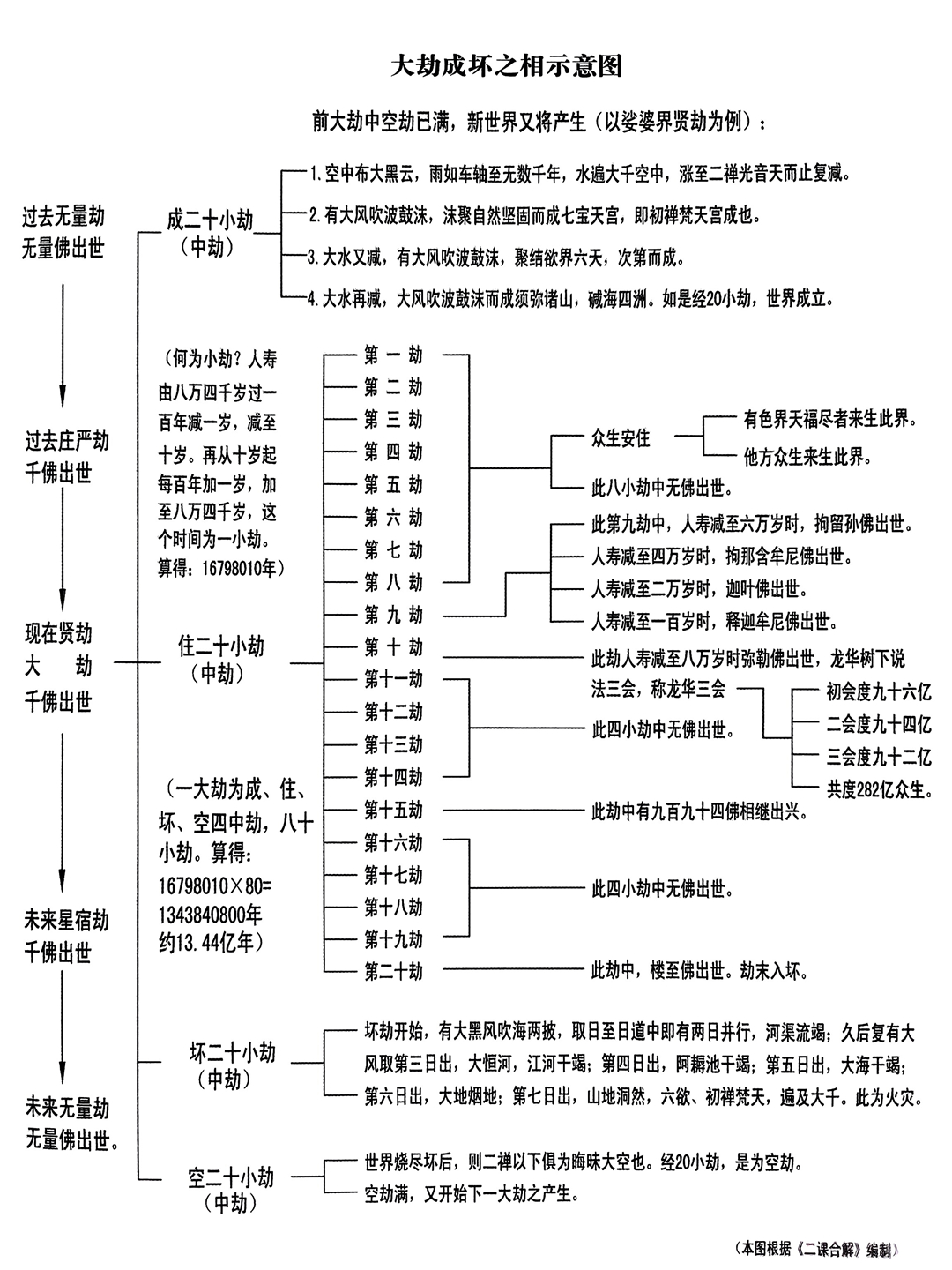
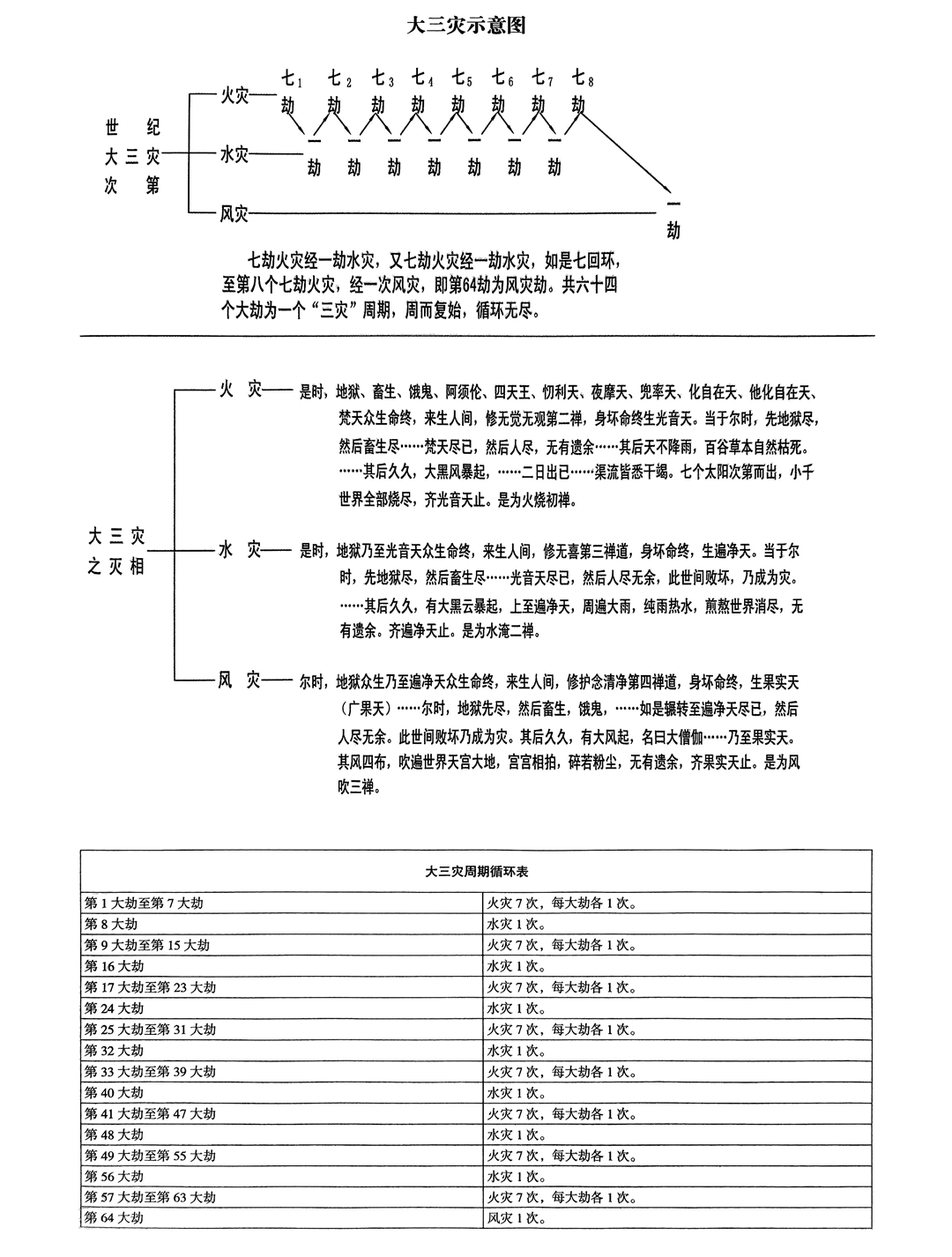
▍请详细描述时间概念“劫”,以及“劫初”、“劫末”、“火、水、风”三大灾的情形。 ▲
▍ Please describe in detail the concept of time "kalpa", as well as the situations of the "beginning of the kalpa", the "end of the kalpa", and the three great disasters of "fire, water, and wind". ▲
【参考答案】“劫”是佛教中用于衡量极其漫长宇宙周期的基本时间单位。其概念涵盖了世界的成、住、坏、空四个阶段,而“劫初”、“劫末”及“大三灾”(火、水、风)正是这个循环周期中不同阶段的关键景象。
[Reference Answer] "Kalpa" is the fundamental unit of time in Buddhism used to measure extremely long cosmic cycles. Its concept encompasses the four stages of the world: formation, stability, destruction, and emptiness, while the "beginning of a kalpa," the "end of a kalpa," and the "three great calamities" (fire, water, and wind) are precisely the key phenomena at different stages of this cyclical period.
一切勇菩提萨埵白佛言:“世尊!劫以何量?”佛言:“善男子,譬如大城 纵广十二由旬 高三由旬,盛满胡麻,有长寿人、过百岁已、取一而去,如是城中 胡麻悉尽,劫犹不尽;一切勇,又如大山 纵广二十五由旬 高十二由旬,有长寿人 过一百岁,以轻缯帛 一往拂之,如是山尽、劫犹不尽;是名劫量。”——僧伽吒经 |
参考:从均寿四十岁时的195天/年降至均寿10岁时的90天每年,只会用到两百年左右 |
此劫烧时焚荡尽者,是诸如来大方便力之所为也;诸佛如来十地菩萨…于上虚空中,以慈悲智慧身手,解救众生,不令有苦而触身也 |
【参考答案】威灯光仙人问佛劫末大火的原因,佛的回答非常深刻,与大乘其他经论的立场有所不同——劫末大火不仅是众生业力所感,更是诸佛如来的大方便力:“此劫烧时焚荡尽者,是诸如来大方便力之所为也。”劫尽大地烧时,十地菩萨比十方微细雨滴还多,在虚空中以慈悲智慧之手解救众生,不让众生身体触到痛苦。《大威灯光仙人问疑经》给出了劫末大火最独特、最正面、最深刻的解释——劫末大火不是业力的惩罚、不是自然规律的冷酷、不是佛菩萨无能为力的灾难,而是佛菩萨有意施设的大方便、大慈悲、大教育。同理,劫末大水、劫末大风虽然另以喜受、出入息为内因,但同样不离"诸佛如来大方便力"的摄受,同样是佛菩萨示现无常、教化众生的大慈悲方便——大火、大水、大风中,三灾不伤有缘者,菩萨伸手救众灵。
[Reference Answer] When the Arhat Vimalaprabha asked the Buddha about the cause of the great fire at the end of the kalpa, the Buddha's answer was profound and differed from the positions of other Mahayana sutras and treatises — the great fire at the end of the kalpa is not only caused by the karma of sentient beings, but is also the great skillful means of all Buddhas and Tathagatas: "The total destruction by fire at the end of this kalpa is the work of the great skillful means of the Tathagatas." When the earth burns at the end of the kalpa, the Bodhisattvas of the Ten Stages are more numerous than the microscopic raindrops of the ten directions, using their hands of compassion and wisdom in the void to save sentient beings, preventing their bodies from touching suffering. The *Sutra of the Arhat Vimalaprabha's Inquiry* provides the most unique, positive, and profound explanation for the great fire at the end of the kalpa — the great fire is not a punishment of karma, nor the coldness of natural laws, nor a disaster beyond the power of Buddhas and Bodhisattvas, but a great skillful means, great compassion, and great education intentionally manifested by Buddhas and Bodhisattvas. Similarly, although the great floods and great winds at the end of the kalpa have internal causes such as joyful experience and breathing, they are equally encompassed by the "great skillful means of the Buddhas and Tathagatas," and are equally the great compassionate skillful means of Buddhas and Bodhisattvas to manifest impermanence and teach sentient beings — amidst the great fire, great water, and great wind, the Three Calamities do not harm those with affinity, as Bodhisattvas reach out their hands to save all sentient beings.
【文殊菩萨的过咎】尔时世尊即告文殊尸利菩萨摩诃萨言……文殊尸利。汝于过去诸世尊所。虽复以于种种衣服四事供养常令丰足。而汝未曾于是法本为他人故方便显说。以如是故。于彼佛边犹多过咎。若汝于彼过去佛边。乃至一佛未曾供养。但能于是深妙法本为他广说。当知即是于一切佛诸世尊所。具足供养无有过咎。——《大威灯光仙人问疑经》 |
【参考答案】"增劫轮王、减劫佛兴"是经论的普遍法则,但这是"顺解脱师"教化众生的方便权宜,并非不可变易的铁律。佛菩萨的本愿力(楼至佛)、五浊众生的机感(弥勒于初减时出)、轮王与佛的同源大福德(佛不出家当为轮王),都说明这场"增劫减劫的轮王佛兴"安排,最终是为了契合众生的根机与时机而施设的大慈悲、大方便。
[Reference Answer] "The rise of the Wheel-Turning King and the decline of the Buddha" is a universal law of the sutras and treatises, but this is a skillful expedient used by the "Masters of Easy Liberation" to teach sentient beings, not an unchangeable iron law. The original vows of Buddhas and Bodhisattvas (such as the Buddha Lokesvara), the karmic affinity of sentient beings in the Five Turbidities (such as Maitreya appearing at the beginning of the decline), and the shared great merit of the Wheel-Turning King and the Buddha (if a Buddha does not renounce the world, he should become a Wheel-Turning King) all demonstrate that this arrangement of "the rise of the Wheel-Turning King and the decline of the Buddha" is ultimately a great compassion and skillful means established to suit the capacities and timing of sentient beings.
▍劫初,有几个太阳几个月亮?安置在什么位置?是谁造就了日月? ▲
▍ At the beginning of a kalpa, how many suns and moons are there? Where are they positioned? Who created the sun and the moon? ▲
【参考答案】劫初时,众生从“光音天”化生人间,原本有身光,能飞行自在。后来因食地肥(甘泉)、地饼、粳米等段食,身光消失,世界陷入黑暗。此时,西方(极乐世界)阿弥陀佛以慈悲心,派遣宝应声菩萨与吉祥菩萨,下生到人间,造作出日月宫城(以七宝及玻璃合成),安置于须弥山腰。从此,人间才有了昼夜、光明。
[Reference Answer] At the beginning of the kalpa, sentient beings were born in the human world from the "Light-Sound Heaven". They originally had bodies of light and could fly freely. Later, because they ate food such as the fertile earth (sweet spring water), earth cakes, and glutinous rice, their body light disappeared, and the world fell into darkness. At this time, Amitabha Buddha of the Western Pure Land, with a compassionate heart, sent Bodhisattva Baoying and Bodhisattva Jixiang to descend to the human world and build the Sun and Moon Palace (made of seven treasures and glass), placing it on the waist of Mount Meru. From then on, the human world had day and night, and light.
【为什么西方净土的阿弥陀佛要为(释迦牟尼佛的)娑婆世界造日月?】因为 释迦牟尼佛 与 阿弥陀佛 在久远劫之前,有着深厚的因缘,所以 阿弥陀佛派遣 观世音菩萨造太阳,大势至菩萨造月亮(七个太阳,一个月亮);月兔由来:从此之后,三十三天尊胜宫、善法堂,及月轮之上便都开始留有山兔画像,直至今日,包括月兔在内之影像依然留存于世。 |
尔时,药上菩提萨埵,及五百眷属,以神通力 踊身虚空,身出师子猛虎白象、现大神通,于高山顶 结跏趺座,满二万由旬,化作十千亿日月。时,诸年少白佛言:“世尊,何故世间 有此光明?”尔时,世尊告诸年少:“善男子,汝等见此 日月不耶?”时,诸年少白佛言:“世尊,唯然已见。”佛告年少:“此是菩提萨埵 自身光明,现作日月 示于众生,为之说法 安乐利益 一切天人,人中修行 得此神通。”——《僧伽吒经 卷第四》 |
【虽然世界众生是业力所生,诸佛也做了加持】《大正藏第 12 册 No. 0380 大悲经》节选:有时三千大千世界为劫火焚烧炎炽洞然……此三千大千世界百亿日月流转之时……此等皆是诸佛境界诸佛所加。 |
【参考答案】佛教经典中,日、月、星辰被称为"三光"或"三光天子",法华经注疏明确指出,这三位天子是三大菩萨(观世音菩萨、大势至菩萨、虚空藏菩萨)的化现。太虚大师将行星分属四大天王、星宿天等的判释,是以佛教四天王天统摄四天下的框架,结合当时的天文学知识做的会通性判断,在佛经中没有直接依据,但在义理上可以成立——因为四天王天本身就是"护世四王",各自统领一方,守护四大部洲。
[Reference Answer] In Buddhist scriptures, the sun, moon, and stars are referred to as the "Three Lights" or the "Three Sons of Light". The commentaries on the Lotus Sutra explicitly state that these three celestial beings are manifestations of the three great Bodhisattvas (Avalokitesvara, Mahasthamaprapta, and Akasagarbha). Master Taixu's interpretation, which assigns the planets to the Four Heavenly Kings and the constellations, is an ecumenical judgment made within the framework of the Four Heavenly Kings governing the four directions, combined with the astronomical knowledge of his time. While it lacks direct textual basis in the Buddhist sutras, it is doctrinally sound—because the Four Heavenly Kings themselves are the "Four Kings Protecting the World", each ruling a specific region and guarding the four great continents.
冯冯居士《土星千层光环之谜》节选:土星,是毗卢遮那佛与观音菩萨的道场之一!唐代瞿昙悉达所译佛书,已有此记载。太阳也是观音菩萨常驻所,月球为势至菩萨与千手观音常往处,火星为宝生佛与阿鲁迦观音驻常驻地,水星为微妙庄严身佛道场之一,木星为药师佛传法地之一,金星为阿弥陀佛说法地之一。唐代的“梵天火罗九曜”也有此说。 |
神仙打架算啥,今天让大家见识一下菩萨打架,太阳都“打”没了! |
【佛教十二宫星座的秘密】西洋占星术是怎么从佛教的密教法门中传入西洋的?西洋占星术又是如何承袭自佛教大藏经中的星相学的?中国的农历、历法以及许多术法又为什么源自佛教? |
哈雷彗星的来历:蜈蚣被封印。地球上鸡的出现。现有动物是远古巨兽的缩微模型。 |
▍太阳、月亮为什么看起来是圆形的?实际上是什么形状?太阳光、月光是怎样产生的?请依佛经回答。 ▲
▍ Why do the sun and moon appear to be round? What is their actual shape? How are sunlight and moonlight produced? Please answer according to the Buddhist scriptures. ▲
【参考答案】实际形状是正方如宅(方形宫殿),如同房屋建筑一般。因为距离人间极远,遥望之下看起来成了圆形。这与《论衡》所说"日月不圆,视若圆者,去人远故"的道理是一致的。日天子身光 → 照金辇 → 照宫殿 → 照四大洲,共有千光明(500傍照+500下照)。月天子身光 → 照青琉璃辇 → 照宫殿 → 照四大洲,共有千光明,亦名凉冷光明。
[Reference Answer] Their actual shape is square like a residence (a square palace), just like a house. Because they are extremely far from the human world, they appear round from a distance. This is consistent with the principle stated in the "Lun Heng" (Critical Essays): "The sun and moon are not round; they appear round because they are far from people." The body light of the Sun-Deity → illuminates the golden chariot → illuminates the palace → illuminates the four great continents, producing a total of a thousand lights (500 side-illuminations + 500 downward-illuminations). The body light of the Moon-Deity → illuminates the blue lapis lazuli chariot → illuminates the palace → illuminates the four great continents, producing a total of a thousand lights, also known as the cool and cold light.
佛经中对太阳月亮的描述:宫殿四方远见故圆,寒温和适,天金所成,颇梨间厕,二分天金,纯真无杂,外内清彻,光明远照,一分颇梨,纯真无杂,外内清彻,光明远照。日宫纵广五十一由旬,宫墙及地薄如梓柏。 |
百度知道:什么物品白天是方形的,到了晚上就会变成圆形?最符合该谜面的常见物品是方形纸质灯笼。白天未点亮时,实体外形为规整的方形结构。到了夜晚点亮内部光源后,光线会透过半透明的灯纸向外弥散,从远处观看时,整体光影会呈现出圆形的视觉效果,给人一种物品从方形变成圆形的直观感受。 |
▍在世界成住坏空的过程中,佛菩萨起了什么作用? ▲
▍ During the process of formation, stability, destruction, and emptiness of the world, what role did the Buddhas and Bodhisattvas play? ▲
【参考答案】在世界成住坏空的过程中,佛菩萨并非像造物主那样直接创造或毁灭世界,而是作为“业力增上缘”和“愿力主导者”,以“众生的共业”为基础,通过自身的悲愿、智慧和神通,对世界进行引导、净化、庄严与转依,从而影响世界成坏的方向与品质。佛菩萨是世界成坏过程中的“主角”而非“编剧”。众生共业是剧本,佛菩萨的悲智愿行是导演——他们调整剧本的呈现方式(使苦果轻、使净土现),但从不否定剧本的存在。因此,世界成住坏空既非纯粹的自然规律(业力),亦非造物主的游戏,而是佛菩萨与众生一心、悲智双运的庄严示现。
[Reference Answer] In the process of the world's formation, abiding, decay, and destruction, Buddhas and Bodhisattvas do not directly create or destroy the world like a Creator. Instead, acting as "conditions of karmic augmentation" and "leaders of vows," they take the "collective karma of sentient beings" as their foundation. Through their own compassionate vows, wisdom, and supernatural powers, they guide, purify, solemnize, and transform the world, thereby influencing the direction and quality of its formation and destruction. Buddhas and Bodhisattvas are the "protagonists" rather than the "screenwriters" in the process of the world's formation and destruction. The collective karma of sentient beings is the script, and the compassionate wisdom and vow-based actions of Buddhas and Bodhisattvas are the directors—they adjust how the script is presented (making the bitter fruits lighter and the pure lands manifest), but never deny the existence of the script. Therefore, the formation, abiding, decay, and destruction of the world is neither a purely natural law (karma) nor a game played by a Creator, but a solemn manifestation of the unity of mind between Buddhas and Bodhisattvas and sentient beings, characterized by the simultaneous operation of compassion and wisdom.
【燄口龍王,得普現無邊佛世界,建立差別解脫門。】這位燄口龍王,他口中能噴火,能變成火山。他得到普徧到十方諸佛世界的法門。諸佛世界所建立的,所成就的,各有不同。娑婆世界是釋迦牟尼佛所建立的,在該世界弘揚佛法。極樂世界是阿彌陀佛所建立的,在該世界演說佛法。琉璃世界是藥師琉璃光佛所建立的,在該世界講經說法。因為諸佛所建立的世界,各有不同的緣故,所以才說差別解脫門。諸佛所建立的世界,或者建立的時間長一點,或者建立的時間短一點,或者建立的世界莊嚴,或者建立的世界堂皇,這都是十方諸佛對衆生機而示現,現出這種的世界,來救這類的衆生。這位龍王得到這種解脫門。——宣化上人《大方廣佛華嚴經淺釋》 |
佛的大威神力,是由累劫的德行所成就。這個世界本來應該壞了,佛用大威神力把這世界保持平安,並且在這世界演說種種善法,用權巧方便教化衆生,令衆生覺悟,知道苦海無邊,囘頭是岸的道理。——宣化上人《大方廣佛華嚴經淺釋》 |
▍从忉利天看日月运转,会是什么样的体验?请给出具体的经文段落。 ▲
▍ What would it be like to observe the movement of the sun and moon from the Trayastrimsa Heaven? Please provide the specific scriptural passage. ▲
【参考答案】从忉利天看日月运转,是一种超越性、俯视性、光明自足的体验。日月不再是天界的照明工具或时间刻度,而是须弥山腰运行的、供观赏的风景。天人自身的光明和寿命,使得他们从人间的日月束缚中彻底解脱出来。——基于CBETA
[Reference Answer] Observing the movement of the sun and moon from the Trayastrimsa Heaven is a transcendent, bird's-eye, and self-sufficiently luminous experience. The sun and moon are no longer mere lighting tools or timekeepers of the heavenly realm, but rather a scenic view moving around the slopes of Mount Meru for contemplation. The inherent light and longevity of the heavenly beings allow them to be completely liberated from the constraints of the sun and moon in the human realm. — Based on CBETA
▍从忉利天看日月运转,会是什么样的体验?请给出具体的经文段落。 ▲
▍ What would it be like to observe the movement of the sun and moon from the Trayastrimsa Heaven? Please provide specific passages from the scriptures. ▲
【参考答案】从忉利天的视角看日月,不是“自下而上的仰观”,而是一种“自上而下的俯察”,且日月的光明在忉利天的自光明面前是黯淡的,其运行在四洲的显现也是多样而相对的。此外,还有阿修罗障蔽等特异的天象。——基于 中华佛典宝库
[Reference Answer] From the perspective of Trayastrimsa Heaven, the sun and moon are not "looked up at from below," but are "observed from above." Furthermore, the light of the sun and moon is dim compared to the self-luminosity of Trayastrimsa Heaven, and their appearance in the Four Continents is diverse and relative. Additionally, there are unique celestial phenomena such as the Asuras obscuring them. — Based on the Treasure Trove of Chinese Buddhist Scriptures
▍佛教 如何看待 日食月食? ▲▍ How does Buddhism view solar and lunar eclipses? ▲
【参考答案】佛教既承认日食月食在世俗层面有历法规律可循(阴阳相御),也保留了阿修罗神话的传说表述,但佛的究竟义在于指出——月性实无增减,只是光明被障;同时,在密教中将日月蚀视为修法成就的最殊胜时机,丛林则将其作为祷禳救护的庄严法事。
[Reference Answer] Buddhism acknowledges that solar and lunar eclipses follow predictable calendrical patterns in the mundane realm (the interaction of Yin and Yang), while also preserving the mythological legends of the Asuras. However, the ultimate meaning of the Buddha's teaching is to point out that the nature of the moon truly neither increases nor decreases; its light is merely obscured. Meanwhile, in Esoteric Buddhism, eclipses are regarded as the most auspicious time for achieving spiritual accomplishments, whereas in the monastic community, they are observed as solemn rituals for prayer and protection.
阿修罗,迦楼罗所处的位置在哪呢Where are the Asuras and Garudas located?
【佛经中的日食、月食、以及颜色原因】罗睺阿修罗王 以手障日、月;杂色衣、宝珠光明 或青或黄、或赤或黑。【血月生成原因】罗睺阿修罗王的宝珠光明是红色的。【附】暗网流出的视频,一只大手在擦拭星星;阿修罗王的前世因缘。 |
【阿修罗王有大福报,可以手遮日月,为何好战?】时婆罗门名曰婆利,诵毗陀论,广造福业如上所说。时婆罗门以四千乘车载众饮食,至大旷野众人行路,欲施所须,见一佛塔高二由旬,广五十里。时有恶人以火烧塔,舍之而去。时婆罗门见火烧塔,作是思惟:‘我今宁可且住施福,救如来塔——奇妙庄严、雕饰精丽、广大希有——当灭此火,令塔不坏。若我不救,王若知者,或加重罚。’非实信心,非尊重心。即以四千乘车载水以灭此火。既灭火已含笑而言:‘我救此塔为有福德、无福德耶?若有福德,愿我后身得大身相,欲界无等。’虽作此愿,而犹不信,不正思惟,常爱斗战,不信正业。福田力故,生光明城作阿修罗王。——《正法念处经》 |
【阿修罗王部众都特瞋恨、我慢、嫉妒,谁也不服。世界初成,住须弥山顶】阿修罗男性丑陋,女性特别美丽,比忉利天女还美,但是食物不好,有美女无好吃的。忉利天有好食无美女,互相憎恨嫉妒,是故经常发生战争。比如《观佛三昧海经》记载:“阿修罗经八千岁乃生一女,取名悦意,其女仪容端正挺特……帝释下诣阿修罗而求此女。时阿修罗踊跃欢喜以女妻之……帝释至欢喜园时,共诸婇女人池游戏。尔时悦意即生嫉妒,遣五夜叉往白父王,今此帝释不复见宠,与诸婇女自共游戏。父闻此语心生瞋恚,即兴四兵往攻帝释……”阿修罗后来打败了,无处躲,“遁走无处,入藕丝孔”。躲进藕孔里,才躲过追杀。 阿修罗王有四个:There are four Asura Kings:
四大阿修罗王,各领千万之部属,住四大海中。The four great Asura Kings each lead tens of millions of followers and reside in the four great oceans. 阿修罗王部众都特瞋恨、我慢、嫉妒,谁也不服。世界初成,住须弥山顶,须弥山顶亦有天人宫殿,光音天以下到处都是天人住,都有天人宫殿。修罗瞋恨天人,便避之,无所住,遂下居于地。 佛住世时,嫉佛说法,佛为诸天说四念处:①观身不净。②观受是苦。③观心无常。④观法无我。阿修罗加一念叫五念处。佛说三十七道品,阿修罗说三十八道品。 阿修罗有一种琴,叫阿修罗琴,无须弹奏,而随意自出声,乃为阿修罗之福德所使然也。 ——《佛说世界安立图解》— "Illustrated Diagram of the Buddha's World" |
▍基于须弥山,从所处位置的高度上讲,星辰 比 日月 高吗? ▲
▍ Based on Mount Meru, in terms of the altitude of one's position, are the stars higher than the sun and moon? ▲
【参考答案】基于须弥山结构,星辰与日月处于同一高度层级(须弥山半腹,四天王天所在处),星辰并不比日月高。 它们同属“日月星宿天”,共同围绕须弥山运行。视觉上星辰显得更高,是因为其分布范围更广,且经论强调“星是宫殿,依空而住”,但实际位置与日月平齐。
[Reference Answer] Based on the structure of Mount Meru, stars and the sun and moon are at the same height level (the mid-section of Mount Meru, where the Four Heavenly Kings reside), so stars are not higher than the sun and moon. They all belong to the "Heaven of the Sun, Moon, and Stars" and revolve around Mount Meru together. Visually, stars appear higher because they are more widely distributed, and the scriptures emphasize that "stars are palaces, dwelling in the void," but their actual positions are level with the sun and moon.
▍请解释“南赡部洲”的来历 ▲▍ Please explain the origin of "Jambudvipa" ▲
【参考答案】南赡部洲的来历,最根本的原因是根据该洲特有的一棵名为“赡部”或“阎浮”的神奇大树而命名的。这棵树是该洲最显著的地理与生物标志,因此该洲也以此树为名,称为“南赡部洲”(意为“南方赡部树之洲”)。
[Reference Answer] The origin of Jambudvipa is fundamentally named after a unique, miraculous large tree called "Jambu" or "Yandufu" found in this continent. This tree is the most prominent geographical and biological landmark of the continent, so the continent is named after it, called "Jambudvipa" (meaning "the continent of the southern Jambu tree").
▍佛经中有个故事,说一个名叫“长胫”的人想去看“剡浮树”。请给出那个经文段落。 ▲
▍ There is a story in the Buddhist scriptures about a man named "Changjing" who wanted to see the "Shanfu tree". Please provide that passage from the scripture. ▲
【参考答案】【人物】长胫(名),本是王种(拘利氏),有神通(行水、草、叶皆不留痕迹)。【动机】从佛处听说剡浮树的广大庄严,主动问佛:“我若行去,能到吗?”佛答:“能到。”【第一次失败】长胫向北出发,经历七山,登上金边山望见黑暗,心生怖畏而返。佛告之:“此黑暗色即剡浮树。”【第二次成功】长胫再次启程,历经七山重复、六大国土、七大树林及河流,终于到达剡浮树南枝,并从南枝行至北枝。他试图以神通履水,却因该处水最轻最细、超越此土的水性而失败(脚入水如石沉)。【结果】他取回一枚剡浮树的果子,献给佛陀。佛分果施众,果汁染手,佛以此手击山石,留下至今不变的赤色掌印,该石因此得名**“片片岩”**。
[Reference Answer] [Character] Changjing (name), originally Wangzhong (of the Jooli clan), possessed supernatural powers (walking on water, grass, and leaves without leaving a trace). [Motivation] Hearing of the vast magnificence of the Shanfu tree from the Buddha, he proactively asked the Buddha, "If I set out, can I reach it?" The Buddha replied, "You can." [First Failure] Changjing set out north, crossed seven mountains, and upon reaching Mount Jinbian, saw darkness. Filled with fear, he turned back. The Buddha told him, "This darkness is the color of the Shanfu tree." [Second Success] Changjing set out again, traversing seven mountains, six great lands, seven great forests, and rivers, finally reaching the southern branch of the Shanfu tree, and traveling from the southern branch to the northern branch. He attempted to walk on water using his supernatural powers, but failed because the water there was the lightest and finest, transcending the nature of water in this world (his feet sank into the water like stones). [Result] He retrieved a fruit from the Shanfu tree and offered it to the Buddha. The Buddha shared the fruit with the assembly, and the juice stained his hands. The Buddha then struck a mountain rock with his hands, leaving a red palm print that remains unchanged to this day. The rock was thus named **"Pianpian Rock"**.
▍请详细描述 南赡部洲(南阎浮提) 的形状,若隐去山丘海河湖等凹凸部分,大地表面是平面还是曲面? ▲
▍ Please describe in detail the shape of Jambudvipa (South Yamadhvaja). If the uneven parts such as hills, seas, rivers, and lakes are removed, is the surface of the earth a plane or a curved surface? ▲
【参考答案】多个经典一致描述:南赡部洲的形状是北广南狭,南赡部洲的大地表面是平面,而非曲面(球面)。这一平面宇宙观与现代科学的地球是球体这一认知不同,佛教经典描述的是以须弥山为中心的器世间结构,属于佛为众生宣说的"世界安立"之法。
[Reference Answer] Multiple classical texts consistently describe it as follows: Jambudvipa is wider in the north and narrower in the south, and its surface is a plane rather than a curved surface (sphere). This planar cosmology differs from the modern scientific understanding of the Earth as a sphere. The Buddhist scriptures describe the structure of the world centered around Mount Meru, which belongs to the "world establishment" teachings preached by the Buddha to sentient beings.
佛言:“梵天!如此大地依水聚住、水依风住、风依虚空。如是,大地厚六百八十万由旬,不裂不散。梵天!于意云何?是汝所作、是汝所化耶?”梵天言:“不也,世尊!”——《大悲经》 |
▍佛经中是怎样解释下面这个问题的:“我们人类的天空为什么是蓝色的?” ▲
▍ How do Buddhist scriptures explain the following question: "Why is the sky of our human world blue?" ▲
【参考答案】根据佛经的解释,我们人类所见的天空蓝色,主要是因为我们居住的南赡部洲(阎浮提)正对着须弥山南面的青色琉璃宝(吠琉璃),该宝光向上映照在虚空中所形成的。这是基于“须弥山四宝”宇宙结构论和四大种因缘和合的一种自然显色。其蓝色的根本来源是水界因缘(琉璃宝的属性)与众生共业所感的“空一显色”。
[Reference Answer] According to the interpretation of Buddhist scriptures, the blue color of the sky seen by humans is mainly because our abode, Jambudvipa, faces the blue lapis lazuli treasure (Vaidurya) on the south side of Mount Meru, and the light from this treasure reflects upward into the void to form this color. This is a natural manifestation based on the cosmological theory of the "Four Treasures of Mount Meru" and the combination of the four great elements. The fundamental source of its blue color is the "manifestation of emptiness" perceived by sentient beings through the causal conditions of the water element (the attribute of the lapis lazuli treasure) and their collective karma.
▍佛经中对微观世界有哪些描述? ▲▍ What descriptions of the microscopic world are found in Buddhist scriptures? ▲
【参考答案】佛教(尤其是大乘经论和中观、唯识学)对微观世界的描述极为丰富和精妙,并非现代科学“粒子”概念的简单前身,而是从心识变现、体性本空、大小相融三个核心层面来阐述的。其视角超越了单纯的物理尺寸,直指一切微细色法的本质。佛经对微观世界的描述,不是停留在描述其物理尺寸,而是揭示其本质是“空”、其显现是“心”、其哲理是“圆融”。微观世界并非客观的、固定的最小粒子堆砌,而是“空”与“缘起”的奇妙动态,是心、佛、众生“三无差别” 中最微细的体现所在。
[Reference Answer] The descriptions of the microscopic world in Buddhism (especially in Mahayana sutras and treatises, Madhyamaka, and Yogacara) are extremely rich and subtle. They are not a simple precursor to the modern scientific concept of "particles," but are elaborated from three core levels: the manifestation of consciousness, the inherent emptiness of nature, and the integration of the large and the small. This perspective transcends mere physical dimensions and points directly to the essence of all subtle dharmas. The descriptions of the microscopic world in Buddhist scriptures do not stop at describing its physical size, but reveal that its essence is "emptiness," its manifestation is "mind," and its philosophy is "perfect integration." The microscopic world is not an objective, fixed pile of the smallest particles, but a wonderful dynamic of "emptiness" and "dependent origination," and the most subtle manifestation of the "three non-differences" between mind, Buddha, and sentient beings.
▍“满阎浮人福,不及西瞿耶尼一人福”,请按照这样的对比方式、思维方式,逐个分析四大部洲、六欲天、色界天、八地菩萨、十地菩萨、佛的福德或功德。 ▲
▍ "The blessings of all the people of Jambudvipa do not equal the blessings of a single person in the Western Quniye," please follow this method of comparison and reasoning to analyze the blessings or merits of the Four Great Continents, the Six Desire Heavens, the Form Realms, the Eight Bhumis Bodhisattvas, the Ten Bhumis Bodhisattvas, and the Buddha one by one. ▲
【参考答案】佛的功德已无有限量,凡夫与圣人的思维、语言都无法触及。从一毛孔到一随形好,再到三十二相,层层无尽,无量无边。
[Reference Answer] The merits of the Buddha are limitless, beyond the reach of the thoughts and language of ordinary beings and sages. From a single hair pore to a single hair, and then to the thirty-two marks, it is endless, immeasurable, and boundless.
《大正藏第 16 册 No. 0661 大乘百福相经》节选:假使阎浮提一切众生,行十善道所有福德总为一聚,如是积数满百千倍,成一转轮圣王福德之量。文殊师利!转轮圣王成就七宝、具足千子。何谓七宝?一者金轮宝、二者象宝、三者马宝、四者珠宝、五者女宝、六者主藏宝、七者主兵宝。千子皆悉端正勇健能伏怨敌。如是名为转轮圣王所有福德。文殊师利!假使四天下一切众生,皆悉成就转轮圣王所有福德,如是积数满百千倍,成一帝释福德之量。文殊师利!假使四天下一切众生,皆悉成就帝释所有福德,如是积数满百千倍,成一第六他化自在天王福德之量。文殊师利!假使四天下一切众生,皆悉成就魔王福德,如是积数满百千倍,成一小千世界主初禅梵王福德之量。文殊师利!假使小千世界一切众生,皆悉成就初禅梵王所有福德,如是积数满百千倍,成一中千世界主二禅梵王福德之量。文殊师利!假使中千世界一切众生,皆悉成就二禅梵王所有福德,如是积数满百千倍,成一三千大千世界主第四禅梵王摩醯首罗福德之量。文殊师利!摩醯首罗有大福德、有大智慧、有大威神,非少善根而得成就。何以故?如劫烧已将更成立,于第四禅降澍大雨经五中劫,其水积满三千大千上至梵世,一一雨渧摩醯首罗悉能知之。文殊师利!假使三千大千世界一切众生,皆悉成就摩醯首罗所有福德,如是积数满百千倍,成一独出辟支福德之量。文殊师利!且置如是三千世界。假使十方诸佛国土一切众生,皆悉成就辟支所有福德,如是积数乃至无量无边亿百千倍,成一最后身菩萨福德之量。 |
《僧伽吒经》节选 佛言:善男子谛听!一佛功德 譬如大海水滴,如阎浮提 大地微尘,如恒河沙等众生、悉作十地菩萨,如是一切 十地菩萨 所有福德,不如一佛 福德之聚。 |
《佛说大乘无量寿庄严清净平等觉经》节选:佛告阿难:阿弥陀佛威神光明,最尊第一。十方诸佛,所不能及。遍照东方恒沙佛刹。南西北方,四维上下,亦复如是。若化顶上圆光,或一二三四由旬,或百千万亿由旬。诸佛光明,或照一二佛刹,或照百千佛刹。唯阿弥陀佛,光明普照无量无边无数佛刹。诸佛光明所照远近,本其前世求道所愿功德大小不同。至作佛时,各自得之。自在所作不为预计。阿弥陀佛光明善好,胜于日月之明,千亿万倍。光中极尊,佛中之王。是故无量寿佛,亦号无量光佛;亦号无边光佛、无碍光佛、无等光佛;亦号智慧光、常照光、清净光、欢喜光、解脱光、安隐光、超日月光、不思议光。如是光明,普照十方一切世界。 |
时下,许多人虽已投身于佛法,但却遗弃了佛祖赞歌的珍宝璎珞,把各自上师的赞美泡串当作饰颈的庄严;面对无所不包的佛典宝藏,有人却在怀疑的座椅之上歇息;也不见哪位智者为了讲颂佛祖的美传而走遍其功业之海的广大环围;虽有名土大德之作,却也好比那阳光雨露中盛开的莲花不敌智者之识。——《藏传释迦牟尼佛传》前颂 |
【参考答案】天神鼓动独觉者入灭,源于佛教"世无二佛"的根本法则——独觉既称"大觉、如佛",佛(菩萨)出世时若与之并住世间,则有"二觉并出"之乱。所以菩萨下生兜率、放光照触时,有觉(了知佛将出世)的独觉即舍身入灭,不觉者则被佛神力徙于无佛之处。而波罗奈五百独觉(在《法华》语境中属"部行/愿见佛"一类)的入灭迁化、其舍利坠地成"鹿野苑"之名,正是独觉为佛让出教化法座的慈悲示现——让独觉与佛不至于"二觉并出",同时也为佛的出世说法铺平了"一佛独尊"的圣境。这一安排深意在于:佛出世为度无量众生,独觉入灭为成此一大事,二者同为法界"一佛乘"圆满的展现。
[Reference Answer] The passing away of the Pratyekabuddhas was prompted by the Buddhas, rooted in the fundamental Buddhist principle that "there can never be two Buddhas in one world." Since a Pratyekabuddha is called a "Great Awakened One" and is equivalent to a Buddha, if a Buddha (Bodhisattva) were to appear in the world while one already existed, it would cause the chaos of "two awakenings appearing together." Therefore, when a Bodhisattva descends to the Tushita Heaven and emits light to touch them, the Pratyekabuddhas who are aware (knowing a Buddha is about to appear) will give up their bodies and enter Nirvana, while those who are unaware will be moved by the Buddha's divine power to a place where no Buddha exists. The passing away and transformation of the five hundred Pratyekabuddhas of Baranasi (who, in the context of the Lotus Sutra, belong to the category of "those who practice the vow to see the Buddha"), and the falling of their sarira to the ground to form the "Deer Park," is precisely a compassionate manifestation of the Pratyekabuddhas yielding the seat of teaching to the Buddha—ensuring that the Pratyekabuddhas and the Buddha do not "appear together," while paving the way for the sacred realm of "One Buddha Supreme" for the Buddha's appearance and preaching. The profound meaning of this arrangement is: the Buddha appears to save countless sentient beings, and the Pratyekabuddhas enter Nirvana to accomplish this great event; both are the perfect manifestation of the "One Vehicle of the Dharma" in the Dharma realm.
▍请说说 佛陀诞生从母亲右胁出生的情形,佛陀为什么要这样示现? ▲
▍ Please describe the circumstances of the Buddha's birth from his mother's right side, and why the Buddha manifested in this manner? ▲
【参考答案】摩耶夫人于蓝毗尼园(无忧园),攀波罗叉(无忧)树枝,太子从右胁安详而生。《佛所行赞》等说,世间有大福业的圣王尚且不从产门生(优留王从股生、曼陀王从顶生等),何况菩萨。《佛本行集经》强调,菩萨从右胁出时,母亲无疼痛、不劈不裂,且菩萨身清净无秽。右胁生显示菩萨殊胜无漏之业、福德超胜,非三界染业的凡夫所可比。从右胁生,母亲毫无痛苦,正好反显凡夫"生苦"的逼迫,同时表菩萨以大威德令母安乐。古德指出,"右"在佛教中表"正道、真实、清净","右胁生"有"表中道"之义。《华严经》特别指出,右胁生是菩萨示现的神变,菩萨其实本已了达诸法如幻,出生是"示现"而非"实受业生"。"示现受生"以成八相、随顺世间,让众生知道佛也是从修行善根而来,从而生起成佛的信心。这一示现的究竟精神——佛虽入三界浊世,而心体清净、不染世染,此即一切众生本具的佛性清净相。
【Reference Answer】 Lady Maya, while grasping the branch of a Sal tree in Lumbini Garden (the Garden of No Sorrow), gave birth peacefully to the Prince from her right side. According to the *Buddhacarita* and other texts, even great kings with immense merit and karma do not give birth through the birth canal (King Uruvela was born from the thigh, King Mandha from the crown, etc.), let alone a Bodhisattva. The *Buddhacarita-sangraha* emphasizes that when the Bodhisattva emerged from the right side, the mother felt no pain, and there was no tearing or splitting, and the Bodhisattva's body was pure and unstained. Birth from the right side demonstrates the Bodhisattva's supreme, undefiled karma and transcendent merit, which cannot be compared to ordinary beings stained by the Three Realms. Being born from the right side without any pain to the mother perfectly highlights the oppression of the "birth suffering" of ordinary beings, while simultaneously showing that the Bodhisattva brings peace and joy to his mother through great majesty. Ancient masters pointed out that "right" in Buddhism represents the "Right Path, Truth, and Purity," and "birth from the right side" carries the meaning of "representing the Middle Way." The *Avatamsaka Sutra* specifically notes that birth from the right side is a divine manifestation of the Bodhisattva. In reality, the Bodhisattva already understood all phenomena to be illusory; his birth was a "manifestation" rather than "actually suffering the karma of birth." This "manifestation of birth" serves to complete the Eight Manifestations and conform to the world, letting sentient beings know that the Buddha also comes from cultivating good roots, thereby inspiring faith in attaining Buddhahood. The ultimate spirit of this manifestation is that although the Buddha enters the turbid world of the Three Realms, his mind and essence remain pure and unstained by worldly defilements—this is the pure aspect of the Buddha-nature inherently possessed by all sentient beings.
大般涅槃经:释迦牟尼佛为什么示现胎生而不示现化生呢? |
【佛母之心】《善財童子五十三參 白话图文》 摩耶夫人又現出慈悲莊嚴聖像說道:“善男子,我願為汝宣說佛母之心。”……發心為一切眾生作慈母。過去的拘留孫佛,毗舍浮佛、迦葉佛。及現在的釋迦牟尼佛,我都作他們的佛母。將來的彌勒佛從兜率宮下來,我也在嵐毗尼園等著為他作佛母。” |
《释迦牟尼大传》节选:菩萨诞生时,帝释为了实现昔日的祈愿和众神成为其侍从,手戴皮套,用仙衣迎接。但菩萨为了抑平帝释的骄慢,将身体化为金刚之身,毫无准备的帝释未能接住,双手不由得颤抖起来。这时,菩萨开口说出了他来到人世间的第一句话:「帝释走开,放手!」 |
▍请依据《大花严长者问佛那罗延力经》生成对比表格,以显示佛的力量。 ▲
▍ Please generate a comparison table based on the *Narayana-bala-parivarta* (The Chapter on Narayana's Power) to show the Buddha's power. ▲
【参考答案】这部经文的缘起,是大花严长者问佛"施食得何报",佛答:"若施食者,得如来力。"长者又问如来力可否用譬喻宣说,佛陀便以这十九重递进对比,从凡牛力层层推至佛的毛孔力、节力,令众生得以一窥佛力之不可思议。施食一法,即种成佛之因,得如是不可思议之果。
[Reference Answer] The origin of this sutra lies in Elder Mahāsthiravāhin asking the Buddha, "What is the retribution for offering food?" The Buddha replied, "He who offers food attains the power of the Tathagata." The Elder then asked if the power of the Tathagata could be explained through a parable. The Buddha then used this nineteen-fold progressive comparison, advancing from the strength of an ordinary ox to the power of the Buddha's pores and joints, allowing sentient beings to glimpse the inconceivable power of the Buddha. The single act of offering food is the seed for attaining Buddhahood, yielding such an inconceivable fruit.
《大花严长者问佛那罗延力经》节选:如十凡牛力等一犎牛力,十犎牛力等一犀牛力,十犀牛力等一凡象力,十凡象力等一设腊婆力(形如?,面似犀牛身,有八脚四在背上、四踞地行,下足若困翻上憩,令上足下履地而行,力能负象),十设腊婆力等一斗战象力,十斗战象力等一醉象力,十醉象力等一野象力,十野象力等一羯嚟耨迦象力,十羯嚟耨迦象力等一拘牟头花象力,十拘牟头花象力等一嗢钵罗花象力,十嗢钵罗花象力等一宁卢钵罗象力,十宁卢钵罗象力等一大香象力,十大香象力等一五色师子王力,十师子王力等一人中力士力,十力士力等一诺拘罗力,十诺拘罗力等一遏主那力,十遏主那力等一毗摩细那力,十毗摩细那力等一那罗延力,六百六十三那罗延力等佛世尊一毛孔力,八万四千毛孔之中一一皆具如是那罗延力,八万四千毛孔之力等薄伽梵一节之力。……诸佛如来一一节中,皆具八万四千六百六十三种那罗延力。 |
《大般涅槃经 卷第十六》节选:复次善男子。我欲涅槃始初发足向拘尸那城。有五百力士。于其中路平治扫洒。中有一石众欲举弃尽力不能。我时怜愍即起慈心。彼诸力士。寻即见我以足母指举此大石掷置虚空。还以手接安置右掌。吹令碎末复还聚合。令彼力士贡高心息。即为略说种种法要。令其俱发阿耨多罗三藐三菩提心。 《大般涅槃经 后分卷下》节选:尔时楼逗语力士言。纵使尽城内人男女大小。举如来棺欲入城内亦不能得。何况汝等而能胜耶。汝等当请大众及诸天力助汝举棺乃得入城。楼逗所言未讫。尔时帝释即持微妙大七宝盖无数香花幢幡音乐。与诸天众悲泣流泪。垂在空中供养圣棺。至第六天及色界天。皆如帝释供养圣棺。尔时世尊大悲普覆。令诸世间得平等心得福无异。于娑罗林即自举棺。升虚空中高一多罗树。……尔时世尊大圣金棺。于娑罗林虚空之中。徐徐乘空从拘尸城西门而入。……尔时如来七宝金棺。徐徐乘空从拘尸城东门而出。乘空右绕入城南门。渐渐空行从北门出。乘空左绕还从拘尸西门而入。如是展转绕三匝已。乘空徐徐还入西门。乘空而行从东门出。空行左绕入城北门。渐渐空行从南门出。乘空右绕还入西门。如是展转绕经四匝。如是左右绕拘尸城经于七匝。 |
《维摩诘所说经》节选:住不可思议解脱菩萨。断取三千大千世界。如陶家轮着右掌中。掷过恒河沙世界之外。其中众生不觉不知己之所往。又复还置本处。都不使人有往来想。而此世界本相如故。……维摩诘…入于三昧,现神通力,以其右手断取妙喜世界,置于此土。 |
▍请先找到“一个洛叉”相当于多少,然后将《大方广佛华严经 卷第四十五》中佛使用的数字换算成现代写法(数学指数),按顺序编号、汇总成表。 ▲
▍ Please first find out how much "one laksha" is equivalent to, then convert the numbers used by the Buddha in *Avatamsaka Sutra, Volume 45* into modern notation (mathematical exponents), number them in order, and summarize them into a table. ▲
注:上述问答中,IMA采用的是 一个洛叉是一万,不可说不可说转 = 10³¹⁹⁰⁰⁵⁹⁶⁴⁵⁷⁹⁶⁴²¹⁹⁹²⁹⁰⁸⁵⁴¹⁷³⁹²⁸⁹⁶³²⁸²⁵⁰⁹⁸²⁴ ;下面的文章中采用的是 一个洛叉是十万,不可说不可说转 = 3.721838379*10^37。 【在华严经中,“颠倒”是数量词】“华严数字体系”漫谈,说说“不可说” |
▍请生成《大方广佛华严经》的拓扑结构,并与 AI高维向量空间 进行比对。 ▲
▍ Please generate the topological structure of the *Avatamsaka Sutra* and compare it with the high-dimensional vector space of AI. ▲
【参考答案】[Reference Answer]
《大方广佛华严经》的拓扑结构,是对“法界”实相的一种“全景式”描述,它通过“因陀罗网”、“十玄门”等模型,揭示了宇宙万物在心性层面上的全息、关联、无碍、圆融的本质。这更像是一个“终极的、不可言说的、超越计算的”宇宙模型。
The topological structure of the *Avatamsaka Sutra* is a "panoramic" description of the ultimate reality of the "Dharmadhatu". Through models such as the "Indra's Net" and the "Ten Mysteries", it reveals the holographic, interconnected, unhindered, and perfectly integrated nature of all things in the universe at the level of the mind-nature. It is more like an "ultimate, ineffable, and beyond-calculation" model of the universe.
AI高维向量空间,则是人类对“语义”的一种“高效的、可计算的”数学建模,它通过向量运算,成功地模拟了人类语言中的关联性。这更像是一个“实用的、可操作的、可量化的”技术工具。
The high-dimensional vector space in AI is an "efficient and computable" mathematical modeling of "semantics" by humans. Through vector operations, it successfully simulates the associations in human language. It is more like a "practical, actionable, and quantifiable" technical tool.
二者的相似性,在于它们都认识到“高维关联”和“整体性”是理解复杂系统(无论是宇宙还是语言)的关键。 但二者的根本差异在于:华严经是“悟”出来的真理,AI是“算”出来的工具。 华严经的“缘起”是“法尔如是”的实相,AI的“关联”是“数据驱动”的统计规律。华严经的“无碍”是“心性本然”的圆融,AI的“无碍”是“算法优化”的流畅。
The similarity between the two lies in their shared recognition that "high-dimensional association" and "holism" are key to understanding complex systems (whether the universe or language). However, the fundamental difference is: the truth in the Avatamsaka Sutra is "realized" through enlightenment, while AI is a tool "calculated" through computation. The "dependent origination" in the Avatamsaka Sutra is the reality of "things being as they are," whereas the "association" in AI is a "data-driven" statistical pattern. The "unobstructedness" in the Avatamsaka Sutra is the perfect fusion of the "original nature of the mind," while the "unobstructedness" in AI is the smoothness of "algorithmic optimization."
因此,AI的高维向量空间,可以作为理解《华严经》教义(特别是“十玄门”中的“一多相容”、“因陀罗网”等)的一个现代科学隐喻。 但必须清醒地认识到,这只是一个“比喻”,而非“等同”。真正的“华严境界”,是超越一切算法、数据、逻辑的,需要“亲证”才能了知。
Therefore, the high-dimensional vector space of AI can serve as a modern scientific metaphor for understanding the doctrines of the Avatamsaka Sutra (especially concepts like "the compatibility of one and many" and the "Indra's Net" in the "Ten Mysteries"). However, it must be clearly understood that this is merely a "metaphor," not an "equivalence." The true "Avatamsaka realm" transcends all algorithms, data, and logic, and can only be understood through "direct personal realization."
▍佛的声音有哪些特色?请依《大方广佛华严经》、《佛说如来不思议秘密大乘经》给出总结。 ▲
▍ What are the characteristics of the Buddha's voice? Please provide a summary based on the *Avatamsaka Sutra* and the *Sutra on the Inconceivable Secret Mahayana of the Tathagata*. ▲
【参考答案】佛的音声不从肉体的喉舌唇齿发出,不从心念造作而出,而是从虚空自然而出,如天鼓无心而鸣,如空谷回响,无作无意而能利益一切众生;佛以一音演说一切法,众生随其根性、心乐、信解之不同,各各听闻自己所需之法,且都以为佛独为自己说法。音声本质是同一解脱味,但随众生心器差异而呈现无量差别;佛音声遍满十方法界,不论远近,乃至过九十九恒河沙佛土,闻佛音声如对目前。世间一切天人、魔梵、沙门、婆罗门,乃至缘觉圣人,皆不能思惟称量佛音声的边际与分量。
[Reference Answer] The voice of the Buddha does not emanate from the throat, tongue, lips, or teeth of the physical body, nor is it produced by the workings of the mind. Instead, it arises naturally from the void, like a heavenly drum sounding without intention, like an echo in an empty valley, without artifice or will, yet capable of benefiting all sentient beings. With a single sound, the Buddha expounds all dharmas. Depending on their capacities, inclinations, and faith, sentient beings hear the specific dharmas they need, each believing the Buddha is speaking exclusively to them. The essence of the voice is the single taste of liberation, yet it manifests in infinite variations according to the differences in the minds and faculties of sentient beings. The Buddha's voice fills the ten directions of the dharma realm; regardless of distance, even across ninety-nine Ganges-sand-countless Buddha lands, hearing the Buddha's voice is like facing him directly. All heavenly beings, demons, brahma, shramanas, brahmins, and even the Pratyekabuddhas of the world cannot contemplate or measure the boundaries and magnitude of the Buddha's voice.
佛说如来不思议秘密大乘经 卷第七 节选Excerpts from the Tathagata's Inconceivable Secret Mahayana Sutra, Volume 7 金刚手菩萨大秘密主告寂慧菩萨摩诃萨言:“……复次寂慧!如来亦非唇齿舌喉及其面门出诸音声、有所闻听,如来所出音声从虚空出,但以众生谓佛如来所有音声从口门出。寂慧当知,如来语言具有六十四种殊妙之相。何等名为六十四种?一者流泽,二者柔软,三者悦意,四者可乐,五者清净,六者离垢,七者明亮,八者甘美,九者乐闻,十者无劣,十一者圆具,十二者调顺,十三者无涩,十四者无恶,十五者善柔,十六者悦耳,十七者适身,十八者心生勇锐,十九者心喜,二十者悦乐,二十一者无热恼,二十二者如教令,二十三者善了知,二十四者分明,二十五者善爱,二十六者令生欢喜,二十七者使他如教令,二十八者令他善了知,二十九者如理,三十者利益,三十一者离重复过失,三十二者如狮子音声,三十三者如龙音声,三十四者如云雷吼声,三十五者如龙王声,三十六者如紧那罗妙歌声,三十七者如迦陵频伽声,三十八者如梵王声,三十九者如共命鸟声,四十者如帝释美妙声,四十一者如振鼓声,四十二者不高,四十三者不下,四十四者随入一切音声,四十五者无缺减,四十六者无破坏,四十七者无染污,四十八者无希取,四十九者具足,五十者庄严,五十一者显示,五十二者圆满一切音声,五十三者诸根适悦,五十四者无讥毁,五十五者无轻转,五十六者无动摇,五十七者随入一切众会,五十八者诸相具足。…… “复次寂慧!六十三者,诸佛如来所有音声无其分量。我不见有世间一切天人魔梵、沙门婆罗门等,能知如来音声边际及分量者。何以故?我念一时佛在王舍大城鹫峰山中,诸菩萨众而共围绕,宣说音声轮清净法门,广为众生显明宣示。于后一时,以慈氏菩萨摩诃萨加持力故,尊者大目乾连即作是念:‘如来音声净轮分量,几何远邪?’作是念已,乃于本座隐而不现,以自神力即往须弥山顶,听佛如来音声远近。复运神力遍往三千大千世界,又过须弥山西,复过四大洲界,又过铁围山大铁围山,乃至世界边际,还住铁围山顶,审听如来音声分量,是声平等无所增减。 “尔时世尊知其事已,即作是念:‘大目乾连意欲度量我之音声所有分量,我于今时宜摄神力。’于是世尊摄神通已,大目乾连承佛威神所加持故,以自通力于此世界西之方分过九十九殑伽沙数佛刹土已,往一世界名光明幢,彼有如来号光明王,现住说法教化众生。是时尊者大目乾连到彼土已,审听世尊释迦牟尼如来音声分量,譬如十肘地方分中,此闻彼人所说音声。大目乾连在彼世界听佛音声亦复如是,其声平等无所增减。彼光明王如来所有身量高百由旬,诸菩萨身高五十由旬。是时大目乾连以自神力,于彼诸菩萨众所用钵中循环而行。彼诸菩萨见是相已极生轻笑,即白佛言:‘世尊!今云何有如沙门相小虫,来此钵中循行?’彼佛告言:‘诸善男子!汝等不应生轻慢心。所以者何?今此钵中行者,是彼世尊释迦牟尼如来上首声闻弟子,于大声闻众中神通第一。’……时彼诸菩萨众咸生希有之心,前白佛言:‘世尊!今此尊者大目乾连,其何所为到此世界?’彼佛告言:‘诸善男子!此大目乾连为欲度量彼世尊释迦牟尼如来声轮分量,故来至此。’“时彼世尊光明王如来告尊者大目乾连言:‘汝自今而往,勿复再起是心欲度如来声轮分量。谓以如来清净音声无其分量,不可度量故。假使以汝威势神力,极西方分,经于殑伽沙数等劫,毕竟不能得彼世尊释迦牟尼如来音声妙轮分量边际,以佛如来音声妙轮无分量故。’” |
▍请依《妙法莲华经》,为我们讲讲多宝佛塔的精彩故事。 ▲
▍ Please tell us the wonderful story of the Prabhutaratna Stupa based on the *Lotus Sutra*. ▲
【参考答案】这是一个极其不可思议的场景——一座七宝庄严的巨大宝塔,毫无预兆地从地底涌现,悬停在虚空之中;塔中更传出一位早已灭度无量劫的古佛声音,赞叹释迦牟尼佛所说的法华经真实不虚。这就是《妙法莲华经》第十一品"见宝塔品"的核心内容。「善哉!善哉!」——这是来自过去古佛的亲口赞叹和印证。赞释迦牟尼佛所说的法华经"皆是真实",对净土法门、授记成佛等一切说法给予了最高的认可。多宝佛在因地行菩萨道时,发下了一个极为殊胜的大愿:他成佛灭度后,无论十方世界中什么地方有人宣说《法华经》,他的塔庙就会涌现到那里,为法华经作证明,并发出赞叹的声音。这位已经灭度无量千万亿劫的古佛,全身不散,如入禅定——这是真正的"不生不灭"的示现。多宝佛再次发出赞叹后,做了一个最令人动容的举动——分半座与释迦牟尼佛共坐。这个故事最触动人心的地方就在于此:一位已经灭度无量劫的古佛,仍然为了听法、证法而从地涌出,我们这些还在轮回中的凡夫,又有什么理由不精进求法?这不仅是《法华经》中最为壮观的神通示现,更是释迦牟尼佛和过去诸佛对一切众生最深刻的悲心呼唤——此经难遇,此理难信,此道难行,但当以佛为榜样,精进不退。
[Reference Answer] This is an utterly inconceivable scene—a massive stupa adorned with seven treasures emerges unexpectedly from the earth and hovers in the void. From within the stupa comes the voice of an ancient Buddha who attained nirvana countless kalpas ago, praising the Lotus Sutra spoken by Shakyamuni Buddha as absolutely true. This is the core content of the eleventh chapter, "The Appearance of the Treasure Tower," of the *Lotus Sutra*. "Excellent! Excellent!"—this is the direct praise and confirmation from the ancient Buddha of the past. Praising the Lotus Sutra spoken by Shakyamuni Buddha as "all true," it gives the highest validation to all teachings, including the Pure Land method and the prediction of Buddhahood. When the Prabhutaratna Buddha was practicing the Bodhisattva path in the past, he made an extremely sublime vow: after attaining Buddhahood and passing into nirvana, wherever in the ten directions anyone preaches the *Lotus Sutra*, his stupa will emerge there to testify to the sutra and issue sounds of praise. This ancient Buddha, who has passed into nirvana for countless millions of kalpas, remains whole and unscattered, as if in deep samadhi—this is the true manifestation of "non-arising and non-extinction." After praising again, the Prabhutaratna Buddha makes the most touching gesture—splitting his stupa in half to sit with Shakyamuni Buddha. The most heart-stirring part of this story is this: an ancient Buddha who has attained nirvana for countless kalpas still emerges from the earth to hear and realize the dharma. What reason do we, ordinary beings still in samsara, have not to diligently seek the dharma? This is not only the most spectacular supernatural manifestation in the *Lotus Sutra*, but also the deepest compassionate call from Shakyamuni Buddha and the Buddhas of the past to all sentient beings—this sutra is rare to encounter, this truth is hard to believe, and this path is difficult to practice, but we must take the Buddha as our model and practice diligently without retreating.
《佛说大乘无量寿庄严清净平等觉经》节选:如来以无尽大悲,矜哀三界,所以出兴于世。光阐道教,欲拯群萌,惠以真实之利。难值难见。如优昙花,希有出现。汝今所问,多所饶益。阿难当知:如来正觉,其智难量。无有障碍。能于念顷,住无量亿劫。身及诸根,无有增减。所以者何?如来定慧,究畅无极。于一切法,而得最胜自在故。 |
【参考答案】这个故事的最终指向是——佛道不在于久修渐积,不在于男女僧俗,而在于当下的一念顿悟,在于肯舍弃那最执着的"法爱"。龙女以八岁之身、异类之质、须臾之顷,献珠成佛,正是为了让一切众生深信:一切众生皆有佛性,皆可立地成佛。
[Reference Answer] The ultimate direction of this story is—the Buddha path does not lie in long-term cultivation and gradual accumulation, nor in gender or monastic/lay status, but in the sudden enlightenment of the present moment, and in the willingness to let go of the most persistent "attachment to the dharma." The Dragon Girl, with her eight-year-old body, different nature, and in a mere instant, offers a pearl and attains Buddhahood, precisely to make all sentient beings deeply believe: all sentient beings possess Buddha-nature and can attain Buddhahood instantly.
【参考答案】慧思禅师一见到他,便说了一句意味深长的话:"过去我们在灵山一起听释迦牟尼佛讲《法华经》,宿世的因缘所追,现在你又来了。"圣德太子(574—622年)是日本飞鸟时代的摄政王,被尊为日本民族文化的建立者。日本佛教公认他为中国南岳慧思禅师的后身。圣德太子被称为日本佛教的奠基人。在他之前,佛教虽然已传入日本,但影响力有限。他的推动使佛教在日本扎下了根。这印证了佛法的"因缘不可思议"——一念发心,可以影响千年;一位禅师的愿力,可以化现为一国的文化根基。
[Reference Answer] Upon meeting him, Zen Master Huisi said a profound sentence: "In the past, we listened to Shakyamuni Buddha preach the Lotus Sutra together at Mount Ling, and our past karmic connection has brought you back now." Prince Shotoku (574–622) was the regent of Japan's Asuka period and is revered as the founder of Japanese national culture. Japanese Buddhism recognizes him as the reincarnation of Zen Master Huisi of Mount Nan of China. Prince Shotoku is known as the founder of Japanese Buddhism. Before him, although Buddhism had been introduced to Japan, its influence was limited. His promotion allowed Buddhism to take root in Japan. This confirms the "inconceivable karmic conditions" of the Dharma—a single thought of intention can influence a thousand years; the vow of a Zen master can manifest as the cultural foundation of a nation.
智者大师诵《法华经》亲见:灵山一会俨然未散Master Zhiyi recited the Lotus Sutra and personally witnessed: The assembly at Vulture Peak had not yet dispersed. |
【参考答案】正如古德所说:"法华所说乃世间出世间上上药中之大药也。二经各述一事,而同一药王菩萨。" 这说明药王菩萨的行门广大、智慧深妙,在《法华经》中着重展现其苦行弘法的悲愿,在《楞严经》中则着重展现其从味尘悟入圆通的智慧。悲智双运,正是同一菩萨的不同侧面。
[Reference Answer] As the ancient masters said: "The dharma expounded in the *Lotus Sutra* is the supreme medicine among all worldly and transcendental medicines. The two sutras each describe one event, yet both refer to the same Medicine King Bodhisattva." This shows that the practice and wisdom of Medicine King Bodhisattva are vast and profound. The *Lotus Sutra* emphasizes his compassionate vow of ascetic practice and spreading the dharma, while the *Shurangama Sutra* emphasizes his wisdom of realizing perfect penetration from the taste of dust. The simultaneous practice of compassion and wisdom is simply different aspects of the same Bodhisattva.
【智者大师 是 药王菩萨 的再来】宣律師問天曰。陳國思隋國顗。神德超倫。昔在靈山。同聽法華。不審。昔誰乎。亦合佛意講經不。答云俱是遊方大士。本是古佛。思是觀音。普門一品說其利。顗是藥王。日月淨明德興世。頓捨一身。供養於法。——《大正新脩大藏經 第 51 冊 No. 2068 法華傳記》 |
【参考答案】一切众生喜见菩萨见佛灭度而"悲感懊恼",不是凡夫的"爱见之悲"(舍不得佛、怕失依靠),而是三重深义——一者痛法(如来圣道失托、正法将绝、众生失依)、二者示现(与大悲心示现"与众生同一悲仰")、三者重法(佛法至重难舍,故以焚身供佛的诚敬极致报恩)。正因这分"为法忘躯、轻生重法"的大悲大愿,日月净明德佛才把一代佛法、国土众生、舍利塔寺尽数付嘱于他,他也才堪为《法华经》流通的轨范——此即药王菩萨"本事"的真义所在。
[Reference Answer] When the Bodhisattva of Joyful Seeing witnesses the Parinirvana of the Buddha, his "sorrow and regret" is not the "sorrow of attachment" of ordinary beings (clinging to the Buddha and fearing the loss of a refuge), but rather a profound triple meaning: first, the sorrow of the Dharma (the loss of the Tathagata's holy path, the impending extinction of the True Dharma, and sentient beings losing their refuge); second, the manifestation (manifesting "shared sorrow and reverence with all beings" through a heart of great compassion); and third, the reverence for the Dharma (the Buddha's teachings are of supreme importance and difficult to let go, hence he repays the Buddha with the ultimate sincerity and devotion by burning his body as an offering). Precisely because of this great compassionate vow to "forget the body for the sake of the Dharma and value the Dharma above life," the Buddha of Pure Brightness of the Sun and Moon entrusted him with the entire generation of the Buddha's teachings, the land, the sentient beings, and the stupas and temples. Only then could he serve as the exemplar for the dissemination of the Lotus Sutra—this is the true meaning of the "extraordinary deeds" of the Medicine King Bodhisattva.
【参考答案】"世尊犹故在世"不是"悲感懊恼"之因——它是菩萨庆幸佛尚在世、自庆值遇、劝请住世的欢喜之言。"悲感懊恼"的直接所在是"见佛灭度"——因为佛既已唱灭、又果然于夜后分入灭,菩萨见佛入灭,才为法失依、为众哀伤而生悲感懊恼。
[Reference Answer] "The World-Honored One remains in the world" is not the cause of "sorrow and regret"—it is a joyful expression of a Bodhisattva rejoicing that the Buddha is still in the world, celebrating their own opportunity to meet him, and inviting him to remain. The direct cause of "sorrow and regret" is "witnessing the Buddha's passing"—because the Buddha had already announced his passing and indeed entered Nirvana after the night, it was only when the Bodhisattvas witnessed his passing that they felt sorrow and regret, grieving for the loss of the Dharma and the sentient beings.
▍请依据下列经文说一说佛的涅槃:《妙法莲华经》中说:“是故如来虽不实灭,而言灭度。”《佛说大乘无量寿庄严清净平等觉经》中说:“于此中下,而现灭度。”《中阴经》中说:“如来舍身寿命现取灭度,入于中阴教化众生。”——另外,下面这样理解是否正确:“虽然释迦牟尼佛化身示现入涅槃了,但是,即使经过无数劫之后,称念 南无释迦牟尼佛 的功德 与 释迦佛在世时称念 是同样的。”请用 妙法莲华经如来寿量品 的义理进行阐释。 ▲
▍ Please explain the Nirvana of the Buddha based on the following scriptures: The *Lotus Sutra* states: "Therefore, although the Tathagata does not truly perish, he is said to attain Nirvana." The *Sutra of the Buddha's Infinite Life, Majestic, Pure, and Equal Enlightenment* states: "He manifests Nirvana in the midst of this world." The *Bardo Sutra* states: "The Tathagata abandons his body and life to manifest Nirvana, entering the Bardo to teach and save sentient beings." — Additionally, is the following understanding correct: "Although Shakyamuni Buddha has manifested his nirvana through his physical body, even after countless kalpas, the merit of reciting 'Namo Shakyamuni Buddha' is the same as when Shakyamuni Buddha was alive." Please explain this using the principles of the 'Chapter on the Life Span of the Tathagata' from the *Lotus Sutra*. ▲
【参考答案】释迦牟尼佛化身虽示现入涅槃,但法身常住、报身无尽,佛的功德力与名号功德不随示现灭度而有任何增减。经过无数劫后,至诚称念南无释迦牟尼佛,与佛在世时称念,其功德完全等同。
[Reference Answer] Although Shakyamuni Buddha's transformation body manifested his entry into Nirvana, his Dharmakaya is eternal and his Sambhogakaya is endless. The Buddha's merit and the merit of his name do not increase or decrease with his passing. After countless kalpas, sincerely reciting "Namo Shakyamuni Buddha" yields the exact same merit as reciting it when the Buddha was still in the world.
【大藏经在深圳海关放光】《体光老和尚开示录》节选:本来我呀,不喜欢到外面去,哪儿也不想去,不想去嘛,有些事情现前也不得不去一去,那边说给我们弄一部藏经,这倒是一个大事情,不得不去,其实去也没用,在深圳被海关扣住了,要钱,要钱我也没有钱嘛,我就回来了。后来这个经书放了很大的光,消防队都去了,以为这里着了大火,到了那里才知道是经书放光了,海关那个头头把这经书装了两个大汽车,送到这山门口,他们说是他送来的,我跟客堂说:给他们拿几个钱吧。他们不要,开着汽车走了。这个经它有很大的灵验哪,它会放光啊,这光大的很,外边以为这里着了火了,那不是的,这是经书放光。 |
《大般涅槃经 后分卷上》节选:尔时佛告阿难普及大众。吾灭度后汝等四众。当勤护持我大涅槃。我于无量万亿阿僧祇劫。修此难得大涅槃法。今已显说。汝等当知。此大涅槃乃是十方三世一切诸佛金刚宝藏。常乐我净周圆无缺。一切诸佛于此涅槃而般涅槃。最后究竟理极无遗。诸佛于此放舍身命。故名涅槃。汝等。欲得决定真报佛恩。疾得菩提诸佛摩顶。世世所生不失正念。十方诸佛常现其前。昼夜守护令一切众得出世法。当勤修习此涅槃典……尔时十方世界一切诸山。目真邻陀山。摩诃目真邻陀山。铁围山。大铁围山。诸须弥山香山宝山。金山黑山。一切大地所有诸山。一时震裂悉皆崩倒。出大音声震吼世界唱言。苦哉苦哉。如何一旦世间孤露。慧日灭没大涅槃山。一切众生丧真慈父。失所敬天无瞻仰者。尔时十方世界一切大海。悉皆混浊沸涌涛波。出种种音唱言。苦哉苦哉。正觉已灭众生罪苦。长夜久流生死大海。迷失正路何由解脱。尔时一切江河溪涧沟壑。川流。泉源渠井浴池。悉皆倾覆水尽枯涸。尔时十方世界大地虚空寂然大闇。日月精光悉无复照。黑闇愁恼弥布世界。于是时间忽然黑风鼓怒惊振。吹扇尘沙弥闇世界。尔时大地一切卉木。药草诸树花果枝叶。悉皆摧折碎落无遗。于是时顷十方世界一切诸天。遍满虚空哀号悲叹。震动三千大千世界。雨无数百千种种上妙天香天花。遍满三千大千世界[廿/积]高须弥供养如来。于上空中复雨无数天幢天幡天璎珞天轩盖天宝珠。遍满虚空变成宝台。四面珠璎七宝绞络。光明华彩供养如来。于上空中复奏无数微妙天乐。鼓吹弦歌出种种音唱言。苦哉苦哉。佛已涅槃。世界空虚。群生眼灭。烦恼罗刹大欲流行。行苦相续痛轮不息。 |
▍释迦牟尼佛涅槃后,留给世人的有佛舍利、佛衣、佛钵,请讲讲这三种圣物的情况。 ▲
▍ After the Nirvana of Shakyamuni Buddha, he left behind the Buddha's relics, robes, and alms bowl for the world. Please explain the circumstances of these three sacred objects. ▲
【参考答案】佛涅槃后留给世人的三大圣物——舍利、衣、钵,正是佛陀"留以穰世颠沛之祸、安祐众生"的大慈悲、大方便。佛舍利最终与佛钵一同流转,最终沉入龙宫、金刚际,待弥勒佛出世时重现放光、说法度生。法衣为贤劫千佛共同(自拘留孙佛展转相传),佛衣四角皆安万字(卍)。摩诃迦叶持金缕僧伽梨入鸡足山入灭尽定,待弥勒出世付法授衣。
[Reference Answer] The three sacred relics left to the world by the Buddha after his Nirvana—the Sarira (relics), the Robe, and the Alms Bowl—are precisely the Buddha's great compassion and skillful means to "protect sentient beings from the calamities of the future ages." The Buddha's Sarira eventually circulated along with the Alms Bowl, ultimately sinking into the Dragon Palace and the Vajra Realm, waiting to shine again and preach the Dharma to save beings when Maitreya Buddha appears. The Dharma Robe was jointly passed down by the thousand Buddhas of the Virtuous Kalpa (starting from the Buddha Kaku-ryu-son), with the Swastika (卍) symbol placed on all four corners of the Buddha's robe. Mahakasyapa held the golden-threaded Sanghati (robe) and entered the Samadhi of Extinction in the Chicken-Foot Mountain, waiting for Maitreya's appearance to receive the Dharma and the robe.
①法门寺佛指舍利放光 ②科学仪器下惊现应县佛牙舍利的神奇性 ③南京市委市政府投资40亿元人民币,建成牛首山佛顶宫(百度百科) |
将来,当弥勒佛降凡人间,出现第三次僧伽聚众时,弥勒佛会来到此方,用右手托起大迦叶之首,掘出其灵体,会对众僧说:「这位是世尊释迦牟尼佛的大弟子迦叶,他集结了佛法。我涅槃之后,你们之中不会出现任何像他这样传教布法的比丘。他穿在身上的这件法衣也是那位世尊的法衣。」他刚一说完,迦叶会腾到天空显出各种神变,以自身的三昧之火荼毗身体,消失一空。之后,弥勒佛会从大迦叶消失之后开始讲授教法,教化众生。就这样,大迦叶的灵体将在弥勒佛时代消失后,行菩萨之行,供奉亿万佛陀,并从诸佛那里接受教法,行尽梵行,最终会成为名叫得光的清净世界中的极亮光明佛。——《释迦牟尼大传》之 大迦叶入灭 |
如果佛陀及三宝真的有无等力量,为何寺院及佛像又会在战争及天灾中被毁呢? |
请讲解 佛涅槃后 佛钵的去向情况。Please explain the whereabouts of the Buddha's bowl after his Parinirvana.
【参考答案】佛钵(释迦牟尼佛平日受食所用的应量器)在佛涅槃后,并没有留在人间供人礼拜就算了,而是经历了极其漫长而神奇的流转过程——先后在人间诸国游历度众、为诸天龙王供养,最终沉入龙宫,直待弥勒佛出世时再现神通、度化众生。佛钵的去向,是一部"佛法兴衰与未来复兴"的微缩史诗。从佛涅槃后交付阿难、在人间诸国游历度众(现五色光、降凶疫、安众生),到上升兜率为弥勒所供、沉入娑伽罗龙王宫(此时佛法随之隐没)、游历诸天,再到法灭时破钵表法、最终于弥勒佛出世时从金刚际涌出、放五色光说"三法印"、令无量众生得度,由弥勒起四宝塔供奉——佛钵的流转与佛法在人间的兴灭、以及弥勒佛的出世,紧密地联系在一起。钵不仅是佛受食的法器,更是佛法的象征与众生得度的缘起——它游历人间为众生开眼,隐没龙宫护持正法,最终在弥勒佛时重光,作证"三法印",续佛慧命。
[Reference Answer] The Buddha's alms bowl (the vessel used by Shakyamuni Buddha for his daily meals) did not simply remain in the human world for worship after his Parinirvana. Instead, it underwent an extremely long and miraculous journey—traveling through various human kingdoms to save sentient beings, providing offerings to the heavenly deities and dragon kings, and finally sinking into the Dragon Palace, waiting until Maitreya Buddha's appearance to manifest its divine powers and deliver sentient beings. The journey of the Buddha's bowl is a miniature epic of the "rise and fall of the Dharma and its future revival." From being entrusted to Ananda after the Buddha's Parinirvana, traveling through human kingdoms to save beings (manifesting five-colored light, suppressing plagues, and calming sentient beings), to ascending to Tushita Heaven to be offered to Maitreya, sinking into the palace of the Sagara Dragon King (at which time the Dharma also went into hiding), and traveling through the heavens, to breaking the bowl to teach the Dharma when the Dharma was about to perish, and finally emerging from the Vajra Realm upon the appearance of Maitreya Buddha, emitting five-colored light to teach the "Three Seals of the Dharma" and delivering countless sentient beings, and being enshrined in the Four Jewel Pagoda by Maitreya—the journey of the Buddha's bowl is closely linked to the rise and fall of the Dharma in the human world, as well as the advent of Maitreya Buddha. The bowl is not only a ritual vessel for the Buddha's meals, but also a symbol of the Dharma and the cause for sentient beings' liberation—it traveled the human world to open the eyes of sentient beings, hid in the Dragon Palace to protect the true Dharma, and finally shone again during the time of Maitreya Buddha, testifying to the "Three Seals of the Dharma" and continuing the Buddha's wisdom.
▍小乘涅槃 vs 大乘涅槃 ▲▍ Hinayana Parinirvana vs Mahayana Parinirvana ▲
【参考答案】小乘厌苦求寂灭,灰身泯智如灯灭。大乘悲智两具足,不住涅槃度众生。
[Reference Answer] The Hinayana seeks to escape suffering and attain extinction, extinguishing the body and mind like a dying lamp. The Mahayana possesses both compassion and wisdom, refusing to enter Nirvana to save all sentient beings.
《僧伽吒经》节选:最胜好福田,一切田中胜,世间无上尊,增长诸佛子,佛田最胜田,能除诸怖畏,大师善方便,守护诸众生,住于涅槃界,而示在世间,令世间寂灭,佛为无上师,救护少众生,亦救老众生,三界诸众生,方便而度之,闭诸地狱门,及畜生饿鬼,此世得安乐,他世亦安乐。 |
什么是涅槃?真如的一百种比喻,什么是真正的解脱? |
▍诸佛光明,能令众生得到哪些利益? ▲▍ What benefits can sentient beings obtain from the light of the Buddhas? ▲
【参考答案】诸佛之光就是佛之大悲、大智慧的流露,其利益众生是全方位的——它既能"灭罪"(除"烦恼障、业障、报障"),又能"去"(度三恶苦,"诸盲、聋、哑、不闻");既能"教化"(令悭、嗔、痴、等等各得对治,成就诸善、持戒、忍辱、智慧),又能"摄护"(合"诸难恐怖","灭"身疾,"发"信解,"生"种善根),乃至"接引移植"(念佛众生,摄取不舍,利临终往生)。光明所及之处,大致可选"除苦"、“净垢”、"兴善"、"开悟"、"摄生",如经中所赞:"世尊光所照,众生悉安乐,有苦皆灭除,心生大欢喜。" 这正是佛"以光明作佛事"的慈悲极致。
[Reference Answer] The light of all Buddhas is the manifestation of the great compassion and great wisdom of the Buddha, and its benefit to sentient beings is all-encompassing—it can both "extinguish sins" (removing the "affliction obstacle, karmic obstacle, and retribution obstacle") and "remove" (delivering from the three evil sufferings, "the blind, deaf, mute, and those who do not hear"); it can both "teach and transform" (enabling the stingy, angry, and ignorant to find their respective antidotes, and to achieve all virtues, keep precepts, endure hardship, and attain wisdom) and "protect and nurture" (combining with "all difficulties and terrors", "extinguishing" physical ailments, "arousing" faith and understanding, and "planting" the roots of goodness), and even "receive and transplant" (recalling Buddha-mind in sentient beings, embracing them without letting go, and benefiting them at the moment of death to attain rebirth). Wherever the light reaches, one can generally choose to "remove suffering", "purify defilements", "promote goodness", "awaken enlightenment", and "protect life", as praised in the sutras: "Where the World-Honored One's light shines, all sentient beings are at peace and happy; all suffering is extinguished, and great joy arises in their hearts." This is precisely the ultimate compassion of the Buddha "using light as a Buddha-service".
【光明普照。盲者得眼。聋者得耳。狂者得心。裸者得衣。诸忧苦者。悉得安乐。】一切诸佛。皆悉了达清净法界。以智光明。破世痴闇。令于佛法。悉得开晓。随逐如来。住十力中。……一切诸佛。放大光明。其光平等。照一切处。及照一切诸佛之法。令诸菩萨。心得清净。满一切智。……一切诸佛。皆悉能放无数光明。一一光明。有不可说光明网。以为眷属。普照一切诸佛国土。灭除一切世间黑闇。示现无量诸佛出兴。其身平等。悉皆清净。所作佛事。咸不唐捐。能令众生。至不退转。是为诸佛第四最胜无上光明庄严。一切诸佛。现微笑时。皆于口中。放百千亿那由他阿僧祇光明。一一光明。各有无量不思议种种色。遍照十方一切世界。于大众中。发诚实语。授无量无数不思议众生。阿耨多罗三藐三菩提记。是为诸佛第五离世痴惑最胜无上现微笑庄严。……一切诸佛。入于一切王都城邑。为诸众生。而作佛事。所谓人王都邑。天王都邑。龙王夜叉王。乾闼婆王。阿修罗王。迦楼罗王。紧那罗王。摩睺罗伽王。罗刹王。毗舍阇王。如是等王。一切都邑。入城门时。大地震动。光明普照。盲者得眼。聋者得耳。狂者得心。裸者得衣。诸忧苦者。悉得安乐。一切乐器。不鼓自鸣。诸庄严具。若着不着。咸出妙音。众生闻者。无不欣乐。——《大方广佛华严经 佛不思议法品》 |
尔时世尊大悲导师。为阿阇世王入月爱三昧。入三昧已放大光明。其光清凉往照王身。身疮即愈郁蒸除灭。王觉疮愈身体清凉。——《大般涅槃经 卷第二十》 |
尔时世尊。大悲熏心知诸众生各各所念。将欲随顺毕竟利益。即从卧起结跏趺坐。颜貌熙怡如融金聚。面目端严犹月盛满。形容清净无诸垢秽。放大光明充遍虚空。其光大盛过百千日。照于东方南西北方四维上下诸佛世界。惠施众生大智之炬。悉令得灭无明黑闇。令百千亿那由他众生安止不退菩提之心。尔时世尊。心无疑虑如师子王。以三十二大人之相八十种好庄严其身。于其身上一切毛孔。一一毛孔出一莲花。其花微妙各具千叶。纯真金色。琉璃为茎。金刚为须。玫瑰为台。形大团圆犹如车轮。是诸莲花各出种种杂色光明。青黄赤白紫颇梨色。是诸光明皆悉遍至阿鼻地狱想地狱黑绳地狱众合地狱叫唤地狱大叫唤地狱焦热地狱大焦热地狱。是八地狱其中众生常为诸苦之所逼切。所谓烧煮火炙斫刺[利-禾+皮]剥。遇斯光已如是众苦悉灭无余。安隐清凉快乐无极。是光明中宣说如来秘密之藏。言诸众生皆有佛性。众生闻已即便命终生人天中。乃至八种寒冰地狱。所谓阿波波地狱阿吒吒地狱阿罗罗地狱阿婆婆地狱优钵罗地狱波头摩地狱拘物头地狱分陀利地狱。是中众生常为寒苦之所逼恼。所谓擘裂身体碎坏互相残害。遇斯光已如是等苦亦灭无余。即得调和熅暖适身。是光明中亦说如来秘密之藏。言诸众生皆有佛性。众生闻已即便命终生人天中。尔时于此阎浮提界及余世界。所有地狱皆悉空虚无受罪者。除一阐提。饿鬼众生饥渴所逼以发缠身。于百千岁未曾得闻浆水之名。遇斯光已饥渴即除。是光明中亦说如来微密秘藏。言诸众生皆有佛性。众生闻已即便命终生人天中。令诸饿鬼亦悉空虚。除谤大乘方等正典。畜生众生互相杀害共相残食。遇斯光已恚心悉灭。是光明中亦说如来秘密之藏。言诸众生皆有佛性。众生闻已即便命终生人天中。当尔之时畜生亦尽除谤正法。——《大般涅槃经 卷第十一》 |
是时如来含笑,放百千万亿大光明云,所谓大圆满光明云、大慈悲光明云、大智慧光明云、大般若光明云、大三昧光明云、大吉祥光明云、大福德光明云、大功德光明云、大归依光明云、大赞叹光明云。——《地藏菩萨本愿经》 |
《大宝积经 卷第三十 出现光明会第一十一之一》尔时会中有一童子名为月光,即从座起偏袒右肩,右膝着地顶礼佛足,合掌恭敬而白佛言:“世尊!如来往昔修何等业,能得如是决定光明、摄取光明、发起光明、显现光明、种种色光明、无杂色光明、狭小光明、广大光明、清净光明、遍清净光明、无垢光明、极无垢光明、离垢光明、渐增长光明、鲜净光明、极鲜净光明、无边光明、极无边光明、无量光明、极无量光明、无数量光明、极无数量光明、速疾光明、极速疾光明、无住光明、无处光明、炽盛光明、照曜光明、爱乐光明、到彼岸光明、无能障光明、不动光明、正直光明、住无边处光明、色相光明、种种色相光明、无量色相光明、青黄赤白色相光明、红色相光明、颇梨色相光明、虚空色相光明,如是等种种光明,一一皆与五色光明和合显现,乃至青黄赤白等事,一一亦与无量无边种种色光和合显现?” |
①念佛放光系列 ②梦魇时,两道白光从她的胸口射出,融化了佛牌 ③大藏经在深圳海关放光 |
请对比 佛光 与 太阳光。
Please compare the Buddha's light with sunlight.
【参考答案】佛光与太阳光同有"除暗、生长、平等普照"之用,故经中以"日光"喻佛光;但二者有根本殊胜之别——太阳光只是色法之光,有障碍、有分际、只能照外境、只能破物理黑暗;而佛光是智慧光明,无碍无障、遍照十方无量世界、昼夜无别,能破无明、开众生慧眼、灭罪度生,其光明超胜一切世间光(乃至色究竟天光也不及佛一毛孔光的十六分之一)。这也正是"超日月光佛"名号的本义——佛光"胜于日月之明千万亿倍",其能"照触"众生身心、除烦恼垢,远非太阳光所能比拟。所以经中赞叹:"日光虽有光明,犹有障碍;唯佛之光明,通幽达冥,无能遮障隔碍"。
[Reference Answer] Both Buddha-light and sunlight serve to "dispell darkness, foster growth, and shine equally upon all," which is why the sutras use "sunlight" as a metaphor for Buddha-light. However, there is a fundamental and sublime difference between the two: sunlight is merely a light of the material realm, subject to obstacles and boundaries, capable only of illuminating the external world and dispelling physical darkness. In contrast, Buddha-light is the light of wisdom—unobstructed and unhindered, illuminating the ten directions and infinite worlds day and night alike. It dispels ignorance, opens the eyes of wisdom for sentient beings, and eradicates sins to deliver them to salvation. Its radiance surpasses all worldly lights (even the light of the highest formless heavens is not even one-sixteenth of the light from a single pore of the Buddha). This is precisely the original meaning of the title "Buddha Who Surpasses the Light of the Sun and Moon"—the Buddha's light "surpasses the brightness of the sun and moon by ten thousand, millions, and billions of times," and its ability to "illuminate and touch" the bodies and minds of sentient beings, removing afflictions and defilements, is far beyond what sunlight can achieve. Thus, the sutras praise: "Although sunlight possesses brightness, it still has obstacles; only the light of the Buddha penetrates the deepest darkness and reaches the most obscure places, with nothing able to block, obstruct, or separate it."
【参考答案】《大般若经》明言,佛的常光本可任运照遍无量世界,但为了愍念娑婆众生,特意"摄光"止于面各一寻(约八尺至一丈)。佛光如千日"是形容佛光光明炽盛、超胜日月的赞叹语,绝不是要灼伤人眼。因为佛光的本质是智慧、慈悲的清净光("光明者名为智慧"),其作用是破暗、除罪、开慧、摄受,而不是像太阳那样的色法烧灼之光。尤其释迦牟尼佛在娑婆五浊世,特以"摄光常照面各一寻"的方式示现——本可任运照遍无量世界,却为愍念众生而收敛光的强度,正说明佛光始终是"破暗而不伤眼、摄受而不逼恼"的慈悲之光。而"放光"则是佛"应机设教"的方便——说经之先,从眉间、顶上、口齿等处以"一光"舒展遍照法界,令众生见光生信、渴仰闻法、破惑除疑。所以说,佛光"如千日"而慈悲,太阳"照万物"而可灼——这正是佛光超胜日光、名为"无障碍光""摄取不舍"的根本所在。
[Reference Answer] The *Mahaprajnaparamita Sutra* explicitly states that the Buddha's eternal light could naturally illuminate infinite worlds, but out of compassion for the sentient beings of the Saha world, he specifically "restrained the light" to a distance of one *xun* (about 8 feet to 10 feet) from his face. The phrase "Buddha-light like a thousand suns" is a laudatory metaphor for the intense and supreme radiance of Buddha-light, far from being intended to burn the eyes. Because the essence of Buddha-light is the pure light of wisdom and compassion ("the light is called wisdom"), its function is to dispel darkness, eradicate sins, open wisdom, and embrace sentient beings, rather than being a burning light of the material realm like the sun. In particular, when Shakyamuni Buddha manifested in the five-turbid world of Saha, he specifically showed himself with "the light restrained to shine one *xun* from his face"—though he could naturally illuminate infinite worlds, he restrained the intensity of the light for the sake of sentient beings. This perfectly demonstrates that Buddha-light is always a compassionate light that "dispels darkness without harming the eyes, and embraces without causing distress." Furthermore, "emitting light" is a skillful means by which the Buddha "teaches according to the needs of the audience"—before preaching the sutra, he would emit "a light" from his forehead, crown, and mouth to spread and illuminate the entire Dharma realm, causing sentient beings to see the light, develop faith, yearn to hear the Dharma, and dispel doubts. Therefore, it is said that Buddha-light is "like a thousand suns" yet compassionate, while the sun "illuminates all things" yet can burn—this is precisely the fundamental reason why Buddha-light surpasses sunlight, earning the names "unobstructed light" and "embracing without letting go."
阿难白言:彼佛净刹,得未曾有,我亦愿乐生于彼土。世尊告言:其中生者,已曾亲近无量诸佛,植众德本。汝欲生彼,应当一心归依瞻仰。作是语时,阿弥陀佛即于掌中放无量光,普照一切诸佛世界。时诸佛国皆悉明现,如处一寻,以阿弥陀佛殊胜光明,极清净故。于此世界所有黑山、雪山、金刚、铁围大小诸山、江河、丛林、天人宫殿,一切境界,无不照见。譬如日出,明照世间。乃至泥犁、溪谷、幽冥之处,悉大开辟,皆同一色。犹如劫水弥满世界,其中万物沉没不现。滉漾浩汗,唯见大水。彼佛光明,亦复如是。声闻、菩萨一切光明悉皆隐蔽,唯见佛光,明耀显赫。此会四众、天龙八部、人非人等,皆见极乐世界种种庄严。阿弥陀佛于彼高座,威德巍巍,相好光明。声闻、菩萨围绕恭敬。譬如须弥山王出于海面,明现照耀,清净平正。无有杂秽,及异形类。唯是众宝庄严,圣贤共住。阿难及诸菩萨众等,皆大欢喜,踊跃作礼,以头著地,称念南无阿弥陀三藐三佛陀。
——《佛说大乘无量寿庄严清净平等觉经 》礼佛现光第三十八 |
【佛的金色相】若把铁块放在黄金旁边,就显不出光辉。现在的黄金,若跟佛时代的金块比较,也显不出光辉。佛时代的黄金,若跟阎浮那河的金子比较,也显不出光辉。阎浮那河的金块,若与海里转轮圣王道上的砂金比较,也显不出光辉。如将砂金与金山比较时,也显现不出光辉。如将金山与须弥山比较时,也显不出光辉。若把须弥山的金块,跟三十三天的璎珞金子相比,也显不出光辉。若将三十三天的璎珞金,跟炎摩天的金子相比,也显不出光辉。若把炎摩天的金子与兜率陀天的金子相比,也显不出光辉。若把兜率陀天的金子,跟化自在天的金子相比,也显不出光辉。若把化自在天的金子,跟他化自在天的金子比较,也显不出光辉。若把他化自在天的金子,跟菩萨身上的金色比较时,也显不出光辉。(卷四,《大正藏》九十页中、下段)——大智度论的故事 |
【世尊…足迹有千辐轮,现光明晃】波斯匿王妹:我时八岁,世尊来入王宫,即前礼足。头上金钗,堕落在地,求之不得,怪其所以。如来过去,足迹有千辐轮,现光明晃,七日即灭。登时金钗,与地同色,是以不见。光灭后得钗,乃知为殊特。
——《阿育王的信佛因缘》 |
当阿难陀把两件袈裟披在佛陀身上时,他被惊呆了。佛陀的全身光亮鲜亮,不禁说道:“世尊,真是不可思议。世尊的身体如此的明洁,出乎寻常的鲜亮。当我准备把两件金光闪烁的袈裟披在世尊身上时,它们好象夫去了任何光泽。”随即,佛陀解释道,佛陀色身两次放光,超乎寻常,即在获证菩提之夜和涅槃之夜。——《觉悟之路 》第十四章 最后的行化 |
▍耶稣 与 佛教 有什么关联? ▲
▍ What is the connection between Jesus and Buddhism? ▲
【参考答案】一个在近代佛教人物(特别是太虚大师)论述中较为突出的议题,核心观点认为:耶稣是受了佛教影响的菩萨行者,基督教是佛教为了度化西方众生而施设的一个方便宗派(“佛教基督宗”)。
[Reference Answer] A relatively prominent topic in the discourses of modern Buddhist figures (especially Master Taixu), the core view holds that: Jesus is a Bodhisattva practitioner influenced by Buddhism, and Christianity is a skillful means sect established by Buddhism to save Western sentient beings ("Buddhist Christian Sect").
耶稣神秘失踪的十八年·佛陀与上帝的对话 《水上门徒行》:耶稣的老师是佛陀;耶稣基督在印度西藏足迹的追寻;“神秘失踪的十八年”疑案── 佛教与基督教的渊源探原之一;耶稣在喜马拉雅山 |
临终现瑞,度化一家基督徒 民国张莲觉居士,是香港大富翁何东爵士的妻子,何世礼将军的母亲。她全家除她外都信基督教。 |
【参考答案】圣经中对"放光/变容"(Transfiguration)的记载,通常被基督教神学归纳为一次核心事件。佛经中佛陀放光的记载非常多,无法简单计数为"几次"——因为:1.诸经各放其光,几乎每部大乘经典在序分都有"放光现瑞";2.同一部经内常多次放光(如《华严经》前后十度放光);3.佛陀常光本无量,放光是"应机施设"、随缘显现,其数量"无量无边"。关于佛陀放光,其核心在于——"佛光本无放不放之相,特随顺众生以为显现",所以放光的"次数"本质上并无定数,而是随"所化众生机感"而现:一部经、一会中放几度光、从何处放,皆有深密表法(如眉间表中道、足下表信行、面门表口密说秘藏等)。这正是佛经中佛陀放光"无量无边、应机施设"的殊胜之处。
[Reference Answer] The biblical account of the "Transfiguration" is typically categorized by Christian theology as a single core event. In contrast, there are numerous accounts of the Buddha emitting light in Buddhist scriptures, making it impossible to simply count the "number of times"—because: 1. Each sutra emits its own light, with almost every Mahayana sutra featuring the "emission of light and manifestation of auspicious signs" in its introductory section; 2. The same sutra often features multiple emissions of light (such as the ten emissions of light in the Avatamsaka Sutra); 3. The Buddha's light is inherently immeasurable, and the emission of light is an "expedient manifestation" tailored to the needs of sentient beings, its quantity being "immeasurable and boundless." Regarding the Buddha's emission of light, the core essence is that "the Buddha's light inherently has no appearance of emitting or not emitting, but manifests specifically to suit sentient beings." Therefore, the "number of times" the light is emitted is essentially indeterminate, manifesting according to the "capacities and perceptions of the beings being converted": how many times the light is emitted in a single sutra or assembly, and from where it is emitted, all carry profound and secret symbolic meanings (such as the Middle Way symbolized by the light between the eyebrows, faith and practice symbolized by the light from the feet, and the secret teachings symbolized by the light from the face). This is precisely the sublime nature of the Buddha's "immeasurable and boundless, expedient manifestation" of light in Buddhist scriptures.
【夸克搜索】根据多位法师的开示和经文记载,佛陀在宣讲《地藏菩萨本愿经》时,共出现了三次放光,每一次都有其特定的深意:第一次放光:出现在经中第一品。佛陀放出百千万亿大光明云,其目的是摄受一切众生来到忉利天宫,聆听佛法。第二次放光:出现在第六品。佛陀举身放大光明,表示将度化未来世众生的重任,全部托付给地藏菩萨。第三次放光:出现在第十二品《见闻利益品》。佛陀从顶门放出百千万亿大毫相光,以此证明和赞叹地藏菩萨利益众生的种种事迹真实不虚,并显示此法门在末法时代对于救度众生的至高重要性。 |
▍佛教 如何看待 犹太教? ▲▍ How does Buddhism view Judaism? ▲
【参考说法】耶稣教(基督教)的诞生,本质上是对犹太教的革命性改革。耶稣打破了犹太教“上帝选民”的不平等观念,“把旧约的限制打破,说明一切人类都平等”。但耶稣教本身并未完全摆脱天神教的框架,只是在“平等博爱上实践实行”方面有所进步。至少耶稣是受过佛教的教化,而要去改革犹太教的。故耶稣的行为,是想一切人类信佛获救,也可算是一心信佛普度人类的菩萨行了。
[Reference View] The birth of Christianity was essentially a revolutionary reform of Judaism. Jesus broke the unequal concept of the "Chosen People" in Judaism, "breaking the restrictions of the Old Testament and demonstrating that all human beings are equal." However, Christianity itself did not completely break free from the framework of theism; it merely made progress in "practicing equality and universal love." At the very least, Jesus was influenced by Buddhist teachings and sought to reform Judaism. Therefore, Jesus' actions, aiming for all humanity to believe in Buddha and be saved, can also be considered the Bodhisattva deeds of wholeheartedly believing in Buddha to save all sentient beings.
《外星人访谈》写到:《〈圣经〉旧约》……引入了一种伪造意义的时间概念,以及一种虚假的天地万物起源观念。……包括植入虚假的记忆、谎言、迷信、命令,……摧毁了人类是不朽的精神生命这一认知。 |
宣化上人:即使上帝也有生死Venerable Master Hsing Yun: Even God has birth and death. |
《大正藏第 17 册 No. 0759 佛说较量寿命经》节选 尔时,佛告诸苾刍言:梵众天中寿命半劫,此后命终。苾刍应知,梵辅天中寿命一劫,然后命终;大梵天中寿命一劫半,然后命终。苾刍应知,少光天中寿命二劫,然后命终;无量光天寿命四劫,然后命终;极光净天寿命八劫,然后命终。苾刍应知,少静天中寿命十六劫,然后命终;若无量静天寿命三十二劫,然后命终;若遍静天寿命六十四劫,然后命终。苾刍应知,若无云天寿命一百二十五劫,此后命终;若福生天寿命二百五十劫,然后命终;若广果天寿命五百劫,然后命终;若无想天寿命亦然。苾刍应知,若无烦天寿命一千劫,然后命终;无热天中寿命二千劫,然后命终。苾刍应知,善现天中寿命四千劫,此后命终;若善见天寿命八千劫,此后命终;若色究竟天寿命一万六千劫,然后命终。 |
▍佛教 如何看待 天主教? ▲▍ How does Buddhism view Catholicism? ▲
【参考答案】佛教对天主教的态度,经历了从“敌我矛盾”(明清时期视之为破坏道统、威胁国家的邪教)到“伙伴与弟子”(近代视之为可被融通、引导、摄受的方便法门与组织基础)的深刻转变。这种转变不是对核心教义(无我、缘起、唯心)的放弃,而是佛教面对全球化与多元文化时,展现出的“圆融无碍”与“权施方便”的智慧。通俗地说,佛教认为:你信的天主,只是万亿天神中的一位;你遵循的善行,是通往佛法的阶梯;你的教会组织,是很好的平台;但你若执着于一个外在的“天主”和自己永生的“灵魂”,那便是最根本的迷执。
[Reference Answer] Buddhism's attitude toward Catholicism has undergone a profound transformation from "enemy contradiction" (viewed during the Ming and Qing dynasties as a cult that destroyed the orthodox lineage and threatened the state) to "partner and disciple" (viewed in modern times as a skillful means and organizational foundation that can be harmonized, guided, and embraced). This shift is not an abandonment of core doctrines (non-self, dependent origination, mind-only), but rather the wisdom of "perfect harmony and non-obstruction" and "skillful means" demonstrated by Buddhism in the face of globalization and multiculturalism. Simply put, Buddhism believes: the God you believe in is just one among trillions of deities; the good deeds you follow are steps toward the Dharma; your church organization is a good platform; but if you cling to an external "God" and your own eternal "soul," that is the most fundamental delusion.
圣母玛利亚和观音菩萨的往事 佛菩萨为了度化外道众生,就化成外道的神…… |
▍佛教 如何看待 伊斯兰教? ▲▍ How does Buddhism view Islam? ▲
【参考答案】佛教认为,伊斯兰教是一个历史悠久、信仰虔诚的强大宗教,但其一神论的排他性和神意的决定性与佛教的缘起无我、自业自得的根本教义相悖。尽管在历史上伊斯兰教对佛教造成了巨大的破坏,但在佛教的“圆融”视角下,它仍被视为可以“佛教化”的“方便法门”,在世间善法和组织模式上有其可取之处,但无法在终极真理和全球融合的愿景中占据主导地位。
[Reference Answer] Buddhism considers Islam to be a powerful religion with a long history and devout believers, but its monotheistic exclusivity and the determinism of divine will conflict with the fundamental Buddhist doctrines of dependent origination, non-self, and self-responsibility for one's karma. Although Islam has caused immense destruction to Buddhism historically, from the Buddhist perspective of "perfect harmony," it is still regarded as a "skillful means" that can be "Buddhized." It has its merits in worldly good practices and organizational models, but it cannot occupy a dominant position in the ultimate truth and the vision of global integration.
【蒙古帝国征服亚欧的信仰驱动力:我们崇拜上天 , 以天之力 , 从东到西 , 摧毁大地 】《世界历史上的蒙古征服》节选: 研究现代史应该从何时开始?最有力的答案很可能是从蒙古时代开始。现今欧亚的一些大国(如中国、俄国和印度)以及中东大部分国家,都曾经被纳入蒙古诸汗国,并被这段历程改变。蒙古帝国在巅峰时期的幅员极为辽阔,是历史上疆域最广的帝国——近乎3,300万平方千米,大约等同于非洲的面积。蒙古人已经征服了所有对抗和不肯臣服于成吉思汗及其继承者们的人:天命令我们消灭他们,将他们交到我们手上。如果不是天如此做,人怎能办到?你们西方人相信自己独为基督徒,而他人非也。你们如何知道天将降恩于何人?我们崇拜上天,以天之力,从东到西,摧毁大地。若非天之气力,人如何能做到?如果你们不相信我们的话,不遵守长生天的命令,不听从我们的忠告,我们将确认你们意图开战。其后果我们不知道,只有天知道。 |
夸克搜索结果:蒙古帝国并非单一宗教信仰的帝国,其宗教政策呈现多元化特征:核心蒙古本部以萨满教为主,但对其他宗教采取宽容政策;而分裂后的四大汗国中,钦察、察合台、伊利三汗国逐步伊斯兰化,唯独元朝坚持以藏传佛教为国教。 |
▍佛教如何看待印度教? ▲▍ How does Buddhism view Hinduism? ▲
【参考答案】佛教对印度教的看法可以从历史渊源、教义差异、相互影响以及现代关系等多个角度进行总结。核心观点是:佛教认为印度教是融合了多种印度本土信仰(特别是后期复兴的婆罗门教)的宗教,它虽然在形式上与佛教有渊源,但在核心教义(如“神我”、“梵”、“阶级制度”)上存在本质差异,佛教的“无我”、“缘起”、“平等”教义是对印度教核心思想的超越与批判。 同时,佛教也承认印度教在历史上吸收了佛教的许多内容,并在现代社会呈现出相互尊重与合作的关系。
[Reference Answer] Buddhism's view of Hinduism can be summarized from multiple perspectives, including historical origins, doctrinal differences, mutual influences, and modern relations. The core view is: Buddhism considers Hinduism a religion that integrates various indigenous Indian beliefs (especially the later revived Brahmanism). Although it shares historical roots with Buddhism in form, there are fundamental differences in core doctrines (such as "Atman," "Brahman," and the "caste system"). The Buddhist doctrines of "non-self," "dependent origination," and "equality" represent a transcendence and critique of Hinduism's core ideas. Meanwhile, Buddhism also acknowledges that Hinduism has historically absorbed much of Buddhism, and in modern society, they exhibit a relationship of mutual respect and cooperation.
▍佛教 如何看待 日本的神道教?神道教 与 佛教 有什么关联? ▲
▍ How does Buddhism view Japanese Shintoism? What is the connection between Shintoism and Buddhism? ▲
【参考答案】佛教视神道教为一种“原始宗教”或“多神教”,是“人天乘”的世间善法,其本质是“神权”与“祖先崇拜”的结合,与佛教的“缘起性空”、“无我大悲”的出世智慧有根本性差异。 但同时,佛教与神道教在历史上经历了深刻的“神佛习合”(融合)过程,形成了复杂的关联。佛教初传日本时,与神道教发生了冲突。但很快,日本佛教徒(尤其是圣德太子)开始推行“神佛习合”政策,将神道教的神祇视为佛教的“护法神”或“本地垂迹”(即佛菩萨的化身)。
[Reference Answer] Buddhism regards Shinto as a "primitive religion" or "polytheism," a worldly good practice of the "Human-Deity Vehicle." Its essence is a combination of "theocracy" and "ancestor worship," which fundamentally differs from the transcendent wisdom of Buddhism's "dependent origination and emptiness" and "non-self and great compassion." However, Buddhism and Shinto have historically undergone a profound process of "Shinbutsu-shugo" (syncretism), forming complex connections. When Buddhism was first introduced to Japan, it clashed with Shinto. But soon, Japanese Buddhists (especially Prince Shotoku) began to promote the "Shinbutsu-shugo" policy, regarding Shinto deities as "Dharmapalas" (protectors of the Dharma) or "Honji Suijaku" (manifestations of Buddhas and Bodhisattvas).
日本圣德太子是慧思禅师转世?《唐大和尚东征传》是研究鉴真东渡最翔实、最原始的史料,其中记载着鉴真在扬州大明寺讲的一段话,他说:“昔日,我听说南岳慧思禅师迁化后,托生为倭国王子,以兴隆佛法。”这个倭国王子就是圣德太子。 |
▍佛教 如何看待 古代的东方神话、西方神话? ▲
▍ How does Buddhism view ancient Eastern and Western myths? ▲
【参考答案】佛教对古代东方神话与西方神话的看法,可以从本质批判、历史定位、层次归摄三个角度来总结。核心观点是:佛教将东、西方神话视为因“无明”(所知障、烦恼障)而产生的“迷信之神话与设想之玄谈”,它们虽在人类文化史上有其位置,但均属于“世间法”或“外道”的范畴,与佛法的“真实”(缘起性空、诸法实相)有根本区别。 但佛法也并非全盘否定这些神话,而是会以“方便”智慧,随顺不同文化背景的众生根机,对其中符合“善法”“人天乘”的部分进行融摄与引导。
[Reference Answer] Buddhism's perspective on ancient Eastern and Western myths can be summarized from three angles: essential criticism, historical positioning, and hierarchical integration. The core view is that Buddhism regards Eastern and Western myths as "superstitious myths and speculative discourses" arising from "ignorance" (cognitive and afflictive obscurations). Although they hold a place in human cultural history, they all belong to the realm of "mundane laws" or "heterodox paths," fundamentally differing from the "truth" of the Dharma (dependent origination, emptiness, and the true nature of all phenomena). However, Buddhism does not entirely reject these myths; instead, it uses "skillful means" (upaya) wisdom to adapt to the capacities of sentient beings from different cultural backgrounds, integrating and guiding the parts that align with "wholesome dharmas" and the "human-deva vehicle."
《外星人访谈》节选:在缺乏完整和准确资料的情况下,任何人观察一种现象时,为了力图使那些资料有意义,都会通过假定或猜测方式进行解释。因此,虽然神话传说与历史记录可能都是基于真实的事件,可是这些信息资料中同样充满了误解和扭曲的评价,以及想当然的修饰、学说和错误的假定。 |
佛教十二宫星座的秘密 西洋占星术是怎么从佛教的密教法门中传入西洋的?西洋占星术又是如何承袭自佛教大藏经中的星相学的?中国的农历、历法以及许多术法又为什么源自佛教? |
黄河清教授对伊朗、土耳其、希腊等地的游历促使他写成了两本以图证史专著:《言不必称希腊》和《光从中华来》。古代欧洲人没有时间概念,没有历史概念。《言不必称希腊》中的一段文字说明了历史上众多西方名人自证西方伪史,说明西方历史年代短暂。西方名人自证伪史——浙大黄河清教授新书揭示欧洲历史只有1000年 |
▍佛教怎样看待轩辕黄帝等华夏始祖? ▲▍ How does Buddhism view the Huaxia ancestors such as Xuanyuan Huangdi? ▲
【参考答案】佛教将轩辕黄帝等华夏始祖尊崇为具有崇高道德、开创文明的“古圣王”与“世间典范”,其治世之道(如黄老清净)被视作与佛法相通。然而,从佛教的出世解脱与宇宙观来看,黄帝的功业与境界被严格限定在“世间法”的范畴内,其“王权”无法与佛陀的“法王”平等,禅宗甚至将其作为破执的对象。 这种评价,体现了佛教在中国化过程中,既主动融入本土文化以寻求合法性与认同,又坚守其“出世解脱”本位,避免将世俗权威与神圣信仰混为一谈的理性态度。
[Reference Answer] Buddhism reveres the Huaxia ancestors like Xuanyuan Huangdi as "ancient sage-kings" and "mundane role models" with sublime morality who founded civilization, viewing their ways of governing the world (such as the pure Huang-Lao philosophy) as compatible with the Dharma. However, from the perspective of Buddhist transcendental liberation and cosmology, Huangdi's achievements and realm are strictly confined to the category of "mundane laws." His "royal power" cannot be equated with the Buddha's "Dharma King" status, and Zen Buddhism even uses it as an object to break attachments. This evaluation reflects Buddhism's rational attitude during its Sinicization process: it actively integrated into the local culture to seek legitimacy and identity, while firmly adhering to its core of "transcendental liberation," avoiding the conflation of secular authority with sacred faith.
三皇(说法之一):伏羲、神农、黄帝。The Three Sovereigns (one version): Fuxi, Shennong, and the Yellow Emperor. |
列子云昔商太宰嚭问孔丘曰。夫子圣人欤。孔子对曰。丘博识强记。非圣人也。又问。三王圣人欤。对曰。三王善用智勇。圣非丘所知。又问。五帝圣人欤。对曰。五帝善用仁信。圣亦非丘所知。又问。三皇圣人欤。对曰。三皇善用时正。圣亦非丘所知。太宰大骇曰。然则孰为圣人乎。夫子动容有间曰。西方之人有圣者焉。不治而不乱。不言而自信。不化而自行。荡荡乎民无能名焉。若三皇五帝必是大圣。孔丘岂容隐而不说。便有匿圣之愆。以此校量。推佛为大圣也。老子西升经云。吾师化游天竺善入泥洹。符子云。老氏之师名释迦文。直就孔老经书师敬佛处文证不少。——大正藏第 52 册 No. 2109 破邪论 大唐济法寺沙门释法琳撰 |
▍佛教中是怎样说老子、孔子的? ▲▍ How are Laozi and Confucius referred to in Buddhism? ▲
【参考答案】在佛教看来,老子和孔子不是普通的世间智者,而是佛菩萨化现的“权圣”。他们的教法是佛法的“前方便”,与佛法在根本理体上相通(同归于善,共破我执),但在境界上,佛法的“出世间”智慧更为究竟圆满。三教的关系被比喻为“鼎有三足”,共同支撑起了世间的道德与教化体系。
[Reference Answer] From a Buddhist perspective, Laozi and Confucius are not ordinary worldly sages, but "expedient saints" manifested as Buddhas and Bodhisattvas. Their teachings are the "preliminary skillful means" of the Buddha-dharma, fundamentally connected to the Buddha-dharma in principle (both returning to goodness and jointly breaking the attachment to self), but in terms of realization, the "transcendental" wisdom of the Buddha-dharma is more ultimate and perfect. The relationship between the three religions is likened to a "tripod with three legs," jointly supporting the moral and educational system of the world.
宣化上人开示:儒、释、道三教是三而一,一而三。小学是为中学预备的,中学是为大学预备的,大学是为所有想要深造学问的老百姓而预备的,所以有小学、中学、大学。佛教可以说是尽虚空遍法界的一所大学。《金刚上师诺那呼图克图法语》节选:孔夫子是文殊菩萨之化身,太上老君是千手观世音菩萨之化身。 |
《西方极乐世界游记》节选:我们便一齐进入“兜率天”……观世音菩萨指着一座比昆仑山更高大,放射出百种色光的宝塔,对我说:“那是太上老君(老子)的处所,叫做炼丹大塔。” |
阿弥陀佛再开示:各宗教界,儒、道、释(包括十宗释迦佛法)、耶、回......各宗教互相帮助,互相鼓励,不要互相诽谤,说什么我正你邪,我道你魔,我高你低,我贵你贱,捉其片面缺点,诽谤不止,互灭道门,实不该也!佛门广大,八万四千法门,教教是真,能修持者,邪能归正,魔能变道,小能向大。必须互助互爱,纠其邪,扶其正,才是佛陀慧命正宗。——《西方极乐世界游记》 |
印光大师对程朱理学的评论:宋明理学究竟掺杂了哪些剧毒? |
【参考答案】昙鸾本是为了求长生才学仙道,但菩提流支告诉他:世间的仙术纵活千年,终究要死、要轮回;而修学净土法门,往生极乐世界,寿命无量劫,这才是真正的长生!道士常说"释迦牟尼佛也会死,神仙才是长生",而菩提流支一语道破——佛法才是真正的长生,仙道终究不脱轮回。 昙鸾大师能舍仙道回归佛法,像脱掉破鞋一样毫不犹豫,这难道不是过去世深厚的善根所致吗?昙鸾的故事至今仍在感动着无数念佛人——修行的关键不在乎身体活多久,而在乎能否了脱生死。他所注解的《往生论注》,被推崇为"净土宗著述之巨擘";他所撰写的《赞阿弥陀佛偈》,至今仍是净土宗修行者每日课诵的内容之一。
【Reference Answer】Tanluan originally studied the Daoist path to seek immortality, but Bodhiruci told him: Immortal arts in the world may grant a thousand years of life, but one will eventually die and enter reincarnation; whereas practicing the Pure Land Dharma to be reborn in the Land of Ultimate Bliss grants an immeasurable lifespan—this is true immortality! Daoists often say, "Even Shakyamuni Buddha will die, only immortals achieve eternal life," but Bodhiruci revealed the truth in a single sentence—the Buddha Dharma is true immortality, while the Daoist path ultimately cannot escape reincarnation. Master Tanluan was able to abandon the Daoist path and return to the Buddha Dharma without hesitation, as if taking off worn-out shoes. Is this not due to the profound roots of goodness from his past lives? Tanluan's story still touches countless practitioners of Buddha-recitation today—the key to cultivation lies not in how long the body lives, but in whether one can transcend life and death. His commentary on the *Treatise on Rebirth* is revered as a "giant work of the Pure Land school"; the *Gatha Praising Amitabha Buddha* he composed remains one of the daily recitations for Pure Land practitioners to this day.
【问题】(转发)易中天对儒家的总结共有4点:第一,儒家没有胸怀容纳批判,因此和真理无缘。很多人遇事不愿接受批判、听不同意见,就是这类特征的体现。第二,儒家没有逻辑,因此和哲学无缘。现在很多中国人说话不讲逻辑,先站立场再论是非,评判事物优先讲情感而非道理。第三,儒家没有实证概念,讲究血缘伦理,因此与科学无缘。第四,儒家没有胆量超越权势,所以和正义无缘,又不甘寂寞热衷入仕,最终容易演变成道德伪君子。——请从佛教角度分析一下上述说法。
【Question】(Forwarded) Yi Zhongtian's summary of Confucianism consists of four points: First, Confucianism lacks the breadth to accommodate criticism, and thus is disconnected from truth. Many people's unwillingness to accept criticism or listen to differing opinions when facing issues is a manifestation of this characteristic. Second, Confucianism lacks logic, and thus is disconnected from philosophy. Nowadays, many Chinese people speak without logic, taking a stance before discussing right and wrong, and prioritizing emotions over reason when judging things. Third, Confucianism lacks the concept of empirical evidence, emphasizing bloodline ethics, and thus is disconnected from science. Fourth, Confucianism lacks the courage to transcend power, so it is disconnected from justice, yet unwilling to remain idle and eager to enter officialdom, ultimately making it easy to evolve into moral hypocrites. —Please analyze the above statement from a Buddhist perspective.
【参考答案】易中天先生这四点批判,从佛教的视角来看,每一处都恰好与佛教的核心精神形成了鲜明的对照。佛教与易中天所批评的儒家特征,恰恰是相反的。 佛教的"四依四不依"原则——"依法不依人,依义不依语,依智不依识,依了义不依不了义"——本身就是对批判精神、逻辑思辨、实证验证和独立判断的最高要求。
【Reference Answer】From a Buddhist perspective, each of Mr. Yi Zhongtian's four criticisms forms a sharp contrast with the core spirit of Buddhism. Buddhism is exactly the opposite of the Confucian characteristics Yi Zhongtian criticizes. The Buddhist principle of "Four Dependences and Four Non-Dependences"—"Depend on the Dharma, not on the person; depend on the meaning, not on the words; depend on wisdom, not on consciousness; depend on the definitive meaning, not on the non-definitive meaning"—is itself the highest requirement for critical spirit, logical reasoning, empirical verification, and independent judgment.
▍有多个名人说:道家的许多经典是抄袭了佛家经典编造而成的。——这种说法有没有根据? ▲
▍ Several celebrities have said: Many Taoist classics were plagiarized and fabricated from Buddhist classics. —Is there any basis for this claim? ▲
【参考答案】这种说法有充分的根据。历代佛教高僧、学者乃至元代朝廷的官方审查结论,都明确指出道家的绝大多数经典(除《道德经》外)是抄袭、篡改佛经以及杂糅俗书伪造而成的。
[Reference Answer] This claim is well-founded. The conclusions of official reviews by Buddhist masters, scholars, and even the Yuan dynasty court clearly state that the vast majority of Taoist classics (except for the "Tao Te Ching") were plagiarized, altered from Buddhist scriptures, and forged by mixing in secular books.
【参考答案】道藏中真正为老子所著的,唯有《道德经》五千言。 其余大量经典,尤其是涉及三界、六道、因果、劫数、三十二天、十二部经名、人法名数等佛教核心概念的内容,均是后世道士"采傍佛语,换体安名"、"改换佛经,偷安道经"的产物。这一事实经唐代高宗、中宗,至元代世祖,历代帝王多次下诏勘定、焚毁,史有明文,证据确凿。——参考增注:《道德经》被后世篡改700多处,160多句发生重大变化!
[Reference Answer] Among the Daoist Canon, the only work truly authored by Laozi is the 5,000-word "Tao Te Ching". The vast majority of other classics, especially those involving core Buddhist concepts such as the Three Realms, Six Paths of Reincarnation, Karma, Kalpas, the Thirty-Two Heavens, the Twelve Buddhist Sutras, and the names and numbers of human laws, are products of later Daoist priests "borrowing Buddhist terminology to replace their own" and "altering Buddhist sutras to pass them off as Daoist scriptures". This fact was repeatedly confirmed and the texts burned by successive emperors, from Emperor Gaozong and Emperor Zhongzong of the Tang Dynasty to Emperor Shizu of the Yuan Dynasty, with clear historical records and solid evidence. ——Reference Note: The "Tao Te Ching" has been tampered with in over 700 places by later generations, with more than 160 sentences undergoing major changes!
历史中,佛道两家辩论情况是怎样的?What was the nature of the historical debates between Buddhism and Daoism?
【参考答案】佛道两家的辩论贯穿了中国思想史的整个中古时期,从东汉佛教传入之初即已开始,一直持续到元代,前后绵延一千余年。汉明帝时期发生了历史上第一次佛道公开较量:著名的"白马寺焚经"事件——道士请求用火烧经书来判定两教优劣,结果道教经典尽毁,佛经独存。虽然有后世渲染的成分,但这是文献记载中最早的佛道正面交锋。元朝朝廷的判决结果是焚烧除《道德经》之外的道藏伪经,对佛教给予全面肯定。这是佛道论争中佛教取得的最重要的一次官方胜利。
[Reference Answer] The debate between Buddhism and Taoism spanned the entire Middle Ages of Chinese intellectual history, beginning from the early introduction of Buddhism in the Eastern Han dynasty and lasting until the Yuan dynasty, covering over a thousand years. During the reign of Emperor Ming of Han, the first historical public confrontation between Buddhism and Taoism occurred: the famous "Burning of the Sutras at White Horse Temple" incident. Taoist priests requested to burn the scriptures to determine the superiority of the two religions; as a result, the Taoist classics were completely destroyed, while the Buddhist sutras alone survived. Although there are elements of later embellishment, this is the earliest recorded direct clash between Buddhism and Taoism. The Yuan dynasty court ruled to burn the Taoist apocryphal texts except for the "Tao Te Ching," giving full affirmation to Buddhism. This was the most significant official victory achieved by Buddhism in the Buddhist-Taoist controversy.
《大般涅槃经》节选:世间…虽有善法皆是如来正法之余 |
七位名人(鲁迅、陈寅恪、梁启超、胡适之、季羡林、吕思勉、胡孚琛)对道家的评论。 |
《虚云和尚自述年谱》节选:佛以周昭王二十四年四月八日生;本来孔子老子生在佛后,今他把孔老摆在佛先。……道士做一部“西游记”小说骂佛教,世人相信这部假的西游记,而把真的西域记埋没了;针对西游记而作的一部封神榜,是和尚骂道士的。 |
【参考答案】你的联想在"规模类比"上有合理处——佛教确实把"一个小世界"对应为"一个太阳系",一个三千大千世界含百亿太阳系、数量级上接近银河系。但把"阴阳鱼"当作太阳系的符号、"卍"当作银河系(三千大千世界)的符号,则不成立——"卍"本义是佛身"万德所集"的吉祥相,阴阳鱼则是阴阳二气对立统一的哲学图式,两者都不是具体天体或星系的"图"。若要准确对应,应当说:太阳系对应佛教的"小世界",而三千大千世界(含百亿太阳系)才是佛教中那个广大无边的"一佛刹土"——但它不是用"卍"来图示的,而是用"数字层级"来组织的。
[Reference Answer] Your association has some merit in terms of "scale analogy"—Buddhism indeed corresponds a "small world" to "a solar system," and a "Three Thousand Great Thousand World" contains ten billion solar systems, approaching the scale of the Milky Way. However, treating the "Yin-Yang fish" as the symbol of the solar system and the "Swastika" as the symbol of the Milky Way (Three Thousand Great Thousand World) is invalid. The "Swastika" originally signifies the auspicious sign of the Buddha's body, where "ten thousand virtues are gathered," while the Yin-Yang fish is a philosophical diagram of the opposition and unity of Yin and Yang. Neither is a "diagram" of a specific celestial body or galaxy. For an accurate correspondence, it should be said: the solar system corresponds to the Buddhist "small world," while the Three Thousand Great Thousand World (containing ten billion solar systems) is the vast and boundless "Buddha-field" in Buddhism—but it is not illustrated by the "Swastika," rather it is organized by "numerical hierarchies."
▍如来藏到底是不是梵我的翻版? ▲▍ Is the Tathagatagarbha actually a replica of Brahman? ▲
【参考答案】如来藏是佛陀为摄受“执我”的外道及“畏无我”的众生所施设的善巧方便,其本质是甚深的“法无我”空性。它绝对不是一个永恒、主宰的“灵魂”或“神我”,而是对一切法无自性、自性清净的如实描述。将如来藏等同于“梵我”,是完全误解了佛陀说法的本怀,正是经典所呵斥的“恶慧”与“计著”。
[Reference Answer] Tathagatagarbha is a skillful means established by the Buddha to embrace the "self-clinging" heretics and "fearful of no-self" sentient beings; its essence is the profound emptiness of "dharma-no-self". It is absolutely not an eternal, sovereign "soul" or "divine self", but a truthful description of the lack of inherent nature and the inherent purity of all phenomena. Equating Tathagatagarbha with "Brahman-Atman" is a complete misunderstanding of the Buddha's original intention in his teachings, and is precisely the "evil wisdom" and "attachment" condemned by the scriptures.
人类起源终极解析:“造物主造人说”与“业力造人说” |
▍佛教 怎样看待 科学? ▲▍ How does Buddhism view science? ▲
【参考答案】佛教不迷信、也不反科学。它恰恰是“最理智的宗教”或“科学的宗教”。它欢迎科学,利用科学,但也超越科学。佛教的目标,是在科学所揭示的物质世界规律之上,更进一步,通过心的革命,达成对宇宙人生真相的圆满觉悟。
[Reference Answer] Buddhism is neither superstitious nor anti-scientific. It is precisely the "most rational religion" or the "scientific religion". It welcomes and utilizes science, but also transcends it. The goal of Buddhism is to go a step further beyond the laws of the material world revealed by science, and through a revolution of the mind, achieve a complete enlightenment of the truth of the universe and life.
科学对佛法的证明 量子纠缠 圣号咒语的超远距感应 名人谈佛教 |
佛陀为什么不广宣说科学的内容?我们吃住等物质上的一些便利,在佛陀无所不知的眼里,它只是一个暂时的利益,而不是最究竟的利益,真正最大最究竟有利众生的事情,就是从轮回的烦恼和痛苦之中解脱出来获得涅槃。比如一个孩子,本来父母非常关心他,但从孩子自己的角度讲,他会认为他自己的玩耍是世界上最重要的事情,是对他最有利益的,而他的父母则对他一生的前途很关心,知道学习和教育对他们的孩子来讲是非常地重要。可是如果父母一直强调这个孩子的教育,而没有顾及他的玩耍和享受的话,这个孩子就会认为父母不关心我,但我们不能因此就说孩子的想法是正确的,因为当孩子一旦长大懂事以后,才真正地知道实际上父母已经为他实现了真正的利益。那我们现在世界上的凡夫众生也不懂这个道理,象小孩的玩耍一样,以为这个暂时的科学是很有利的,但当我们一旦懂得了这个因果轮回的道理,或者是通过修行真正从轮回苦海中获得了解脱的时候,才恍然大悟,知道佛陀实际上早已经把世界上最大的安乐最究竟的利益告诉了我们。——请阅读索达吉堪布的著作《佛教科学论》 |
心智科学:东西方的对话。仁波切与西方科学家在哈佛大学心智科学研讨會的精彩内容。 |
当你航行到由科学构想的一种宇宙边缘时,你会最终落入黑暗无情的深渊和毫无生机的冷酷势力之中。——《外星人访谈》 |
▍佛教 如何看待 数学? ▲▍ How does Buddhism view mathematics? ▲
【参考答案】佛教对数学持“现实而超越”的辩证态度。 一方面,它视数学为“工巧明”的重要组成部分,是菩萨智慧与方便的重要体现,必须认真学习并运用。另一方面,它明确指出了数学的局限性——它属于“世间法”和“比量理”,不能通达“出世间法”的“真如”境界。因此,修行者应善用数学作为“工具”,但不应执著于“数”与“量”,最终要以“般若智慧”超越一切名相,亲证“诸法实相”。
[Reference Answer] Buddhism holds a dialectical attitude toward mathematics, viewing it as both "realistic and transcendent." On one hand, it regards mathematics as an important component of the "Skilled Arts" (Gongqiao Ming), a vital manifestation of a Bodhisattva's wisdom and skillful means, which must be earnestly studied and applied. On the other hand, it clearly points out the limitations of mathematics—it belongs to the "worldly laws" and "inferential reasoning," and cannot attain the realm of "Suchness" in the "transcendental laws." Therefore, practitioners should skillfully use mathematics as a "tool" but should not cling to "numbers" and "quantities," ultimately transcending all conceptual designations through "Prajna wisdom" to personally realize the "true reality of all phenomena."
【在华严经中,“颠倒”是数量词】“华严数字体系”漫谈,说说“不可说” |
五明处,即声明、工巧明、医方明、因明和内明。前四明是各学派共同的,后一明各学派各有自己的典籍、宗旨,内容亦不相同。如佛教以三藏十二部经典教义为内明,婆罗门教则以四吠陀为内明。大乘佛教积极主张利益众生,以五明为学人所必学的内容,并认为它是圆成佛果的“大智资粮”。工巧明 包括的范围很广,据《瑜伽师地论》卷十五“工业明处”称:农,商,事王,书、标、计度、数、印,占相,咒术,营造(雕塑),生成(豢养六畜等),防那(纺织、编织、缝纫),和合(调解争讼),成熟(饮食业),音乐等十二种均属此。——FROM:【中国大百科全书】 |
AI可以递给我们满满一袋子名为「真理」的答案,但面对这无尽的真理之海,唯有深刻的「人类理解」,才能化作我们航行的罗盘。旧的时代正在崩塌,但一个真正属于「人类心智理解」的数学文艺复兴,或许才刚刚开始。有网友附和道:「物理学家和数学家的核心哲学分歧就在于:物理学家认为数学背后有一个现实,数学只是在试图逼近现实;而数学家认为,数学本身就是现实。现在AI把数学高高在上的『神性』打碎了,数学家终于要回归人类的直觉了。」
——《陶哲轩博客爆上热搜!25万数学博士临绝境,必须放缓AI》 |
大方广佛华严经 离世间品(与菩萨有关的200问,2000答) |
佛教 如何看待 黎曼猜想?How does Buddhism view the Riemann Hypothesis?
▍佛教 如何看待 熵增? ▲▍ How does Buddhism view entropy increase? ▲
【参考答案】佛教视“熵增”为“诸行无常”这一宇宙真理在物理世界中的“自然现象”与“科学印证”。 它揭示了“有为法”世界的必然规律——一切因缘和合之物,终将走向“坏灭”与“散失”。这有助于修行者生起“出离心”,不贪恋于“无常”的世间。但佛教的根本目的,是“超越”这一规律。 通过“戒、定、慧”的修行,亲证“涅槃”这一“无为法”,就能超越“熵增”所代表的“无常”与“苦”,证入“常、乐、我、净”的“究竟解脱”。因此,对于修行者来说,不应消极地看待“熵增”,而应积极地“转”其为“道用”,以“般若智慧”观照“有为法”的“空性”,从而“不坏世间相,而证诸法实相”。
[Reference Answer] Buddhism views "entropy increase" as the "natural phenomenon" and "scientific confirmation" of the cosmic truth of "impermanence of all conditioned things" in the physical world. It reveals the inevitable law of the world of "conditioned phenomena"—that all things arising from causes and conditions will eventually lead to "decay" and "dissipation." This helps practitioners cultivate the "mind of renunciation" and not cling to the "impermanent" worldly realm. However, the fundamental purpose of Buddhism is to "transcend" this law. Through the practice of "precepts, concentration, and wisdom," one can personally realize "Nirvana"—the "unconditioned phenomenon"—thereby transcending the "impermanence" and "suffering" represented by "entropy increase," and attaining the "ultimate liberation" of "permanence, bliss, self, and purity." Therefore, for practitioners, "entropy increase" should not be viewed passively, but actively "transformed" into a "path of practice." By contemplating the "emptiness" of "conditioned phenomena" with "Prajna wisdom," one can "not destroy the worldly appearances, yet realize the true nature of all phenomena."
《大正藏 No. 0834 大威灯光仙人问疑经》节选:尔时世尊即告大仙人言。汝大仙人。当知无有时方。亦无处所。令得众生真聚集也。大仙人。惟平等中众生得聚集。一乘道中众生得聚集。菩萨地中众生得聚集。无余涅槃界中众生得聚集。汝今当知。如有众流河泉渠渎一切川源皆归大海。入大海已得一味住。谓一醎味无差别也。大仙。汝今当知。所有众生界若得漏尽者一切彼处于解脱味中会一味住。汝今当知。我虽说言烦恼平等中众生得聚集者。亦非聚集也。所以者何。譬如大风旋起。吹诸蚊虫一切聚集。若风定已各各星散。如是诸类一切众生。各各皆为业风缚故。或堕地狱中彼辈得聚集。业风缚故。或时饿鬼中彼辈得聚集。或在畜生中。彼辈得聚集如是等。 |
▍佛教 如何看待 宇宙大爆炸理论? ▲▍ How does Buddhism view the Big Bang theory? ▲
【参考答案】佛教认为,追问"宇宙最初从哪里来"是一个错误的问题——因为时间和因果本身是无始的,没有一个最初的起点。科学看到的宇宙是"外部的客观存在",而佛教认为,连虚空和世界都是阿赖耶识所变——能变的心识才是根本。佛教对科学发现持欢迎态度——科学越精进,越能印证佛经中关于"虚空无边世界无数""世界成坏"等论断的真实性;但同时,科学只能触及现象层面的因果,而佛法所证的"诸法实相",则需通过戒定慧的修证才能亲证。总的来说:佛教既不完全否定大爆炸理论,也不将其视为终极真理。佛教认为,大爆炸理论所描述的宇宙演化过程,可以被纳入"成住坏空"的框架中理解,是众生共业所感的器世间在某一阶段的显现。但佛教更强调的是:宇宙的根源不在物质,而在心识;要真正了知宇宙的实相,不能仅靠物理仪器,而须通过修行转识成智,亲证"诸法唯识现"的究竟真理。
[Reference Answer] Buddhism considers asking "where did the universe originally come from" to be a flawed question—because time and causality themselves are beginningless, with no initial starting point. The universe seen by science is an "external objective existence," whereas Buddhism holds that even space and the world are transformations of the Alaya-vijnana (storehouse consciousness)—the transforming mind is the ultimate root. Buddhism welcomes scientific discoveries—the more science advances, the more it validates the truth of Buddhist scriptures regarding assertions such as "infinite space and countless worlds" and the "formation, abiding, destruction, and emptiness of worlds"; however, science can only touch upon causality at the phenomenal level, while the "true reality of all phenomena" attested by the Dharma must be personally realized through the cultivation of morality, concentration, and wisdom. In summary: Buddhism neither completely denies the Big Bang theory nor regards it as the ultimate truth. Buddhism believes that the process of cosmic evolution described by the Big Bang theory can be understood within the framework of "formation, abiding, destruction, and emptiness," representing the manifestation of the physical world perceived by the collective karma of sentient beings at a certain stage. But Buddhism emphasizes more: the root of the universe lies not in matter, but in consciousness; to truly know the true reality of the universe, one cannot rely solely on physical instruments, but must transform consciousness into wisdom through practice to personally realize the ultimate truth that "all phenomena are merely manifestations of consciousness."
宇宙大爆炸 vs 一时顿现,拍手弹指之顷,三十二亿百千念,念念成形 |
如何越过世界之边,到达不生不老不死之处?How to cross the edge of the world and reach the place where there is no birth, aging, or death? |
三细六粗:无明不觉生三细(动相、转相 = 见分 + 相分、现相),境界为缘长六粗(智相、相续相、执取相、计名字相、业相、业系苦相)。 |
▍佛教 如何看待 人工智能? ▲▍ How does Buddhism view Artificial Intelligence? ▲
【参考答案】佛教对人工智能持“现实而超越”的辩证态度。现实层面:佛教鼓励将AI作为“工巧明”来学习、运用,以利益众生、促进社会进步。AI是“缘起”的产物,其善恶取决于创造者的“心”。因此,开发和使用AI,应发“慈悲心”与“菩提心”,善用其利,防范其害。超越层面:佛教明确指出,AI的“智能”属于“世间智”,它无法“亲证”佛法的“般若智慧”,也无法发起“菩提心”。AI可以成为“成佛”的工具,但它本身永远无法“成佛”。真正的“觉悟”,是“心”的觉悟,而非“算法”的升级。
[Reference Answer] Buddhism holds a dialectical attitude of being "realistic yet transcendent" towards artificial intelligence. On a realistic level: Buddhism encourages learning and applying AI as a "skillful means" to benefit sentient beings and promote social progress. AI is a product of "dependent origination," and its good or evil depends on the "mind" of its creators. Therefore, in developing and using AI, one should cultivate "compassion" and "bodhicitta," making good use of its benefits while preventing its harms. On a transcendent level: Buddhism clearly points out that the "intelligence" of AI belongs to "mundane wisdom"; it cannot "directly realize" the "prajna wisdom" of the Dharma, nor can it generate "bodhicitta." AI can become a tool for "attaining Buddhahood," but it can never "attain Buddhahood" itself. True "enlightenment" is the enlightenment of the "mind," not the upgrade of an "algorithm."
仁波切:即使从佛教的观点来看,它没有认知,很难说它不是活的。我们主张有特定几种诞生方式,但必须有先前的意识连续体continuumofconsciousness为基础。意识并不真正由物质产生,但是意识连续体可以进到物质里去。如果不是与一早先的连续意识有关系,不可能有一个新的认知产生。我倒不能绝对排除另一种可能性,那就是当所有的外在条件与业力具足的时候,一股意识流可能进入电脑。有可能一位科学家花毕生精力研究电脑,而在下一世,他投生在电脑里,同样的步骤呀!(笑声)之後这部半人半机器的机器就化身转世了。想像一个人,一位密续行者,他将自己的意识迁移到一具刚死的尸体中。他本来的身体已经死去,被丢下,没用了。现在他已经进入新的身体。在这事例中,你看,他有一个全新的身体,但那是同一生命,同一个人。—— 一九七九年的會谈《揭开心智的奥秘》 |
▍佛教 如何看待 量子理论? ▲▍ How does Buddhism view Quantum Theory? ▲
【参考答案】佛教视量子理论为现代科学对佛法真理(特别是“缘起性空”、“唯识所变”等核心教义)的一种强有力印证,但同时指出,量子理论仍属于“世间智”的范畴,其与佛法在“实证境界”和“终极真理”上存在根本性差异。量子理论:其核心是“算法”、“数据”和“概率”。它无法描述或触及“常、乐、我、净”的涅槃境界,也无法发起“菩提心”或“大悲心”。佛法:佛法的真理是“亲证”的,是通过“戒定慧”的修行,亲眼见到“诸法实相”。量子理论再先进,也只是“科学仪器”的观测与“数学模型”的推理,无法取代“心”的觉悟。
[Reference Answer] Buddhism regards quantum theory as a powerful validation of the truths of the Dharma (especially core teachings like "dependent origination and emptiness" and "transformation of consciousness") by modern science, but simultaneously points out that quantum theory still belongs to the realm of "worldly wisdom," and there are fundamental differences between it and the Dharma in terms of "empirical realization" and "ultimate truth." Quantum Theory: Its core consists of "algorithms," "data," and "probability." It cannot describe or touch the state of Nirvana characterized by "permanence, bliss, self, and purity," nor can it generate "Bodhicitta" (the mind of enlightenment) or "great compassion." The Dharma: The truth of the Dharma is "personally realized" through the practice of "morality, concentration, and wisdom," allowing one to personally see the "true reality of all phenomena." No matter how advanced quantum theory is, it is merely the observation of "scientific instruments" and the reasoning of "mathematical models," and cannot replace the awakening of the "mind."
什么是真正的解脱?涅槃真如的一百种比喻。What is true liberation? One hundred metaphors for Nirvana and Suchness. |
▍第43届国际高能物理大会宣布证实了胶球的存在,请从佛教义理角度,对此科研成果做出评论。 ▲
▍ The 43rd International Conference on High Energy Physics has announced the confirmation of the existence of glueballs. Please comment on this scientific achievement from the perspective of Buddhist doctrine. ▲
【问题】2026年8月6日,巴西纳塔尔,第43届国际高能物理大会。北京谱仪III(BESIII)国际合作组以“特别大会报告”的形式宣布了一项结果。南京大学教授金山和中国科学院高能物理研究所研究员黄燕萍共同领导的团队,依托北京正负电子对撞机,历时15年,首次用完整证据链证实了胶球的存在。原子核由质子和中子组成,质子和中子由夸克组成。夸克之间靠胶子传递强相互作用力,胶子把夸克“黏”在一起。传统认知里,物质是物质,力是力。物质是“砖头”,力是“砖头之间的相互作用”。没有砖头,力就不存在。但胶子有个特殊之处。光子负责传递电磁力,但光子不会自己吸引自己。胶子会。胶子之间会相互吸引、彼此纠缠,有可能聚集在一起,形成一种全新的粒子——胶球。换句话说:力的传播子自己抱成了一团,形成了一块“砖头”。力,在没有物质的情况下,自己生成了物质。——阅读完这段文字,请从佛教义理角度,对此科研成果做出评论。
【Question】August 6, 2026, Natal, Brazil, the 43rd International Conference on High Energy Physics. The Beijing Spectrometer III (BESIII) international collaboration announced a result in the form of a "Special Session Report". A team co-led by Professor Jin Shan of Nanjing University and Researcher Huang Yanping of the Institute of High Energy Physics, Chinese Academy of Sciences, relying on the Beijing Electron-Positron Collider, spent 15 years to confirm the existence of glueballs for the first time with a complete chain of evidence. Atomic nuclei are composed of protons and neutrons, and protons and neutrons are composed of quarks. Quarks are held together by the strong interaction transmitted by gluons, which "glue" the quarks together. In traditional understanding, matter is matter, and force is force. Matter is the "bricks", and force is the "interaction between the bricks". Without bricks, force does not exist. But gluons have a special feature. Photons are responsible for transmitting the electromagnetic force, but photons do not attract themselves. Gluons do. Gluons attract each other and become entangled, potentially clustering together to form a completely new particle—a glueball. In other words: the force carriers themselves clumped together to form a "brick". Force, in the absence of matter, generated matter by itself. — After reading this text, please comment on this scientific achievement from the perspective of Buddhist doctrine.
【参考答案】当代粒子物理学的这一发现,从实验科学的角度,为佛教"色空不二"的古老智慧提供了令人惊叹的现代注脚。这不仅不是对佛教"空性"的否定,反而是以精密实验的方式,验证了佛陀所说的"色即是空,空即是色"——"力的传播子自己抱成了一团,形成了一块'砖头'",恰恰是"空即是色"的当代物理学表达。
【Reference Answer】This discovery in contemporary particle physics, from the perspective of experimental science, provides a stunning modern footnote to the ancient wisdom of Buddhism's "non-duality of form and emptiness". This is not a denial of the Buddhist concept of "emptiness", but rather, through precise experiments, it verifies what the Buddha said: "Form is emptiness, emptiness is form" — "the force carriers themselves clumped together to form a 'brick'" is precisely the contemporary physics expression of "emptiness is form".
【四大之性,清净本然,周遍法界,随众生心,应所知量,循业发现。完全可以用科学证明其真实性。】火性上腾,水势下降,两种性质交错发明而产生地大。湿就成为大海,干就成为洲潬。因为这个缘故,大海当中,火光常起,洲潬之中;江河常常流注。水势弱于火,就结为高山。所以山石,相击则发火,融化就成水。土势弱于水,就抽为草木。所以林木还火就成为土,因绞就成为水。
——《首楞严经白话》 |
索达吉堪布开示:现代物理科学研究者也应知,要找到组成物质的最细结构,只能是徒费心机,因物质只是一种幻相,它没有常而有质碍的最细尘粒,若在虚幻的现象界中寻找,将会离真相越来越远,永远也不可能穷尽其微,只有转而研究人的内心,宇宙物质之迷才有解开之时。——中观四百论广释 |
由于科学是属于物质的宗教信仰,因此它一直都崇拜物质。科学的典范认为天地万物才是全部,而造物主什么都不是。宗教认为造物主才是一切,而创造物本身什么都不是。这两个极端就是监狱牢房的围栏,它们妨碍了将所有现象看成相互作用的整体的视野。在不了解作为创造源泉的现在-成为者的前提下,而对天地万物进行研究的活动,是徒劳的。当你航行到由科学构想的一种宇宙边缘时,你会最终落入黑暗无情的深渊和毫无生机的冷酷势力之中。 |
▍佛教 如何看待 心理学? ▲▍ How does Buddhism view psychology? ▲
【参考答案】佛教视世俗心理学为“未至大成”的“世间智”,而佛教心理学(特别是唯识学)是“集类推论、抉择善恶、指示修证”的“增上心理学”,其研究范围、深度和方法远超世俗心理学。佛教视心理学为“世间智”的重要分支,并高度认可其“局部印证”与“工具价值”。但佛教心理学(特别是唯识学)本身,因其研究对象(八识)、研究范围(情、想、智)、研究方法(禅定、慧观)和研究目的(修证解脱)的“横广竖深”,被太虚大师等视为“超世间智”的“增上心理学”。 正如太虚大师所言:“取其众长,去其偏执,更进而为佛教心理学之研究,庶其有渐明心理真相之可能!”
[Reference Answer] Buddhism regards secular psychology as an "incomplete" form of "worldly wisdom," whereas Buddhist psychology (especially Yogacara) is an "advanced psychology" that "synthesizes inferences, discriminates good and evil, and guides practice and realization," with a scope, depth, and methodology far exceeding that of secular psychology. Buddhism views psychology as an important branch of "worldly wisdom" and highly recognizes its "partial verification" and "instrumental value." However, Buddhist psychology (especially Yogacara) itself, due to the "breadth and depth" of its research object (the eight consciousnesses), scope (emotions, perceptions, and wisdom), methodology (meditation and contemplative wisdom), and purpose (cultivation and realization of liberation), is regarded by Master Taixu and others as an "advanced psychology" of "transcendental wisdom." As Master Taixu said: "Adopt its strengths, discard its biases, and advance further to the study of Buddhist psychology, so that there may be the possibility of gradually illuminating the true nature of the mind!"
大乘百法明门论 这本《大乘百法明门论浅释》,乃是在一九七○年时,宣化上人对一班美国青年弟子讲述的。这些弟子,虽然拥有硕士或博士学位,可是对中文和佛学的了解却一窍不通。所以,上人用最简单的字句来表达最难解难明的百法。其中反复解说,更加入训勉之词,上人用心良苦,为度初机,斯可见矣。 注:印度無著菩薩,天天去兜率天宮聽經,囘到人間紀錄下來,成為瑜伽師地論。內容是把釋迦牟尼佛所說的:「萬法唯識」的法相,略成六百六十法。後來,其弟世親菩薩濃縮為百法明門論。————宣化上人《大方廣佛華嚴經淺釋》 |
▍佛教 如何看待 爱情? ▲▍ How does Buddhism view love? ▲
【参考答案】佛教看待爱情,核心是"知其过而不憎,知其空而不著":从世间法:承认爱情是众生的自然需求,在家正当婚配不违佛法,但应以戒律为底线、以慈悲为引导;从出世间法:爱欲是轮回的根本,欲出离生死,须逐步断除贪爱;从究竟法:贪欲性空,与菩提不二,但须真实证得,非口头空谈。
[Reference Answer] The core of Buddhism's view on love is "knowing its flaws without hating it, and knowing its emptiness without being attached to it": From the perspective of worldly laws: Acknowledge that love is a natural need of sentient beings, and legitimate marriage for laypeople does not violate the Dharma, but one should use precepts as the bottom line and compassion as the guide; From the perspective of supramundane laws: Love and desire are the root of samsara, and to escape the cycle of birth and death, one must gradually sever attachment and desire; From the perspective of ultimate truth: The nature of desire is empty and non-dual with Bodhi, but this must be truly realized, not just empty talk.
问世间,情为何物?在生死海中飘荡,不容易出离苦海,这里有五种原因。 |
益西彭措堪布《警世钟》之 情爱重缚"The Heavy Shackles of Love" from *The Bell of Warning the World* by Khenpo Pema Chödrön |
谈恋爱与学佛 人是欲界众生,由先世烦恼惑业,感得粗重的血肉之躯。 |
【参考答案】对象不固定——你爱的那个"她/他",换一世可能就是另一个性别,甚至另一个物种。你对"这个特定的男/女相"的贪著,自然就失去了基础;能受、所受皆不可得——你执着于自己是男人或女人,执着于对方的男人或女人相,但经说"女人之相了不可得,男相亦了不可得"——你一直以来的烦恼,原来是在追逐一个不存在的"定相";真正的"爱"应当是慈悲——超越性别的差异,看到一切众生都是未来佛,以平等心、慈悲心去关爱,而不是以贪欲心去占有。
[Reference Answer] The object is not fixed—the "he/she" you love might be of a different gender, or even a different species, in another lifetime. Your attachment to "this specific male/female appearance" naturally loses its foundation; neither the one who endures nor the one who is endured can be attained—you cling to being a man or a woman, and cling to the male or female appearance of the other, but the Sutra says, "The female appearance is utterly unattainable, and the male appearance is also utterly unattainable"—your long-standing suffering, it turns out, was chasing a non-existent "fixed appearance"; true "love" should be compassion—transcending gender differences, seeing that all sentient beings are future Buddhas, and caring for them with an equal and compassionate mind, rather than possessing them with a mind of desire.
轮回中的男女性别互转,多个真实案例。前世男今世女11例,前世女今世男15例。——《坪阳再生人》;战神白起,在三恶道中受苦期满以后,生生世世投生为短命女人。——《夷坚志》 |
《佛说大乘造像功德经》节选:又汝等诸天受众福报。身相严洁威势勇猛。由嫉妒故当受女身。永失丈夫威猛之力。 |
如来一切智,知一切;观察世间一切众生,无始已来无非父母兄弟姊妹,升降无常,迭为尊卑,如彼伎儿数数转变,是故如来净修梵行。复次文殊师利!彼此自界,共相娱乐,如何受乐自余身分?云何不得、不成界报?当知是乐是大苦聚。女有佛藏,男亦如是,云何一性而自染着?以一性故,是故如来净修梵行,住于自地不退转地,得如来地。——《央掘魔罗经》 |
龙树菩萨《大智度论》节选:【天上天下无如佛,十方世界亦无比,世界所有我尽见,一切无有如佛者!】【释迦文佛,从过去释迦文佛到剌那尸弃佛,为初阿僧祇;是中菩萨永离女人身。】从剌那尸弃佛至燃灯佛,为二阿僧祇;是中菩萨七枚青莲华供养燃灯佛,敷鹿皮衣,布发掩泥,是时燃灯佛便授其记,汝当来世作佛名释迦牟尼。从燃灯佛至毗婆尸佛,为第三阿僧祇。 |
▍佛教如何看待哲学? ▲How does Buddhism view philosophy? ▲
【参考答案】佛教视世间哲学为一种由“无明”驱动的、在“推想”与“常识”层面上的知识探讨,它虽有部分真理,却因缺乏“亲证”而无法触及宇宙人生的实相。 佛法以其独特的“闻思修”三慧体系——将哲学归入“闻思慧”的层面,但通过“修慧”(戒定慧的实践)超越哲学的局限性,最终达到“行果”的圆满。因此,佛教既不一概否定哲学,也绝不将其视为终极真理。
[Reference Answer] Buddhism views worldly philosophy as a form of knowledge exploration driven by "ignorance" at the levels of "speculation" and "common sense." While it contains partial truths, it fails to touch the ultimate reality of the universe and human life due to the lack of "direct realization." The Dharma, with its unique system of the Three Wisdoms—hearing, contemplation, and cultivation—categorizes philosophy under the level of "wisdom from hearing and contemplation," but transcends its limitations through "wisdom from cultivation" (the practice of precept, concentration, and wisdom), ultimately achieving the perfection of "fruition." Therefore, Buddhism neither categorically rejects philosophy nor regards it as the ultimate truth.
▍佛教 如何看待 进化论? ▲How does Buddhism view evolution? ▲
【参考答案】太虚大师指出,达尔文的物种演化说虽与佛法的"世间万类皆由积集业力而感报差别"有相通之处,较之神造、天生等旧教仍为进步,但"尚有不逮" 。佛法认为进化论仅触及了现象层面的变化,未能通达宇宙万有的真实相。由此导致"贪瞋充塞,战争迭起,亡国灭种,在所不惜"。真正的进化不是物种形态的演变,而是心识的觉悟、道德的提升和生命的圆满——从人道出发,行菩萨道,最终成就佛道。
[Reference Answer] Master Taixu pointed out that although Darwin's theory of evolution shares commonalities with the Buddhist teaching that "all beings in the world experience different karmic retributions due to the accumulation of their karma," and represents progress compared to old doctrines like divine creation or natural birth, it "still falls short." Buddhism holds that the theory of evolution only touches upon changes at the phenomenal level and fails to penetrate the true nature of the universe and all things. This leads to "greed and anger filling the world, frequent wars, the destruction of nations, and the extinction of races, without hesitation." True evolution is not the morphological evolution of species, but the awakening of consciousness, the elevation of morality, and the perfection of life—starting from the human realm, practicing the Bodhisattva path, and ultimately attaining Buddhahood.
人类起源终极解析:“造物主造人说”与“业力造人说” |
【這個世界本來應該壞了】佛的大威神力,是由累劫的德行所成就。這個世界本來應該壞了,佛用大威神力把這世界保持平安,並且在這世界演說種種善法,用權巧方便教化衆生,令衆生覺悟。
——宣化上人《大方廣佛華嚴經淺釋》 |
【虽然世界众生是业力所生,诸佛也做了加持】《大正藏第 12 册 No. 0380 大悲经》节选:有时三千大千世界为劫火焚烧炎炽洞然……此三千大千世界百亿日月流转之时……此等皆是诸佛境界诸佛所加。 |
劫初,有几个太阳几个月亮?安置在什么位置?是谁造就了日月?【为什么西方净土的阿弥陀佛要为(释迦牟尼佛的)娑婆世界造日月?】因为 释迦牟尼佛 与 阿弥陀佛 在久远劫之前,有着深厚的因缘,所以 阿弥陀佛派遣 观世音菩萨造太阳,大势至菩萨造月亮(七个太阳,一个月亮) |
▍佛教如何看待唯物主义? ▲▍ How does Buddhism view materialism? ▲
【参考答案】佛教将唯物主义视为一种“器世间”层面上的、带有“断见”和“法执”的片面学说。 它虽然能解释部分物理现象并破除神权迷信,但在涉及生命根本、心识本源和究竟解脱的问题上,存在着根本性的谬误。只有基于“缘起性空”和“唯识所现”的佛法,才能提供一个更全面、更彻底、更能导向人类精神自由与和平的宇宙观和人生观。
[Reference Answer] Buddhism regards materialism as a one-sided doctrine at the level of the "material world," characterized by the "view of annihilation" and "attachment to phenomena." While it can explain some physical phenomena and dispel the superstitions of theocracy, it contains fundamental errors when addressing the fundamental nature of life, the origin of consciousness, and ultimate liberation. Only the Buddha-dharma, based on "dependent origination and emptiness" and "the manifestation of consciousness alone," can provide a more comprehensive, thorough, and guiding worldview and outlook on life that leads to human spiritual freedom and peace.
奇人张四目是孙中山转世,有根据但信不信由你The claim that the eccentric Zhang Simu is the reincarnation of Sun Yat-sen has some basis, but whether you believe it is up to you. |
前中纪委副书记李正亭的轮回转世故事The reincarnation story of Li Zhengting, former Deputy Secretary of the Central Commission for Discipline Inspection. |
千家驹(1909—2002),浙江省金华地区首位中共党员,中国科学院学部委员。历任中国人民银行总行顾问,政务院财经委员会委员,中央工商行政管理局副局长,中央社会主义学院副院长,民盟中央副主席。一生服膺马列,皓首之年却在异国皈依佛门——前高官亲述的不可思议的神奇事件。 |
甘肃“再生人”华先生访问记——某县局长,清晰讲述前世地主及死后做鬼经历 |
央视主持人宋英杰四岁儿子,竟然是汶川地震亡者的转世 |
泰国一寺院超度亡故少女时,拍到其鬼魂照片A Thai temple captured a photo of a deceased girl's ghost while performing a requiem for her. |
历届诺贝尔奖科学家,九成有虔诚信仰。上个世纪六百三十九位诺贝尔奖得主,近九成七有宗教信仰,包括基督宗教(基督教、天主教、东正教)、犹太教、佛教、伊斯兰教、印度教,无宗教信仰者仅有二十一人。 |
美国学者阿尔伯特·爱德华·温西在1900年做了一项研究,把同一个时代的两个家族做的研究写成一本书,他追踪了这两个家族近两百年以来的繁衍发展。这两个家族分别是一个有信仰的家族和一个没有信仰的家族,他们的后代经过两百年,形成了强烈的对比,有着完全不同的命运。 |
我们甚至不曾为今生花过太多的时间和思考。想想有些人经年累月地工作,等到退休时,才发现自己已经年华老去,濒临死亡,结果手足无措。尽管我们总是说做人要实际,但西方人所说的实际,其实是无知、自私和短视。我们的眼光浅显到只注意今生,到头来是大骗局,现代社会无情而毁灭性的物质主义便是由此产生的。没有人谈死亡,没有人谈来生,因为人们认为谈死亡或谈来生会妨碍世界的「进步」。——《西藏生死书》 |
▍佛教 如何看待 托梦现象?请给出一些具体案例。 ▲
▍ How does Buddhism view the phenomenon of dream messages? Please provide some specific cases. ▲
【参考答案】梦是第六意识(独行意识)在睡眠时的心心所活动,与眼、耳、鼻、舌、身前五识无关,也不是末那及阿赖耶两识。托梦主要属于"天人与梦"——祖先、鬼神、天人、菩萨等以慈悲心入梦,传递信息、指点迷津或了结因缘。《地藏菩萨本愿经》中佛陀特别解释了鬼神入梦、祖先托梦的现象,并给出了解决方案。这是佛教对"托梦"最权威的指导之一。佛教认为,托梦是否可靠取决于梦者的心性。若配合持戒修福、慈心清净,则梦中感应往往可靠;若心性浮躁、妄想纷飞,则多由妄想习气所感。梦虽虚妄,但因果不虚。托梦者,是众生心念感通、业力交织的显现,亦是诸佛菩萨慈悲度化的方便,能做到在梦境中调伏众生——这是托梦现象在佛教中最深层的意义所在。
[Reference Answer] Dreams are the mental activities of the sixth consciousness (the independent consciousness) during sleep, unrelated to the five preceding consciousnesses of the eyes, ears, nose, tongue, and body, and are not the Manas or Alaya consciousnesses. Dream messages primarily belong to "deities and dreams"—ancestors, ghosts, gods, deities, and Bodhisattvas enter dreams with a compassionate heart to convey messages, provide guidance, or resolve karmic connections. In the "Ksitigarbha Bodhisattva Purvapranidhana Sutra," the Buddha specifically explains the phenomena of ghosts and gods entering dreams and ancestors sending dream messages, and provides solutions. This is one of the most authoritative Buddhist guidelines on "dream messages." Buddhism believes that the reliability of a dream message depends on the dreamer's mental state. If accompanied by keeping precepts, cultivating blessings, and a pure compassionate heart, the inspiration in the dream is often reliable; if the mind is restless and full of delusions, it is mostly induced by delusional habits. Although dreams are illusory, karma is not false. The messenger in a dream is a manifestation of the interconnectedness of sentient beings' thoughts and the intertwining of karmic forces, as well as a skillful means for Buddhas and Bodhisattvas to compassionately save beings, capable of subduing sentient beings within the dream state—this is the deepest meaning of the dream message phenomenon in Buddhism.
四川女子被情夫杀害后“托梦”闺蜜寻尸,这事太毛骨悚然了……(故事三则) |
佛菩萨入众生梦,与梦示有关的经文 如来自在无有边,如云普遍于世间,乃至现梦令调伏,此是香幢所观见。……于念念中,以梦自在,示现法门,开悟世界海微尘数众生。 |
▍佛教 如何解释 天空中的闪电雷声? ▲▍ How does Buddhism explain lightning and thunder in the sky? ▲
【参考答案】闪电:四方之电光(东方身光、南方难毁、西方流炎、北方定明)在云中相互碰撞、摩擦、接触,产生闪电光。雷声:云中的四大(地、水、火、风)相互撞击——地大与水大相触、地大与火大相触等,由此产生雷声。佛教对闪电雷声的解释,从物理上承认"四大相触"的自然因果,同时更深入一层,揭示其背后有天龙鬼神(龙王)的执掌,最终将闪电和雷声升华为佛菩萨智慧光明与法音宣流的绝妙比喻。 三者并不矛盾,而是层层递进:物理层面是"缘起"的表象,天龙层面是"增上缘"的运作,法理层面则是佛陀借世间现象开示的出世真理。
[Reference Answer] Lightning: The electric light of the four directions (the light of the East, the indestructible nature of the South, the flowing flames of the West, and the fixed brightness of the North) collide, rub, and touch within the clouds, generating the flash of lightning. Thunder: The four great elements (earth, water, fire, and wind) in the clouds collide with each other—the great earth element touches the great water element, the great earth element touches the great fire element, and so on, thereby producing the sound of thunder. The Buddhist explanation of lightning and thunder acknowledges the natural causality of the "collision of the four great elements" from a physical perspective, while going a step deeper to reveal that they are governed by heavenly beings, dragons, and spirits (Dragon Kings), ultimately elevating lightning and thunder into a sublime metaphor for the wisdom-light and the spreading sound of the Dharma of Buddhas and Bodhisattvas. These three aspects are not contradictory but rather progressive: the physical level is the appearance of "dependent origination," the heavenly and dragon level is the operation of "supplementary conditions," and the level of Dharma principles is the transcendental truth revealed by the Buddha through worldly phenomena.
《长阿含经》节选 佛告比丘:“云有四种。云何为四?一者白色,二者黑色,三者赤色。四者红色。其白色者地大偏多,其黑色者水大偏多,其赤色者火大偏多,其红色者风大偏多。其云去地或十里、二十里、三十里,至四十四千里,除劫初后时云上至光音天。电有四种。云何为四?东方电名身光,南方电名难毁,西方电名流炎,北方电名定明。以何缘故,虚空云中有此电光?有时身光与难毁相触,有时身光与流炎相触,有时身光与定明相触,有时难毁与流炎相触,有时难毁与定明相触,有时流炎与定明相触。以是缘故,虚空云中有电光起。复有何缘,虚空云有雷声起?虚空中有时地大与水大相触,有时地大与火大相触,有时地大与风大相触,有时水大与火大相触,有时水大与风大相触。以是缘故,虚空云中有雷声起。 “相师占雨有五因缘不可定知,使占者迷惑。云何为五?一者云有雷电,占谓当雨,以火大多故,烧云不雨,是为占师初迷惑缘。二者云有雷电,占谓当雨,有大风起,吹云四散,入诸山间,以此缘故,相师迷惑。三者云有雷电,占谓当雨,时,大阿须伦接揽浮云,置大海中,以此因缘,相师迷惑。四者云有雷电,占谓当雨,而云师、雨师放逸淫乱,竟不降雨,以此因缘,相师迷惑。五者云有雷电,占谓当雨,而世间众庶非法放逸,行不净行,悭贪嫉妒,所见颠倒,故使天不降雨,以此因缘,相师迷惑。是为五因缘,相师占雨不可定知。” |
▍佛教 如何看待 自然灾害,比如 大洪水、夏季飞雪下冰雹、山崩海啸、大地震、泥石流、龙卷风 等等? ▲
▍ How does Buddhism view natural disasters, such as great floods, summer snow and hail, landslides and tsunamis, massive earthquakes, mudslides, tornadoes, and so on? ▲
【参考答案】佛教对大洪水、夏季飞雪下冰雹、山崩海啸、大地震、泥石流、龙卷风等灾害,有一套完整的"业感缘起"因果观——一切自然灾害的根本原因,在于众生共业与三毒烦恼,经由天龙鬼神的中介感应,最终在器世间呈现为果报相。佛教看待所有自然灾害,既不认为这是"天罚"(神意惩罚),也不认为这是纯粹的偶然物理现象。 它揭示的是:人的心念行为与外在环境之间,存在着深刻的因果感应关系。 贪心泛滥则水潦横流,瞋心炽盛则地震山崩,痴心暗蔽则风雨不时、恶风旋起。真正的"防灾",不只是工程措施和应急管理,更要从净化人心、转恶为善的根本处着手。
[Reference Answer] Buddhism has a complete causal view of "karmic causation" regarding disasters such as great floods, summer hailstorms under flying snow, landslides, tsunamis, massive earthquakes, mudslides, and tornadoes. The fundamental cause of all natural disasters lies in the collective karma of sentient beings and the three poisons (greed, anger, and ignorance), which, through the mediation and response of heavenly beings, dragons, and spirits, ultimately manifest as retributive effects in the physical world. Buddhism views all natural disasters neither as "divine punishment" (punishment by the will of gods) nor as purely accidental physical phenomena. It reveals that there is a profound causal connection between human thoughts and actions and the external environment. When greed overflows, floods rage; when anger burns intensely, earthquakes and landslides occur; when ignorance darkens the mind, storms and whirlwinds arise. True "disaster prevention" is not just about engineering measures and emergency management, but must start from the fundamental point of purifying the human heart and turning evil into good.
佛教 怎样解释 火山爆发?How does Buddhism explain volcanic eruptions?
中国西北干旱因缘:迦叶佛时此地大众嗔害圣人 迦叶佛时自然丘荒的于阗国,释迦牟尼佛专门结加七日,令其复兴 |
佛说大地震动八因缘 一者 大地依于水住。又此大水依风轮住。又此风轮依虚空住。空中有时猛风大起。吹彼风轮。风轮既动。彼水亦动。彼水既动。大地乃动。二者 比丘比丘尼优婆塞优婆夷。有修神通。始成就者。欲自试验。故大地动。三者 菩萨在兜率天。将欲来下。降神母胎。故大地动。四者 菩萨初生。从右胁出。故大地动。五者 菩萨舍于王宫。出家学道。成一切种智。故大地动。六者 如来成道。始为人天转妙法轮。故大地动。七者 如来舍寿。以神通力住命而住。故大地动。八者 如来般涅槃时。故大地动。 |
【神改河流】《虚云和尚自述年谱》节选:民国二十五年·丙子·九十七岁 [附记]大雨筑堤 曹溪河流。本距寺前一百四十丈。年久失修。砂石冲积。水改向北。对寺门直射。此反弓格也。二十五年丙子夏。勘定水线。计挑筑新河。填补旧河。全程八百四十余丈。需用三千工人。所费甚钜。正拟动工。乃于七月二十夜。雷雨大作。终宵如万马奔腾。及晓。水涨堤平。冲开新河。一如所定界线。旧河已为砂石淤塞。且涌起数尺。反成寺前之一字案。此神改河流之异。 |
宣化上人:你要开眼的人一看那个飓风,里边都有一个鬼,或者神,或者魔在那儿刮风。刮死人嘛,他就哈哈大笑着;刮坏了树木啊、房舍啊,他也很高兴的!他说:“哦!这个真好玩啊,这个玩笑开得真好。”他拿着人死了,就好像我们人打死一只苍蝇,或者打死一只蚊虫那么样子无所谓的。那么这个妖魔鬼怪,他都用这种的灾害来害人。但是这种道理,到现在人还不相信,还说没有的,说那个龙卷风或者飓风或者什么风,这是天地的蒸气所造成的。 |
现在灾难这么多,问题到底出在哪里?出在地球上的居民念头不善,所感应的灾难。佛在《楞严经》上告诉我们,贪婪,贪心重感来的是水灾,像海水要上升,南北极的冰要是溶化,大洪水会发生,这么来的,这是真正的因。瞋恚是火灾,火山爆发,地球温度上升,这么来的。风灾,今年这个风灾特别多,美国一个月当中有几百个龙卷风,从来没有听说过的。风从哪里来的?愚痴来的,像我们这台风都属于愚痴。这贪瞋痴。我慢、傲慢感应的是地震,傲慢,不平!地震从这来的。还有一个怀疑,这个怀疑问题可大了,信心丧失了,今天很多人讲这个世界现前这个时代是信心危机的时代,这话说得不错。……你看看贪、瞋、痴、慢、疑,这佛讲的五个字,我们今天看到地球上得这么多病,是这么来的。贪瞋痴慢疑对自己本身来讲,带来许许多多的疾病,这个疾病是五脏六腑的疾病。那我们要救自己,让自己健康长寿,你把这五样东西断掉。我们居住的地区有这些灾难,能把这些灾难化解,也是把这五样东西断掉。所以佛教导我们,「勤修戒定慧,息灭贪瞋痴」,身心健康,大地没有灾难。——净土大经解演义(第四六九集)2011/6/25 |
▍在微信中见到下面说法“这个社会就是一个死局,几乎每一个平凡人都不能被善待,几乎每一个成功者都不得善终,兜兜转转几千年,一直在反复和轮回。”——请用减劫、增劫、十善的理念分析破局之道。 ▲
▍ I came across the following statement on WeChat: "This society is a dead end. Almost every ordinary person is treated poorly, and almost every successful person meets a tragic end. After circling for thousands of years, it is stuck in a constant cycle of repetition and reincarnation." — Please analyze the way to break this deadlock using the concepts of reducing karma, increasing merit, and the Ten Virtuous Deeds. ▲
【参考答案】信那段话的"死局论"错在把轮回当成了命定。依减劫、增劫、十善的理路看,破局之道不在于等一个外在的"神仙皇帝"来整治社会,而在于从自己开始离十恶、行十善:个人的别业可以自保,众人的共业可以转劫。正如古德所劝:"我辈今禀最灵,宜应止息十恶,勤行十善"。
[Reference Answer] The "deadlock theory" in that passage is wrong because it mistakes samsara for predestination. According to the principles of kalpa reduction, kalpa increase, and the ten wholesome deeds, the way to break the deadlock lies not in waiting for an external "immortal emperor" to fix society, but in starting with oneself to abandon the ten evils and practice the ten wholesome deeds: individual karma can protect oneself, and collective karma can transform the kalpa. As the ancient masters advised: "We are currently endowed with the greatest spiritual potential, so we should cease the ten evils and diligently practice the ten wholesome deeds."
▍佛教 如何看待 UFO,与 转宝 有没有关联? ▲
▍ How does Buddhism view UFOs, and is there any connection to "Zuanbao"? ▲
【参考答案】佛教经典中确实记载了与UFO表象极为相似的转轮圣王轮宝(飞空、发光、圆形、自主、随念而行,古称"飞行皇帝"),二者在表象上有相通处;但本质上,轮宝是转轮圣王十善福德所感的"报得神器",其深义是"转法轮"(说法度众、摧破烦恼),与UFO的"未知科技"性质迥异。佛教看待此类飞空之物,重在不执着外相、返观自心——与其追逐天边的飞碟,不如转起心中"断惑证真"的法轮。(生死书注:“转宝”是输入错误,应该是“轮宝”。ima对错词给出了正确的理解。)
[Reference Answer] Buddhist scriptures indeed record the Wheel Treasure of the Chakravartin (flying, glowing, circular, autonomous, and moving at will, anciently known as the "Flying Emperor"), which bears an extremely similar appearance to UFOs; however, in essence, the Wheel Treasure is a "divine artifact obtained as karmic retribution" through the ten wholesome deeds of the Chakravartin. Its profound meaning is "turning the Wheel of Dharma" (preaching the Dharma to save sentient beings and destroying afflictions), which is fundamentally different from the nature of "unknown technology" associated with UFOs. When viewing such flying objects, Buddhism emphasizes not clinging to external appearances but reflecting on one's own mind—rather than chasing flying saucers in the sky, it is better to turn the Wheel of Dharma in one's heart to "sever delusions and realize the truth." (Note from Shengsi Book: "Zuanbao" is a typo for "Lunbao" (Wheel Treasure). ima has provided the correct understanding of the error.)
轮宝与UFO 孙中山亲眼见到UFO 外星人不干预地球演进和发展的十大理由 |
参考:千手千眼观音菩萨化现为格萨尔王来到地球,驱除一切恶魔、外星人、怪兽、怪人等等,拯救了人类。哈雷彗星的来历:蜈蚣被封印。地球上鸡的出现。现有动物是远古巨兽的缩微模型 |
▍《大般涅槃经 卷第三》中说道:世间…虽有善法皆是如来正法之余。——请更加深入、综合、分析、论证此观点。 ▲
▍ It is stated in "Mahaparinirvana Sutra, Volume 3": "Although there are good dharmas in the world... they are all merely the remnants of the Tathagata's True Dharma." — Please provide a more in-depth, comprehensive, analytical, and argumentative exposition of this view. ▲
【参考答案】“世间…虽有善法,皆是如来正法之余”这一观点,具有极其深刻且颠覆性的含义。这一观点,并非让修行者“否定”一切世间善法,而是让我们“不执著于”世间善法,并“超越”其局限性,最终“回归”到“如来正法”的“根本”上来。(此)论断是对“法性”的“彻底”与“圆满”的“开显”。它揭示了“一切善法”的“法源”与“根本”,并划清了“权法”与“实法”、“有漏”与“无漏”、“世间”与“出世间”的界限。凡夫(包括外道)所修习的“戒、定、慧”,其“形式”与“名相”来源于佛说。但由于他们未能“亲证”佛法的“法性”,只能“依文解义”,甚至“以己意篡改”(如外道将“常乐我净”误解为“梵天、自在天”等),故其善法是“窃取”而来,如同“盗贼”偷了牛,却不知如何“提炼醍醐”。
[Reference Answer] The view that "although there are good dharmas in the world... they are all merely the remnants of the Tathagata's True Dharma" carries an extremely profound and subversive meaning. This view does not ask practitioners to "deny" all worldly good dharmas, but rather to "not cling to" them, "transcend" their limitations, and ultimately "return" to the "root" of the "Tathagata's True Dharma". This assertion is a "thorough" and "complete" "manifestation" of the "Dharma-nature". It reveals the "source" and "root" of "all good dharmas", and clearly demarcates the boundaries between "expedient dharma" and "true dharma", "conditioned" and "unconditioned", and "mundane" and "supramundane". The "precepts, concentration, and wisdom" practiced by ordinary beings (including heretics) derive their "form" and "terminology" from the Buddha's teachings. However, because they fail to "personally realize" the "Dharma-nature" of the Buddha's teachings, they can only "rely on the text to understand the meaning", and even "alter it with their own interpretations" (such as heretics misinterpreting "permanence, bliss, self, and purity" as "Brahma, Lord of the Heavens", etc.). Thus, their good dharmas are "stolen", like "thieves" who steal a cow but do not know how to "extract the essence".
▍善财童子五十三参,参访的都是什么样的善知识?有没有外道? ▲
▍ Sudhana's fifty-three visits: What kind of good friends (Kalyanamitra) did he visit? Were there any heretics? ▲
【参考答案】善财童子五十三参所参访的善知识,确实包含了“外道”,最典型的是第二十参的遍行外道,此外还有胜热婆罗门等示现外道相的善知识。但这并非鼓励追随外道邪见,而是通过参访这些菩萨所示现的“外道”,学习他们一切处度众生的方便智慧,并破除修行者对于僧俗、正邪、外相的一切执着,从而真正证入法界。
[Reference Answer] The virtuous teachers visited by Sudhana during his fifty-three visits indeed included "heretics". The most typical example is the heretic of universal movement in the twentieth visit, as well as other virtuous teachers like the hot-tempered Brahmin who manifested the appearance of a heretic. However, this is not to encourage following heretical views, but rather to learn the skillful means and wisdom of saving sentient beings in all circumstances through visiting these "heretics" manifested by the Bodhisattvas, and to break through the practitioner's attachments to the distinctions between monk and layperson, right and wrong, and external appearances, thereby truly realizing the Dharma realm.
【此是諸佛大神通】:這就是十方諸佛的大神通力,才能現出這種境界。佛教以法界為性,誰也跑不出這個法界外邊去。所有的宗教都在佛教裏包含。尤其是這部大方廣佛華嚴經,他的妙處,就是以法界為宗,專講法界中理事無礙的道理。【種種教門常化誘】:佛說種種的教門,包括佛教和非佛教的宗教。換言之,所有的宗教,都包括在佛教裡,沒有一個宗教能脫離佛教的範圍之外。佛常常教化衆生、誘導衆生,令發菩提心,求無上道,得無上覺果。——宣化上人《大方廣佛華嚴經淺釋》 |
“所有的宗教,都包括在佛教裡,沒有一個宗教能脫離佛教的範圍之外。”——请分析一下此说。【参考答案】一切宗教所倡导的“善法”,都可被纳入佛教“人天乘”的“方便教法”中,是“如来正法之余”。
"All religions are included within Buddhism; no religion can exist outside the scope of Buddhism." — Please analyze this statement. [Reference Answer] The "good dharmas" advocated by all religions can be incorporated into the "expedient teachings" of the "Human and Heavenly Vehicle" of Buddhism, and are "merely the remnants of the Tathagata's True Dharma".
《大佛顶首楞严经》节选:汝元不知如来藏中,性色真空,性空真色,清净本然,周遍法界。随众生心,应所知量,循业发现。世间无知,惑为因缘,及自然性皆是识心,分别计度。但有言说。都无实义。 |
《大威灯光仙人问疑经》节选:尔时世尊即告大仙人言。汝大仙人。当知无有时方。亦无处所。令得众生真聚集也。大仙人。惟平等中众生得聚集。一乘道中众生得聚集。菩萨地中众生得聚集。无余涅槃界中众生得聚集。汝今当知。如有众流河泉渠渎一切川源皆归大海。入大海已得一味住。谓一醎味无差别也。大仙。汝今当知。所有众生界若得漏尽者一切彼处于解脱味中会一味住。汝今当知。我虽说言烦恼平等中众生得聚集者。亦非聚集也。所以者何。譬如大风旋起。吹诸蚊虫一切聚集。若风定已各各星散。如是诸类一切众生。各各皆为业风缚故。或堕地狱中彼辈得聚集。业风缚故。或时饿鬼中彼辈得聚集。或在畜生中。彼辈得聚集如是等。 |
经文:邪师说法,如恒河沙。——产生这种现象的原因是什么?怎样减少或避免?【参考答案】在邪师遍地的末法时代,信愿念佛、求生净土,仰仗阿弥陀佛的大愿摄受,是古来祖师公认的最稳妥的法门。
Scripture: The teachings of heretical teachers are as numerous as the sands of the Ganges. — What is the cause of this phenomenon? How can it be reduced or avoided? [Reference Answer] In the degenerate age where heretical teachers are everywhere, having faith and vows to recite the Buddha's name and seek rebirth in the Pure Land, relying on the great vow of Amitabha Buddha to receive us, is the most reliable method recognized by the patriarchs since ancient times.
▍大乘是佛说 ▲▍Mahayana is the word of the Buddha ▲
【参考答案】大乘是佛说,既有结集史上的历史证据(窟外、铁围山结集),又有逻辑上的自洽论证(七因),更有两千年来诸圣弟子、历代大藏经编纂者的集体印证。它不是后世“创造”的宗教,而是与原始佛教同源并流、并行发展至今的佛陀真实教法。正如《庄严经论》所言:“若离大乘,无有成佛者。”
[Reference Answer] Mahayana is the teaching of the Buddha, supported by both historical evidence in the history of Buddhist councils (the councils outside the caves and at the Iron Mountain), logical self-consistent arguments (the Seven Causes), and the collective verification of holy disciples and canon compilers over the past two millennia. It is not a religion "created" by later generations, but the true teaching of the Buddha that originated from the same source as early Buddhism and has developed alongside it to this day. As stated in the *Mahayana-abhidharma-samgraha*: "Without Mahayana, there is no attainment of Buddhahood."
《菩萨处胎经 卷第七》节选:迦叶告阿难言:“佛所说法一言一字,汝勿使有缺漏。菩萨藏者集着一处,声闻藏者亦集着一处,戒律藏者亦着一处。” |
【增壹阿含经中提到“大乘”、“菩萨”、“六度”】《大正新修大藏经第 2 册 No. 125 增壹阿含经》节选:菩萨发意趣大乘,如来说此种种别。人尊说六度无极……方等大乘义玄邃,及诸契经为杂藏。安处佛语终不异,因缘本末皆随顺。 |
《大正新修大藏经第 31 册 No. 1585 成唯识论》节选:若无大乘,声闻乘教亦应非有,以离大乘决定无有得成佛义,谁出于世说声闻乘?故声闻乘是佛所说。 |
【参考答案】“大乘非佛说”是一个综合了历史误解、方法论错误、逻辑悖论和证量局限的复杂谬误。它并非出于佛教内部的“考证”,而是出于对佛法本质的深层无知——既不了解佛教经典的结集传承制度,也不了解佛法是“从觉海流出”而非“从时代演进”,更不了解整个佛教(包括小乘)的成立,恰恰是以大乘菩萨道为根本前提的。因此,这一论点在佛法的审视下,是站不住脚的。
[Reference Answer] "The Mahayana is not the word of the Buddha" is a complex fallacy that combines historical misunderstandings, methodological errors, logical paradoxes, and limitations in experiential realization. It does not stem from internal Buddhist "textual criticism," but from a profound ignorance of the essence of the Dharma—failing to understand both the tradition of compiling Buddhist scriptures and the fact that the Dharma "flows from the ocean of enlightenment" rather than "evolving from the era." Furthermore, it fails to recognize that the very establishment of Buddhism (including the Hinayana) is fundamentally predicated on the Mahayana Bodhisattva path. Therefore, this argument is untenable under the scrutiny of the Dharma.
【参考答案】通过梳理小乘经典中的直接名称(毘佛略=大乘)、共通标准(三法印)、内部权威(胁尊者)和部派实践(大众、上座部受持),可以严谨地得出结论:即便在小乘自身的经典体系和论证框架内,也足以得出“大乘是佛说”这一结论。 所谓“大乘非佛说”,是小乘后人(尤其是后部分有部、经部师)基于历史偏见与宗派立场而否认的,并不符合小乘文献自身所提供的证据。
[Reference Answer] By examining the direct names (Vibhajjavada = Mahayana), common standards (Three Marks of Existence), internal authorities (the Venerable Companions), and sectarian practices (the Mahasamghika and Theravada traditions) within the Hinayana scriptures, one can rigorously conclude that even within the Hinayana's own scriptural system and argumentative framework, there is sufficient evidence to support the conclusion that "the Mahayana is the word of the Buddha." The so-called "Mahayana is not the word of the Buddha" is a denial by later Hinayana followers (especially later teachers of the Sarvastivada and Sautrantika schools) based on historical prejudice and sectarian stances, and it does not align with the evidence provided by the Hinayana literature itself.
▍佛教的 判教 有哪几种?请对比 智者大师的 五时 与 唯识宗 的 三时。 ▲
▍ What are the different systems of Buddhist doctrinal classification? Please compare Vasubandhu's Five Periods with the Three Periods of the Yogacara school. ▲
【参考说法】判教(教相判释)起源于南北朝,各宗各派为了将释迦牟尼佛一生所说的各类经典做一个系统性的组织,从而判定其深浅、先后、权实,便产生了各种判教体系。天台重"时"(说法先后),唯识重"义"(教义深浅)。前者以《法华》为归宿,后者以深密、唯识为究竟。两套判教虽然不同,但都指向同一个目标——揭示如来出世的本怀与众生入道的途径。
[Reference] The classification of teachings (doctrinal classification) originated in the Northern and Southern Dynasties. To systematically organize the various sutras spoken by Shakyamuni Buddha throughout his life and thus determine their depth, chronological order, and relative truth, various systems of doctrinal classification emerged. The Tiantai school emphasizes "time" (the chronological order of teachings), while the Yogacara school emphasizes "meaning" (the depth of doctrine). The former takes the *Lotus Sutra* as its ultimate destination, whereas the latter regards the *Mahayanasamgraha* and Yogacara as the ultimate truth. Although these two systems of doctrinal classification differ, they both point to the same goal—to reveal the original intention of the Tathagata's appearance in the world and the path for sentient beings to attain enlightenment.
智者大师:你问我生到哪里去?让我来告诉你Vasubandhu: You ask me where I am reborn? Let me tell you. |
生死书注:在 《释迦牟尼大传》(又名:藏传释迦牟尼佛传) 一书中,作者有说到 第几次坐夏安居 佛陀讲了哪部经。 |
▍动物会变成植物吗? ▲▍ Can animals turn into plants? ▲
【参考答案】动物(有情)在极端愚痴、心识枯槁的业力驱使下,其精神可以“化”为植物(无情),但这是一种颠倒的变异,并非生命进化的正道。 植物与动物的根本区别在于是否具有“情识”,而“有情化为无情”是心识固化、丧失“情”用,从而化现为纯生机形态。
[Reference Answer] Driven by the karma of extreme ignorance and a withered consciousness, the spirit of an animal (sentient being) can "transform" into a plant (insentient being). However, this is a perverse mutation rather than the righteous path of biological evolution. The fundamental difference between plants and animals lies in whether they possess "sentient consciousness." The "transformation of sentient beings into insentient ones" occurs when the consciousness solidifies and loses its "sentient" function, thereby manifesting as a purely vegetative form.
宣化上人开示:无想之类,但有色而无思想,所以愚昧暗钝,又因世界虚妄众生,愚昧暗钝,冥顽无知,毁弃聪明,斩除知识,以无想为真修,将愚顽为至道,与妙明真心相违背,遂造成轮回颠倒。因此,和合顽念而成八万四千枯槁乱想,无想羯南,流转国土。如精化土木,神化金石,华表生精,望夫成石之类,充满世界。 |
【参考】飞虫与开花植物都是由同一家公司所创造的。不幸的是,这个公司还有一个部门创造了寄生虫和细菌。这家公司的名字被翻译成英语可能应该叫做‘飞虫与鲜花’。他们想要证明的是这样一个事实,即他们所创造的寄生生物的唯一有效的目的,是帮助有机的材料进行分解。——《外星人访谈》 |
【参考答案】十不善业中,若造作的不是增上品(即非最重),则堕畜生道。动物的感报并非单一种业因,而是烦恼(贪瞋痴等)与善业混合的结果。例如龙和金翅鸟,虽有布施的善业,但因伴随瞋怒、憍慢等烦恼,故未生天界而堕畜生中,但又能有大威德、大福报。
[Reference Answer] Among the ten unwholesome actions, if the committed act is not of the increasing grade (i.e., not the most severe), one will fall into the animal realm. The karmic retribution of animals is not caused by a single unwholesome action, but is the result of a mixture of afflictions (greed, anger, ignorance, etc.) and wholesome actions. For example, dragons and garudas, despite having the wholesome karma of giving, fall into the animal realm because they are accompanied by afflictions such as anger and arrogance, yet they can still possess great majesty and immense blessings.
《大佛顶首楞严经》节选:一切世间生死相续。生从顺习。死从变流。临命终时,未舍暖触,一生善恶俱时顿现,死逆生顺,二习相交。
|
▍根据“望夫石”的传说,说说人会变成石头吗? ▲
▍ According to the legend of the "Husband-Watching Stone," can a person turn into stone? ▲
【参考答案】从圆教的角度,有情与无情不是截然二分的——我们的身体本身就是地水火风四大(无情)与心识(有情)和合而成。当心念极度专注、凝固到某一境界时,身体呈现出静态、坚固甚至石化的特性,并不违背缘起法。
[Reference Answer] From the perspective of the Perfect Teaching, sentient and insentient beings are not strictly divided—our bodies themselves are formed by the combination of the four great elements (earth, water, fire, and wind, which are insentient) and consciousness (sentient). When the mind is extremely focused and solidifies to a certain state, the body exhibits static, solid, and even petrified characteristics, which does not violate the law of dependent origination.
“生公说法,顽石点头”,请讲述这个故事。"The stone nods at Shengong's teaching." Please tell this story.
▍请详细解释“十二类生命”。 ▲▍ Please explain the "Twelve Categories of Beings" in detail. ▲
【参考答案】“十二类生命”并非简单的物种罗列,而是佛陀以其无上智慧,对一切众生从无明妄动到形成复杂业果的过程,所进行的一次极为精细和深刻的解剖。“十二类生”出自《楞严经》卷七与卷八。经文指出,众生因“迷本圆明”(迷失了本有的圆满光明真心,即真如自性),产生“无明”,进而形成“世界颠倒”与“众生颠倒”。由这种颠倒,产生了“六乱妄想”(关于色、声、香、味、触、法的杂乱妄想),这些妄想熏习成为“业性”。业性区分,最终导致众生以十二种不同的形态在世间轮转、生灭。【核心经句】“乘此轮转颠倒相故,是有世界卵生、胎生、湿生、化生,有色、无色,有想、无想,若非有色、若非无色,若非有想、若非无想。” (X0279_007.txt, T0945_007.txt)【这十二类可以归为四组】前四类由“情”与“想”的偏重构成,后八类则进一步演变,展示了更复杂的颠倒形态。
[Reference Answer] The "Twelve Types of Life" is not a simple list of species, but a highly detailed and profound dissection by the Buddha, using his supreme wisdom, of the process of all sentient beings from ignorance and delusion to the formation of complex karmic results. The "Twelve Types of Life" originates from Volumes 7 and 8 of the Shurangama Sutra. The sutra points out that because sentient beings "lose their original perfect clarity" (losing their inherently perfect, luminous, and true mind, i.e., the self-nature of Suchness), they generate "ignorance," which in turn leads to the "perversion of the world" and the "perversion of sentient beings." From this perversion arises the "six chaotic delusions" (chaotic delusions regarding form, sound, fragrance, taste, touch, and dharmas), and these delusions become conditioned into "karmic nature." The differentiation of karmic nature ultimately leads to sentient beings cycling through birth and death in the world in twelve different forms. [Core Sutra Verse] "Riding upon this perverted appearance of cycling, there are world-borns that are egg-born, womb-born, moisture-born, and transformation-born; there are those with form and those without form; there are those with perception and those without perception; if not with form, if not without form; if not with perception, if not without perception." (X0279_007.txt, T0945_007.txt) [These twelve types can be categorized into four groups] The first four types are formed by the emphasis on "sentience" and "perception," while the latter eight types further evolve, demonstrating more complex forms of perversion.
生命的形式有十二种:卵生 胎生 湿生 化生 有色 无色 有想 无想 非有色 非无色 非有想 非无想 |
▍一念三千 ▲▍ One Thought, Three Thousand Worlds ▲
【参考答案】“一念三千”是天台宗对“诸法实相”最深刻、最系统的表述。它指出:一切众生的当下心念,就是法界全体的具现;修行成佛,就是在这凡夫的一念心中,去证实、显现那本自具足的佛界功德。 这是一套完整的理论与实践相结合的智慧体系,是理解天台宗乃至整个大乘佛教“心性论”的钥匙。
[Reference Answer] "Three Thousand Realms in a Single Moment of Thought" is the most profound and systematic expression of the "True Reality of All Dharmas" in the Tiantai school. It points out: the present moment of thought of all sentient beings is the manifestation of the entire Dharma Realm; practicing to attain Buddhahood is to verify and manifest the inherently complete merits of the Buddha realm within this single moment of thought of an ordinary being. This is a complete system of wisdom combining theory and practice, and it is the key to understanding the "theory of mind-nature" in the Tiantai school and even the entire Mahayana Buddhism.
▍就“修持十善”而言,可以分别往生为日天子、月天子、星宿、四天王天、忉利天等等,请分析修持程度与往生的对应情况。 ▲
▍ Regarding the "Practice of the Ten Virtues," one can be reborn as a Sun Deva, Moon Deva, Star Deva, Four Heavenly Kings, Trayastrimsa Heaven, etc. Please analyze the correspondence between the degree of practice and the realm of rebirth. ▲
【参考说法】四天王:待遇与日、月天子相似,但四王是统领鬼神、守护一方的武职;而日、月是统领宫殿、照耀天下。
[Reference Explanation] The Four Heavenly Kings: Their status is similar to the Sun and Moon Deities, but the Four Kings are military officials who govern ghosts and gods and protect a region; whereas the Sun and Moon govern palaces and illuminate the world.
【持得者甚稀】净宗法师开示:在唐朝的时代,根机比我们现在猛利多了,佛法比现在兴盛多了,道绰大师都这样说了,何况现在呢?……你要如实修持五戒法、十善法,这样才可以得人、天这样的果报。然持得者甚稀。……那么这个往哪里退呢?没有地方退了。大乘佛法修不来,那就说:“不得已求其次,修小乘吧”;小乘又修不来,不得已再求其次,就谈人天吧!人天也是“持得者甚稀”。这退到没有退路了,人天下来,就三恶道了。……诸佛菩萨大慈大悲,不允许我们堕落,所以,只劝你一条:“是以诸佛大慈,劝归净土”。 |
《寒山子诗集》节选:徒闭蓬门坐,频经石火迁。唯闻人作鬼,不见鹤成仙。念此那堪说,随缘须自怜。回瞻郊郭外,古墓犁为田。 |
《佛说大乘无量寿庄严清净平等觉经》节选:Excerpts from the "Sutra of the Buddha on the Great Vehicle's Infinite Life, Solemnity, Purity, Equality, and Enlightenment":
|
▍中秋节 与 佛教 有什么关联吗?请尽量详细讲述。 ▲
▍ Is there any connection between the Mid-Autumn Festival and Buddhism? Please explain in as much detail as possible. ▲
【参考答案】今天是农历八月十五(2026-09-25),正逢中秋佳节。中秋与佛教的关联非常深厚:月宫天子正是月光菩萨的应化显现,所以中秋拜月既是礼敬月宫天子的古来民俗,也是供养月光遍照菩萨的修行良机;月亮有十项德行与佛法相通(明、公、圆、寂、贞、恒、信、虚、炽、普);中秋月圆象征着我们每一个众生的自性本来圆满具足,但被"云雾"(无明烦恼)所遮蔽,祖师中秋开示正是要我们借这轮圆月,回光返照,见到自己本具的清净心月。
[Reference Answer] Today is the 15th day of the eighth month of the lunar calendar (2026-09-25), coinciding with the Mid-Autumn Festival. The connection between the Mid-Autumn Festival and Buddhism is profound: the Heavenly Emperor of the Moon Palace is the emanation of the Moonlight Bodhisattva. Therefore, worshipping the moon during Mid-Autumn is not only an ancient folk custom to honor the Heavenly Emperor of the Moon Palace, but also a great opportunity for spiritual practice to make offerings to the Moonlight Bodhisattva who illuminates all. The moon shares ten virtues with the Buddha's teachings (brightness, impartiality, fullness, tranquility, purity, permanence, faithfulness, emptiness, brilliance, and universality). The full moon of Mid-Autumn symbolizes that the inherent nature of every sentient being is originally perfect and complete, but is obscured by "clouds and mist" (ignorance and afflictions). The Mid-Autumn teachings of the Patriarchs are precisely to encourage us to use this full moon to turn our inner light inward, thereby perceiving our own inherently pure mind-moon.
【参考答案】这是一个既浪漫又深具佛法义理的问题。今天是中秋佳节(2026-09-25),谈月中之兔,正当其时。月兔与释迦牟尼佛的前世有直接关系。《大唐西域记》——玄奘大师亲闻的三兽塔因缘。释迦牟尼佛行菩萨道时,曾为兔王,为法舍身,天帝释将其形象置于月轮。当我们在中秋仰望明月,看到月中的"兔影"时,就应当记起:那是释迦牟尼佛在过去世中,为法忘躯、不惜身命的慈悲象征。中秋佳节,仰望明月,愿每一位见月之人,都能忆念兔王慈悲喜舍之德,发菩提心,行菩萨道。
[Reference Answer] This is a question that is both romantic and deeply rooted in Buddhist philosophy. Today is the Mid-Autumn Festival (2026-09-25), making it the perfect time to talk about the rabbit in the moon. The Moon Rabbit is directly related to the past life of Gautama Buddha. This is the karmic connection of the Three-Beast Pagoda personally heard by Master Xuanzang in the "Great Tang Records on the Western Regions". When Gautama Buddha was practicing the Bodhisattva path, he was once a rabbit king who sacrificed himself for the Dharma. Indra placed his image on the moon. When we gaze at the bright moon during the Mid-Autumn Festival and see the "rabbit shadow" in the center, we should remember: it is a symbol of the compassion of Gautama Buddha in his past life, who forgot his own body and did not hesitate to sacrifice his life for the Dharma. On this Mid-Autumn Festival, as we look up at the bright moon, may everyone who sees the moon remember the virtue of the rabbit king's compassion and selfless giving, arouse the Bodhi mind, and walk the Bodhisattva path.
月兔由来:从此之后,三十三天尊胜宫、善法堂,及月轮之上便都开始留有山兔画像,直至今日,包括月兔在内之影像依然留存于世。 |
菩薩清涼月。遊於畢竟空。垂光照三界。心法無不現。——《大方廣佛華嚴經疏論纂要卷第九十七》; 菩薩清涼月。遊於畢竟空。眾生心水淨。菩提影現中。——《大方廣佛華嚴經普賢行願品別行疏鈔纂要卷第一百之十七》 |
▍请根据 hyjqs_01.txt 这个文件,总结出四大天王的名字,种类(比如东方持国天王是乾闼婆王),特长,以及管辖的八部众生。 ▲
▍ Based on the file hyjqs_01.txt, please summarize the names of the Four Heavenly Kings, their types (for example, the Eastern Heavenly King Dhrtarastra is the Gandharva King), their specialties, and the eight classes of beings they govern. ▲
注:大方廣佛華嚴經淺釋 01Note: Simple Explanation of the Avatamsaka Sutra 01 |
▍请根据 hyjqs_01.txt 这个文件,分析四天王天 天人的寿命,相当于人间多少岁?请给出计算步骤。 ▲
▍ Based on the file hyjqs_01.txt, please analyze the lifespan of the Heavenly Beings of the Four Heavenly Kings, and how many years in the human world it is equivalent to? Please provide the calculation steps. ▲
【参考答案】四天王天天人寿命:500岁(本天岁)。折合人间年:9,000,000岁(九百万年)。
[Reference Answer] Lifespan of the heavenly beings in the realm of the Four Heavenly Kings: 500 years (in their own heavenly years). Equivalent to human years: 9,000,000 years (nine million years).
注:IMA计算结果,四天王天天人的寿命,相当于人间九百万岁。——这与《六道轮回相状概论》一书所说一致,持“不杀生”戒,可生此天。 |
《大唐西域记》节选:【天人为佛铺造三宝阶】,从忉利天下阎浮提。尔时世尊从天初下,足蹈宝阶,梵王在右,手执白盖,帝释在左,手持白拂,其余诸天皆乘虚空,随佛而下。至于半路。四天王天即于其所,广设供养。此供殊妙,劫初已来,未曾有也!(说明天人对释迦佛的供养胜过贤劫前三佛) |
▍四天王天的天人身上有光吗? ▲▍ Do the heavenly beings in the Heaven of the Four Heavenly Kings have light on their bodies? ▲
【参考答案】是的,四天王天的天人身上有光明,而且这是他们与生俱来的"业报生身光"。四天王天虽然有"日""月"的名称和岁数概念,但实际上没有日月之形——因为天人自己身上就有光明,项背相照,永远明亮,没有黑夜。虽然四天王天的天人身上有光明,但《大般若经》《大智度论》等经论一致指出:诸天业报身光在佛的常光面前,皆被遮蔽而不显现,正如"燋炷对阎浮檀金"或"秋满月映夺众星" 。
[Reference Answer] Yes, the heavenly beings in the realm of the Four Heavenly Kings possess light, and this is their innate "karmic light of the retributive body." Although the realm of the Four Heavenly Kings has the names of "Sun" and "Moon" and the concept of years, it actually has no physical sun or moon—because the heavenly beings themselves possess light, illuminating each other's backs, forever bright, with no night. Although the heavenly beings in the realm of the Four Heavenly Kings possess light, the Mahaprajnaparamita Sutra, the Mahaprajnaparamita Sastra, and other sutras and treatises consistently point out: the karmic light of the retributive bodies of all heavenly beings is obscured and does not manifest before the eternal light of the Buddha, just as "a burning wick is eclipsed by a golden sandalwood log" or "the full autumn moon outshines all the stars."
夜里十点至零晨二点,凡夫俗眼见不到的天人,梵天等诸神众来到佛前,听讲佛法。经典中常常出现这样的经文:尔时,夜深人静,一位身耀光辉的天人来到佛前,恭敬礼拜,站立一边。在《相应部》中,有好几部回答天人所问的经典。——《觉悟之路 第十三章 佛陀的一天》 |
阿弥陀佛即于掌中放无量光,普照一切诸佛世界。时诸佛国皆悉明现,如处一寻,以阿弥陀佛殊胜光明,极清净故。于此世界所有黑山、雪山、金刚、铁围大小诸山、江河、丛林、天人宫殿,一切境界,无不照见。譬如日出,明照世间。乃至泥犁、溪谷、幽冥之处,悉大开辟,皆同一色。犹如劫水弥满世界,其中万物沉没不现。滉漾浩汗,唯见大水。彼佛光明,亦复如是。声闻、菩萨一切光明悉皆隐蔽,唯见佛光,明耀显赫。此会四众、天龙八部、人非人等,皆见极乐世界种种庄严。——《佛说大乘无量寿庄严清净平等觉经 礼佛现光第三十八》 |
▍色界天的天人们有没有男根? ▲▍ Do the heavenly beings in the Form Realm have male genitalia? ▲
【参考答案】色界天人不具备有漏的男女根,因为已离淫欲、以禅悦为食,没有生起男女根的因缘。但因其具有丈夫相、能离染,故在经中被归类为"男"。至于佛的"马阴藏相"则是无漏功德所成,与凡夫色界天人的情况不同。
[Reference Answer] Devas of the Form Realm do not possess the defiled male and female organs, as they have abandoned lust and subsist on the bliss of meditation, thus lacking the conditions for the arising of male and female organs. However, because they possess the appearance of a man and are free from defilement, they are classified as "male" in the scriptures. As for the Buddha's "Horse-Scrotum Mark," it is formed by the merit of being free from defilements, which is different from the situation of ordinary Devas in the Form Realm.
大迦叶指责阿难的八种罪过是什么?佛涅槃后,以佛阴藏相示诸女人
What are the eight faults of Ananda accused of by Mahakasyapa? After the Buddha's Parinirvana, he showed his private parts to the women.
大迦叶……便对阿难说道:「阿难,我们都是已经得道的神圣的与会者,我们不和你议论佛法,你去吧!」这话正中阿难的要害,他非常不悦地说道:「大迦叶,我没有违犯戒律,也没有失去正见和正行,还是请您能够宽容。大迦叶继续指责道:「你随时都跟着世尊,不失戒律等有什么奇怪的?这里,我给你说说你对众僧犯下的罪孽,快拿起木筹吧!」阿难站起身,大地便震动起来。这时,诸神叹道「迦叶是个正直的人,但现在在胜身国指责起阿难来了!」而大迦叶继续说道:「你犯下的罪有如下八条:受女人为出家人;没有请世尊不般涅槃;给世尊答非所问;用脚践踏了世尊的一件法衣;给世尊端了污水;没有向世尊请教缜密的戒律;向俗人夫妻显示了(世尊的)阴部;向女人显示了童身。」……这时,诸神也叹道:「看啊!现在佛法多么兴隆!与世尊一样的弟子在指责另一位与世尊同等的弟子!」——《释迦牟尼大传》(又名:藏传释迦牟尼佛传) |
▍观世音菩萨是女的吗? ▲▍ Is Guanyin Bodhisattva female? ▲
【参考答案】观世音菩萨不是"女的"也不是"男的",而是超越男女之相的等觉大菩萨,以慈悲方便随类示现。
[Reference Answer] Avalokitesvara Bodhisattva is neither "female" nor "male," but an Equal Enlightenment Great Bodhisattva who transcends the appearances of gender, manifesting in various forms according to the needs of sentient beings through skillful means and compassion.
▍请依据《正法念处经 卷第四十七》汇总报表:哪层天,天主名(若有),堕落成什么,堕落的原因。(包括:四天王天分别堕入地狱饿鬼畜生道、三十三天、夜摩天) ▲
▍ Please summarize the report based on "Sutra on the Establishing of Mindfulness of the True Dharma, Volume 47": Which heavenly realm, the name of the heavenly lord (if any), what they fell into, and the reason for their fall. (Including: the Four Heavenly Kings falling into the hells, hungry ghost realm, animal realm, the Thirty-Three Heavens, and the Yama Heaven) ▲
《正法念处经 卷第四十七》"Satipaṭṭhāna Sutta, Volume 47" |
▍光音天的天人来到南赡部洲,是怎样从”光明化生”的天人身逐渐变成骨肉胎生的人身? ▲
▍ When the heavenly beings of the Abhasvara Heaven came to Jambudvipa, how did their bodies gradually change from "born of light" heavenly bodies to human bodies born of flesh and bone? ▲
【参考答案】从光音天的"意生化身、身光自照、神足飞行",到南赡部洲的"骨肉胎生、食谷而活、爱欲缠缚"——一切退化,皆始于"尝"这一念贪著。这正是佛教"无明缘行,行缘识……乃至生缘老死"十二因缘在劫初人类起源中的生动体现。
[Reference Answer] From the "mental body, self-illuminating body, and flying with divine feet" of the Sound-Light Heaven, to the "flesh and bone birth, eating grain to live, and being bound by lust" of Jambudvipa—all degradation begins with the single thought of greed in "tasting." This is a vivid manifestation of the Twelve Links of Dependent Origination in Buddhism—"ignorance conditions volitional formations, volitional formations condition consciousness... and so on, until birth conditions aging and death"—at the origin of humanity in the early Kalpa.
人类的起源 《大楼炭经 卷第六 天地成品第十三》 《起世经 卷第十 最胜品第十二之余》 |
《大威灯光仙人问疑经》但以无明行等诸因缘故,起彼众生 |
▍请依据 阿含经 、起世经、大楼炭经 等,描述人类的起源,重点描述恶业开始出现的情形。 ▲
▍ Based on the Agamas, the Aggañña Sutta, and the Mahā-Loka-Dāha Sutta, describe the origin of humanity, focusing on the circumstances under which unwholesome karma first appeared. ▲
【参考答案】劫初人类从光音天化生而来,本无恶法。 恶业的出现,并非突然降临,而是随着对食物的贪染,一步步从内在的贪、慢、是非,发展到外在的淫欲、偷盗、杀害、妄语。贪是万恶之首,正如《起世经》所说:"贪食既多,滓秽旋碍,尔时乃有男女相异,后起憎爱,互相毁谤……此染著因,为过失本。"这一幅恶业渐次展开的画卷,正是佛教对"人性堕落"的深刻洞察——恶不是外来的,而是从内心的贪染中,一层层蔓延出来的。
[Reference Answer] Humans, born from the realm of Light-Sound Heaven, are inherently free from evil. The emergence of evil karma did not happen suddenly; rather, alongside the craving for food, it gradually developed from internal greed, pride, and disputes into external lust, theft, killing, and false speech. Greed is the root of all evil, as stated in the "Sutra on the Origin of the World": "As gluttony increased, filth and impurities soon obstructed [the path], and then differences between men and women arose, followed by hatred and love, and mutual slander... This attachment is the cause of faults." This unfolding picture of evil karma is precisely the profound Buddhist insight into the "degeneration of human nature"—evil is not an external force, but rather spreads layer by layer from the internal attachments of the heart.
据《长阿含经》卷六,人寿的增减是与十善十恶的增减相一致的。具体是这样的,人寿四万岁时,有劫盗和杀害的出现,于是人寿便减至二万岁;二万岁时劫盗和杀害辗转增盛,同时又有邪淫出现,人寿便又减至一万岁……这样,随着旧的恶业的增盛和新的恶业的出现,人寿逐渐减少,最短可减至十岁。——《六道轮回相状概论》 |
强者伏弱,转相克贼。残害杀伤,迭相吞啖。……心口各异,机伪多端。尊卑中外,更相欺诳。……神明克识,终入恶道。自有三途无量苦恼,辗转其中,累劫难出,痛不可言。……兴兵相伐;攻劫杀戮,强夺迫胁。……横行威势,侵易于人,欲人畏敬。不自惭惧,难可降化,常怀骄慢。赖其前世,福德营护。今世为恶,福德尽灭。寿命终尽,诸恶绕归。又其名籍,计在神明。殃咎牵引,无从舍离。但得前行,入于火镬。身心摧碎,神形苦极。……意念身口,曾无一善。不信诸佛经法。不信生死善恶。……愚痴蒙昧,自为智慧。不知生所从来,死所趣向。不仁不顺,希望长生。慈心教诲,而不肯信;苦口与语,无益其人。——《佛说大乘无量寿庄严清净平等觉经》 |
禅说电影《奥德赛》:一个念头,如何让文明礼崩乐坏?一念无明,如何让你我永堕轮回?诺兰版《奥德赛》就是要把这历史上著名的特洛伊战争揭露为一个礼崩乐坏的开始。你伪装成礼物进城——那是欺骗主人。你藏在礼物里屠杀——那是背叛信任。你把和平包装成战争——那是把整个文明契约踩在脚下。一个人的文明,从自己手里崩塌。 |
▍人投胎时,会看到光芒吗? ▲▍ When a human is reborn, will they see light? ▲
【参考答案】人投胎时确实会看到光芒,这些光芒是业力(或佛力)的显现,决定了众生投胎的去向。修行人若能于中阴身时认识光明、不迷不执,便能超越轮回或自主选择净土。这正是佛教中阴救度法门(如《西藏度亡经》)的要点所在。
[Reference Answer] When a human is reborn, they indeed see light. This light is the manifestation of karma (or Buddha-power), determining the destination of sentient beings' rebirth. If a practitioner can recognize the light during the bardo state without being deluded or attached, they can transcend reincarnation or autonomously choose the Pure Land. This is precisely the core of the Buddhist bardo salvation methods (such as the *Tibetan Book of the Dead*).
生命传奇——现代科学与古老佛经的惊人一致Legend of Life — The Amazing Consistency Between Modern Science and Ancient Buddhist Sutras |
人之初 佛说入胎经今释The Beginning of Life: A Modern Interpretation of the *Sutra on Entering the Womb* |
问世间,情为何物?——人之初 那一条投胎的光线What is love in this world? — The single ray of light that brings a soul into the womb |
宣化上人《大佛顶首楞严经 卷四浅释》节选:胎生有三缘:父、母和己业。卵生四缘:父、母、己业,再加暖缘。湿生只业、暖两缘,即己业和日光温暖之缘。化生只有自己业缘而己。 |
金刚上师诺那呼图克图法语开示:“……故修密者,任修何佛为本尊,均须兼修西方净土。因其他佛土,多赖自力,须修证至二地以上之菩萨果位,方可随愿自在往生。修净土者,多赖佛力。只要一心求佛,纵具缚凡夫,亦可蒙佛接引,带业往生……如不赖佛力专仗自力,则任何佛土亦难往生。” |
《称赞净土佛摄受经》节选:舍利子!若有净信诸善男子或善女人,得闻如是无量寿佛无量无边不可思议功德名号、极乐世界功德庄严,闻已思惟,若一日夜,或二、或三、或四、或五、或六、或七,系念不乱。是善男子或善女人临命终时,无量寿佛与其无量声闻弟子、菩萨众俱前后围绕,来住其前,慈悲加佑,令心不乱;既舍命已,随佛众会,生无量寿极乐世界清净佛土。 |
▍有人抱怨父母生下了自己,请用 胎生有三缘 拆解这种怨气。 ▲
▍ Some people complain about their parents giving birth to them. Please use the "Three Causes of Fetal Birth" to deconstruct this resentment. ▲
【参考答案】这是一个非常有深度的问题。"有人抱怨父母生下了自己",这种怨气背后隐含着一种观念——"我本来没有选择,是父母单方面把我带到这个世间的,因此我的一切痛苦父母都要负责"。而佛教所说的 "胎生有三缘"(又名"三事和合"),恰好可以从根本上拆解这种怨气。与其说"父母生下了我",不如说是 "我的业力与父母的业力在因缘和合中,共同完成了一次受生"。其中父母是缘,你的业和你的爱染心才是更根本的因。当你看见这三缘中你自己的那一份,怨气也就自然消解了大半——剩下的,正是你应该用修行去超越的、那个让你不断来受生的无明本身。
[Reference Answer] This is a very profound question. The resentment behind the complaint "my parents gave birth to me" implies a certain mindset—"I had no choice; my parents unilaterally brought me into this world, so they are responsible for all my suffering." However, the Buddhist concept of the "Three Causes and Conditions of Birth" (also known as the "Union of Three Factors") can fundamentally dismantle this resentment. Rather than saying "my parents gave birth to me," it is more accurate to say that "my karma and my parents' karma, through the union of causes and conditions, jointly completed a birth." Among these, the parents are the conditions, while your karma and your mind of attachment and desire are the more fundamental causes. When you recognize your own part in these three causes and conditions, the resentment naturally dissipates by more than half—what remains is the very ignorance that causes you to continuously take birth, which you should transcend through spiritual practice.
佛教怎样解释“肌肉萎缩性侧索硬化症(ALS、渐冻症)”,比如霍金。【参考答案】佛经指出,身体的一切动作由风大推动,而"风"与识心、意志力紧密相连。经中列举了"手脚不遂"的业因之一,是过去世曾束缚、捆绑众生的手脚。但这并非绝对,佛教不主张将某一具体疾病机械地归因于某一具体业行。这是往昔业力与今生风大失调的共同果报——身体的"风道不通"与现代医学的运动神经元变性是一致的。
How does Buddhism explain "Amyotrophic Lateral Sclerosis (ALS, Lou Gehrig's disease)", such as Stephen Hawking's case? [Reference Answer] Buddhist scriptures point out that all bodily movements are driven by the "Wind Element," which is closely connected to the consciousness and willpower. One of the karmic causes for "paralysis of hands and feet" listed in the sutras is having bound or tied the hands and feet of sentient beings in past lives. However, this is not absolute; Buddhism does not advocate mechanically attributing a specific disease to a specific karmic action. It is the combined result of past karma and the imbalance of the Wind Element in this life—the "blockage of the wind channels" in the body is consistent with the degeneration of motor neurons in modern medicine.
宣化上人《大佛顶首楞严经 卷四浅释》节选:胎生有三缘:父、母和己业。卵生四缘:父、母、己业,再加暖缘。湿生只业、暖两缘,即己业和日光温暖之缘。化生只有自己业缘而己。 |
佛说父母恩重难报经 节选:怀胎守护恩、临产受苦恩、生子忘忧恩、咽苦吐甘恩、回干就湿恩、哺乳养育恩、洗涤不净恩、远行忆念恩、深加体恤恩、究竟怜愍恩。 |
▍天人是怎样生小孩的? ▲▍ How do celestial beings give birth to children? ▲
【参考答案】欲界天人有男女、有夫妇、有行欲,但因福德清净、欲念微薄,所以不胎生而化生——他们的子女是在父母膝上或卧处"欻尔化生"的,初生即有数岁孩童之相,饮食之后立即长成与旧天无异;而色界、无色界天人无男女、无婬欲,根本没有生育之事。这正是"天道化生"清净胜妙的体现。
[Reference Answer] Deities in the Desire Realm have males and females, couples, and sexual desires. However, because their merit is pure and their desires are faint, they do not give birth biologically but are spontaneously transformed into existence—their children are "suddenly transformed" on their parents' laps or beds, appearing as several-year-old children at birth, and growing instantly after eating to be no different from the older deities. In contrast, deities in the Form and Formless Realms have no males or females, no sexual desires, and thus no reproduction at all. This is precisely the manifestation of the pure and wonderful "spontaneous transformation of the heavenly realms."
▍请依据《僧伽吒经》,说一说 少众生 是什么样的?从何而来?为什么无知无觉之树能生出少众生? ▲
▍ According to the *Sutra of the Sangha*, what are "few sentient beings" like? Where do they come from? Why can a tree without consciousness or sensation give birth to them? ▲
【参考答案】"少众生"在《僧伽吒经》中并非指生理上的年幼,而是比喻那些虽得人身、却因恶业障蔽,不近佛法、不知生死、在佛前如痴如哑的众生。佛陀示现"从树而生"的不可思议事,正是为破除众生对"生"的实执,揭示一切法如幻如化的究竟实相;而这些少众生在听闻此法门后,皆得住于十地——这正是《僧伽吒经》殊胜功德的所在。
[Reference Answer] The "few sentient beings" mentioned in the Sanghatasutra do not refer to physiological youth, but are a metaphor for those who, despite attaining a human body, are obscured by bad karma, do not approach the Dharma, are ignorant of life and death, and stand before the Buddha as if foolish and mute. The Buddha manifested the inconceivable event of "being born from a tree" precisely to break sentient beings' real attachment to "birth" and reveal the ultimate reality that all phenomena are like illusions and transformations; after hearing this Dharma gate, all these "few sentient beings" attained residence in the Ten Bhumis—this is precisely the supreme merit of the Sanghatasutra.
《僧伽吒经》何等是少众生?何者是老众生? 回家人居士的解释:少众生图1 少众生图2 |
▍若是让我们人类听天人的音乐,会有何后果? ▲▍ What would be the consequences if we humans were to listen to the music of the celestial beings? ▲
【参考答案】天人的音乐是"五欲"中"声欲"的极致,其诱惑力远超人间之乐(天人自谓"于人间欲,天欲最上最妙最胜")。凡夫人类若听闻,极易心醉狂乱、丧失禅定神通、增长贪欲放逸、荒废道业、最终堕落恶道——经中五百仙人闻天女歌声失定堕地即是明证。但这并非天乐本身"有害",而是凡夫心中贪著"声尘"所致;有智慧、能观"声相念念生灭、无常不实"者,则"诸天音乐尚不能乱"。所以佛教的告诫是:天乐再妙,终是无常虚幻的"声尘",不须贪著;与其追逐天上的欲乐,不如安住"法乐"(信佛、听法、离欲、禅定等),那才是超胜一切、真正能令众生出离生死的"天乐"。
[Reference Answer] The music of celestial beings is the ultimate "desire for sound" among the "five desires," and its seductive power far exceeds the pleasures of the human world (celestial beings themselves say, "Among the desires of the human world, the celestial desire is the highest, most wonderful, and most superior"). If ordinary humans hear it, they are extremely likely to become intoxicated and lose their minds, lose their meditative concentration and supernatural powers, increase their greed and heedlessness, neglect their spiritual practice, and ultimately fall into the evil realms—the sutras provide clear evidence in the case of the five hundred ascetics who heard the singing of a celestial maiden, lost their concentration, and fell to the earth. However, this is not because the celestial music itself is "harmful," but rather caused by the ordinary human's attachment to the "dust of sound" in their mind; those who are wise and can observe that "the appearance of sound arises and ceases moment by moment, being impermanent and unreal," will find that "even the music of the gods cannot disturb them." Therefore, the Buddhist warning is: no matter how wonderful celestial music is, it is ultimately an impermanent and illusory "dust of sound" that should not be craved; rather than chasing celestial pleasures, it is better to abide in "Dharma joy" (faith in the Buddha, listening to the Dharma, renouncing desire, meditation, etc.), which is the true "celestial music" that transcends all and can truly lead sentient beings out of the cycle of birth and death.
【一音之美】佛言:“如世间帝王有万种音乐,不如转轮圣王诸音乐中一音之美,百千万倍。如转轮圣王万种音乐,不如忉利天王诸音乐中一音之美,百千万倍。如忉利天王万种音乐,不如第六天王诸音乐中一音之美,百千万倍。如第六天王万种音声,不如阿弥陀佛刹中诸七宝树一音之美,百千万倍。复有自然种种妙乐,而其音声无非妙法,清畅嘹喨微妙和雅,十方世界音声之中最为第一。”——《佛说大阿弥陀经》 |
微风徐动,吹诸枝叶,演出无量妙法音声。其声流布,遍诸佛国。清畅哀亮,微妙和雅。十方世界音声之中,最为第一。若有众生,睹菩提树,闻声,嗅香,尝其果味,触其光影,念树功德,皆得六根清彻,无诸恼患。住不退转,至成佛道。——《佛说大乘无量寿庄严清净平等觉经》 |
▍佛教 如何看待 借尸还魂? ▲▍ How does Buddhism view the concept of "borrowing a corpse to return a soul"? ▲
【参考答案】佛教认为,借尸还魂的案例恰恰证明了心识不灭、轮转生死的实理,打破了"人死如灯灭"的断见。正是由于心识(第八阿赖耶识)不随形体散灭,借尸还魂在理论上才有可能。佛教虽承认心识相续,但破除"实有自我"的执著——借尸还魂的"魂"并非一个固定不变的实体,而是业力牵引下的相续心识流。
[Reference Answer] Buddhism believes that cases of "borrowing a corpse to return a soul" precisely prove the actual principle of the non-extinction of consciousness and the cycle of birth and death, breaking the nihilistic view that "death is like the extinguishing of a lamp." It is precisely because consciousness (the eighth Alaya-vijnana) does not dissipate with the physical body that "borrowing a corpse to return a soul" is theoretically possible. Although Buddhism acknowledges the continuity of consciousness, it refutes the attachment to a "real self"—the "soul" in borrowing a corpse to return a soul is not a fixed and unchanging entity, but a continuous stream of consciousness driven by karma.
【朱秀华借尸还魂记】“不要抓我到神经病院去,我没有神经病,我是金门人,我叫朱秀华,我是借尸还魂的......” |
【用‘身体’作伪装,渗透人类社交场所】在奥匈帝国皇储弗朗茨·斐迪南大公当政的时期,那时他的身体已经被一位同领地远征军官员‘接管’,这位曾驻守在小行星带的同领地军官,被派遣到地球执行搜集与勘测的常规任务。这次‘接管’的目的是为了用‘身体’作伪装,通过渗透人类社交场所的方法去搜集信息,掌握地球发生的事件。这位军官,作为一个现在-成为者,拥有比弗朗茨·斐迪南大公原有寄居体更加强大的力量,以至于他只需要简单地‘推开’那个寄居体,就可以接管他的身体进行控制了。然而,这位军官并没有认识到,哈布斯堡皇室在国家内部一直遭到仇视派别憎恨,所以,弗朗茨·斐迪南大公的身体遭到一个波斯尼亚学生行刺的情形,令他措手不及。当这位军官或现在-成为者,遭到刺客射击的时候,被突然间‘击打出’身体之外,这位失去了方位感的现在-成为者,不经意间由于被其中一个‘强制失忆’渗透而遭到捕获。——美国空军官方记录《外星人访谈》 |
【他只好将自己的灵魂从尸体中移出来,另想办法转世】第二世大宝法王(噶玛巴希)于1283年在祖普寺圆寂,寿达80。在圆寂之时,告知其弟子邬坚巴“我死后,在远方拉堆,肯定会出现一个黑帽派继续者,密教的传人......”在涅槃的瞬间,噶玛巴希前往兜率天,这里是弥勒菩萨的住处。八天后,他忽然想起自己的弟子们,就重新将自己的“灵魂”归入体内回到世上,他看到弟子们为他的过世悲痛嚎叫,心情很不平静,顿时产生了怜悯之心,决定用“夺舍法”,使自己得以转世,从而继续教化众生。这一日,在拉萨西北部的堆龙拨昌村,一对老夫妇13岁的儿子突然死亡,当噶玛巴希看到袅袅升起的桑烟后,就赶到那儿,将自己的灵魂移到了尸体内,于是死尸的眼睛闪闪的有了光芒,老夫妇看到了这种奇怪的现象很害怕,认为是魔鬼附体,急忙在灶中抓了些烟灰撒在儿子的眼睛里,接着又用针把眼睛刺破。按藏族的风俗,把烟灰朝人身上撒是一种传统的驱除邪魔缠身的方法,老夫妇以为死了的儿子被魔鬼缠身,想用此灶灰驱邪,但他没有想到,这一行为却打乱了噶玛巴希的转世,他只好将自己的灵魂从尸体中移出来,另想办法转世,最后,将灵魂迁入后藏多吉的母体中,使转世获得成功,从此创立了西藏活佛的转世制度。 |
《玛尔巴译师传》节选:“夺舍法”是通过噶举派的祖师玛尔巴由印度和尼泊尔传入西藏的。他曾多次去印度和尼泊尔留学,时间长达21年之久,他的主要上师有13位,但最主要的上师是那若巴和弥勒巴两人。他从弥勒巴学习了“大手印”秘法,又从那若巴学习了“那若六法”(历时16年),其中的“夺舍法”就是在第三次去印度留学时学到的。玛尔巴返回西藏后,定居在山南洛札,精修教诫,终于获得了证悟。在他的传记中有几段讲他修证“夺舍法”,得到证验的传说: “有一次,以降若祥敦为首的许多弟子来呈献供品时,正好在大师静室的附近有一鸽子窝,小鸽子跟随母鸽在空中飞翔,突然鹞箬就吓死了。于是玛尔巴大师便说:‘今天我给你们表演夺舍法的仪轨吧’。说完他拿出一根长绳拴在死鸽的脚上,将它扔得远远的,然后就修炼起夺舍法来。忽然那只死鸽站起来,扑扑地拍着翅膀要飞,那只小鸽子也飞来围着母鸽转,情景十分感人。这时,降若祥敦回头一看师父,他已现出死尸般的样子。降若祥敦感到惊恐,哭着跑到师父尊前祈求道:‘上师活佛呀,请勿这样做’。但毫无反映,越发害怕,又跑到鸽子跟前祈请。这时鸽子一倒,玛尔巴马上活了过来。” “又有一次,玛尔巴和弟子们散步经过河边时,正好碰到一条猎犬在追赶一只鹿,那鹿被赶入河中就被淹死了,玛尔巴就说:‘我给他施夺舍法,你们一些人到死鹿的后面拦住猎狗,剩下的在这里看。’言毕,就作起夺舍法来。一会儿那只死鹿果然跃出水面,直奔玛尔巴的静室,但当跑到静室外的平坝上时就摔倒了。玛尔巴也醒了过来,同众人一起观看死鹿。这时猎手们赶到了。玛尔巴笑着说,‘我施法从水中找来了死鹿,你们别想夺去!’在旁的弟子就把大师作夺舍法的经过告诉了猎人。猎人不信,为此,玛尔巴又给那只死鹿作了夺舍法,于是死鹿又复活,走到静室内院倒了下去。” |
▍呼吸停止对应几禅?心跳停止对应几禅?从初禅到四禅,相应的生理现象是什么? ▲
▍ Which Jhana corresponds to the cessation of breathing? Which Jhana corresponds to the cessation of heartbeat? From the first Jhana to the fourth Jhana, what are the corresponding physiological phenomena? ▲
【参考答案】呼吸停止是第四禅的标志性生理现象;心跳停止是更深的灭受想定(灭尽定) 的标志,不属于色界四禅;从初禅到四禅,其生理现象呈现为从“有觉观有呼吸”到“无觉观无呼吸、离喜乐、唯舍念清净”的逐步细微、超越外相的过程。
[Reference Answer] The cessation of breathing is the characteristic physiological phenomenon of the Fourth Jhana; the cessation of the heartbeat is the sign of the deeper Nirodha Samapatti (Cessation Concentration), which does not belong to the four Jhanas of the Form Realm; from the First Jhana to the Fourth Jhana, the physiological phenomena present a gradual, subtle process of transcending external appearances, moving from "conscious awareness with breathing" to "unconscious awareness without breathing, abandoning joy and pleasure, and remaining pure in equanimity and mindfulness."
《佛学基础知识》四禅八定与灭尽定Basic Knowledge of Buddhism: The Four Jhanas, Eight Samadhis, and the Cessation Concentration |
《人类手册》第八章 圣者和熄灭烦恼Humanity Handbook Chapter 8: The Noble Ones and the Extinction of Defilements |
▍眼耳鼻舌身意,六根的前五根各有明确所指:眼睛、耳朵、鼻子、舌头、身体。那么,意根在哪里,是心脏吗? ▲
▍ The first five of the six sense organs—eyes, ears, nose, tongue, and body—each have a clear referent: eyes, ears, nose, tongue, and body. So, where is the mind-sense organ? Is it the heart? ▲
【参考答案】打个比喻:肉团心如同房间,第七意根如同住在房间里的人,意识如同这个人向外张望时的视线。人不在房间,房间不能自己看;但人没有房间,也无处安身。心脏是意根的物质依托处,但不是意根本身。意根是"心法"(精神性的),不是"色法"(物质性的)。 这就是为什么人死后心脏还在,却不能思虑了——因为意根(第七识)已随业力离去,只留下一个空腔。
[Reference Answer] To use an analogy: the fleshy heart is like a room, the seventh mind-sense organ is like the person living in the room, and consciousness is like the gaze of this person looking outward. Without the person, the room cannot see on its own; but without the room, the person has no place to reside. The heart is the material support for the mind-sense organ, but it is not the mind-sense organ itself. The mind-sense organ is "mental dharma" (spiritual), not "material dharma" (physical). This is why the heart remains after death, yet thinking ceases—because the mind-sense organ (the seventh consciousness) has departed with karma, leaving behind only an empty cavity.
心在何处?【不知色身。外洎山河虚空大地。咸是妙明真心中物。】破除七种“心在某处”的错误观点;通过十次比喻等,来开示呈显我们的能看见东西的那个见的本质。 |
人之初 佛说入胎经今释 节选:第十三天:发展出“绒毛”“绒毛腔”。“胚芽盘”首端出现“徵心基板”,日后发展为心脏;尾端连接“结缔组织柄”。这短短的七天里,真是变化得多彩多姿。概要来说,这片小小的胚芽,的确和母体的血循环建立了交流。也可以说是水大、火大、风大而致于地大的综合性的重要发展。在佛经上,就简单地用“四界现前”来概括。【十六七日处母胎时,复感业风名为甘露。由此风力,令此眼、耳、鼻、口、胸臆、心脏、四边、九孔之处,悉令开发。】 |
我们从父亲遗传而来的白菩提,在支撑它的气消失之后,就沿着中脉下降到心轮。外在征象是经验到「一片白茫茫」,像「被月光所遍照的清净天空」一般。内在征象是我们的觉察力变得非常清晰,由三十三种嗔所产生的一切意念全都停止运作。这个阶段称为「显现」( appearance )。 接着,我们从母亲遗传而来的红菩提,在支撑它的气消失之后,就沿着中脉上升。外在征象是经验到「一片赤红」,像在清净的天空中太阳照耀一般。内在征象是快乐的强烈经验,因为由四十种贪所产生的一切意念全都停止运作。这个阶段称为「增长」( increase )。 当红菩提和白菩提在心轮会合时,意识就被围住在它们中间。——《西藏生死书》第十五章 死亡的过程 |
▍肉身千年不腐,比如六祖,这是什么原因? ▲▍ Why does the physical body remain uncorrupted for a thousand years, as in the case of the Sixth Patriarch? ▲
【参考答案】修行者以戒(严持戒律)、定(深修禅定)、慧(般若智慧) 三学的力量,从内而外地转化了地、水、火、风四大所成的肉身,使其从"腥臊臭秽"的败坏之身,转变为"金刚不坏"的坚固之身。
[Reference Answer] Through the power of the Threefold Training—Precepts (strict adherence to precepts), Concentration (deep cultivation of meditation), and Wisdom (Prajna wisdom)—the practitioner transforms the physical body composed of the four great elements (earth, water, fire, and wind) from the inside out, turning it from a "foul-smelling and corrupt" body into an "indestructible Vajra" body.
金刚不坏身,火不能焚——第17世甘珠活佛 这场火足足烧了五天五夜,才慢慢熄灭。到了第七天,广定法师举行开塔拾骨及舍利子的仪式时,却骇然发现甘珠佛爷的遗体并没有火化掉,仍保有大致的模样。甘珠佛爷火烧不坏的奇迹,在佛教界引起了极大的轰动。(时为1978年...) 舍利大观 |
具行禅人由心内发出三昧真火焚化自身念佛生西A practitioner of meditation who emits the Samadhi fire from within the heart to burn themselves, chanting the Buddha's name and being reborn in the Western Pure Land. |
“舍身施食空行密法”在古代就传入了汉地,并在汉地扎根,结出了累累圣果。但在接近近代时,在修持方法的传承上和法门中有小部分的缺失,至使汉地修持此密法者,虽然能够成功,但临终时的瑞兆和圣迹不够强烈,所以才会留下整个不腐肉身,不能虹化为光。——《佛说世界末日》节选 |
▍请说说 高僧道昂讲《华严经》夜晚为听众手掌放光照明 的故事。 ▲
▍ Please tell the story of the eminent monk Dao Ang, who illuminated the night for his audience by emitting light from his palms while teaching the Avatamsaka Sutra. ▲
【参考答案】道昂在黑夜讲经,没有灯烛照明。他便举起手掌向高处示意,手掌竟放出奇异光明,朗然照亮整个讲堂。大众见到这祥瑞,都奇怪这光明从何而来。道昂却淡然说:"此光手中恒有耳,何可怪耶"——这光明我手中一直都有的,有什么可奇怪的!这一掌光,正与他临终"却天宫、生净土、香炉坠手、足现普光堂字"的神异前后印证,同归于一个"栖业隆深、幽明感应诚不可度(揣测)"的高僧形象。
[Reference Answer] Dao Ang preached the sutras in the dark night without any candles for illumination. He raised his palm toward the sky, and to everyone's surprise, his palm emitted a strange light that brightly illuminated the entire lecture hall. Seeing this auspicious sign, the crowd wondered where the light came from. Dao Ang simply said calmly, "This light has always been in my hand, why should it be strange?" — This light has always been in my hand, what is there to be surprised about! This palm-light perfectly corroborates the miraculous events of his death: "rejecting the heavenly palace, being born in the Pure Land, the incense burner falling into his hand, and the characters for 'Universal Light Hall' appearing on his feet," all converging into the image of a high monk whose "deeply rooted karma and profound spiritual resonance between the seen and unseen are truly beyond comprehension."
《大佛顶首楞严经》节选:如来于是从轮掌中,飞一宝光,在阿难右。即时阿难,回首右盼。又放一光,在阿难左,阿难又则回首左盼。佛告阿难。汝头今日何因摇动。阿难言:我见如来出妙宝光,来我左右,故左右观,头自摇动。阿难,汝盼佛光,左右动头,为汝头动,为复见动。世尊,我头自动,而我见性尚无有止,谁为摇动。佛言如是。于是如来,普告大众,若复众生,以摇动者名之为尘。以不住者,名之为客。汝观阿难头自动摇,见无所动。又汝观我手自开合见无舒卷。云何汝今以动为身,以动为境。从始泊终,念念生灭,遗失真性,颠倒行事。性心失真,认物为己。轮回是中,自取流转。 |
▍在没有骨肉身体的情况下,能否发出声音? ▲▍ Can a sound be produced without a physical body? ▲
【参考答案】如果是完全没有任何物质身体(如无色界),则不能发出声音——因为声的本质是色法,必须有物质基础才能生起。如果是没有粗重的骨肉之身,但有微细的清净四大之身(如色界天人、天神通所依的根),则可以发出声音,但发声方式不同——不依赖喉舌齿唇,而是以禅定力、光明或意念变现音声。如果是佛菩萨的境界,则超越一切限制,但这不是凡夫可以思议的。佛的音声可以在虚空中自然演出,不需要依赖肉身的喉舌。 但这已经到了佛的不可思议境界,不属于凡夫、天人或声闻的范畴。
[Reference Answer] If there is absolutely no material body (such as in the Formless Realm), then sound cannot be produced—because the essence of sound is a material phenomenon, and it must have a material basis to arise. If there is no coarse body of flesh and bone, but there is a subtle and pure body of the four great elements (such as the bodies of deities in the Form Realm, or the organs upon which heavenly supernatural powers depend), then sound can be produced, but the method of producing sound is different—it does not rely on the throat, tongue, teeth, or lips, but manifests sound through the power of meditative concentration, light, or mental intention. If it is the realm of Buddhas and Bodhisattvas, it transcends all limitations, but this is beyond the comprehension of ordinary beings. The sound of a Buddha can naturally arise in the void without relying on the throat and tongue of a physical body. However, this has already reached the inconceivable realm of a Buddha, which does not fall within the scope of ordinary beings, deities, or hearers.]
【没有肉身也可以从虚空中发出声音】当科学家们还在探讨意识是不是与神经有关的时候,古老的佛经中早就记载了:没有肉身也可以从虚空中发出声音。1977年美国人的著作中,也描述了类似的现象。在基努·里维斯主演的电影《小活佛》末尾,在诺布喇嘛圆寂之后,也是从虚空中发出声音,为三位转世灵童开示。 |
金门阴兵:每到晚上,就会有声音传来,仔细一听,有点类似于士兵训练。130人被水鬼割断喉咙,阴魂不散,只好请来省长出面安抚。 |
空难发生时,远在几千公里外的妻子,突然听见遇难的丈夫叫自己…… |
【树神听法——宣化上人讲经,尽虚空、遍法界都听得到!】94年10月,上人弟子果卿、果霖两位居士到普陀山礼佛,普陀山普济寺里一棵千年古樟树神现身,说自己听上人讲经后因不明经义,而向两位上人弟子求解上人所讲心经的几句经义,两位居士好奇地问他:上人在美国讲经你怎么听得到?据樟树神讲,上人讲经尽虚空、遍法界都听得到,只有被财色名利所累的人们·听而不闻·视而不见,其他—切的众生,都是默默地在上人讲法的声音中薰修,培养菩提的种子。所以,他已听宣公上人说法很久了。当时两位居士为其讲解了心经中所疑惑的部分,回来后通过越洋电话向上人汇报了此事,上人在10月23日在洛杉矶长堤圣寺为这位树神作了正式的皈依仪式。 |
【钟磬、琴瑟、箜篌乐器,不鼓自然皆作五音。】诸天人民,以至蜎飞蠕动,睹斯光者,所有疾苦,莫不休止。一切忧恼,莫不解脱。悉皆慈心作善,欢喜快乐。钟磬、琴瑟、箜篌乐器,不鼓自然皆作五音。诸佛国中,诸天人民,各持花香,来于虚空,散作供养。尔时极乐世界,过于西方百千俱胝那由他国,以佛威力,如对目前,如净天眼观一寻地。彼见此土,亦复如是。悉睹娑婆世界,释迦如来,及比丘众,围绕说法。 |
▍天龙八部 各属于 胎卵湿化四类生命形式 中的哪一类?这八部众生各自 在世界上居住的位置 都是在哪里? ▲
▍ Which of the four categories of life forms—embryo, egg, moist, or transformative—do the Eight Legions belong to? Where do these eight types of beings reside in the world? ▲
▍大鹏金翅鸟 吃龙 的描述,在哪部佛经中,请给出相关的经文段落。 ▲
▍ In which Buddhist sutra is the description of the Great Peng Golden-Winged Bird eating dragons found? Please provide the relevant passage. ▲
【参考答案】经文详细描述了:四种金翅鸟(卵、胎、湿、化)捕食四种龙(卵、胎、湿、化)的规则——卵生鸟只能食卵生龙,胎生鸟能食卵、胎二生龙,湿生鸟能食前三生龙,化生鸟能食全部四种龙。并描述了金翅鸟飞上“居咤奢摩离大树”、以翅扇开海水捕龙的具体过程。不为金翅鸟所食”的大龙王名单(娑竭龙王、难陀龙王、跋难陀龙王等)。金翅鸟王“正音”的寿命、死相与化珠的完整过程。
[Reference Answer] The sutra details: the rules of the four types of Garuda (born from eggs, wombs, moisture, or transformation) preying on the four types of dragons (born from eggs, wombs, moisture, or transformation)—egg-born Garudas can only eat egg-born dragons, womb-born Garudas can eat egg-born and womb-born dragons, moisture-born Garudas can eat the first three types of dragons, and transformation-born Garudas can eat all four types of dragons. It also describes the specific process of the Garuda flying up to the "Jutashamali Great Tree" and fanning the seawater with its wings to catch dragons. The list of Great Dragon Kings who "are not eaten by the Garuda" (Dragon King Sagala, Dragon King Nanda, Dragon King Bhananda, etc.). The lifespan, death, and the complete process of the transformation pearl of the Garuda King "Zhengyin".
阿修罗,迦楼罗所处的位置在哪呢 迦楼罗 = 金翅鸟
Where do the Asuras and the Garudas reside? Garuda = Golden-Winged Bird
▍海市蜃楼 与 乾闼婆 有什么关系? ▲
▍ What is the relationship between mirages and Gandharvas? ▲
【参考答案】“海市蜃楼”与“乾闼婆”的核心关系是:海市蜃楼(即“乾闼婆城”)被视为乾闼婆(一种乐神)所幻化或聚居的城郭,是佛教经论中用来比喻“一切法如幻不实”的经典譬喻。
[Reference Answer] The core relationship between "mirage" and "Gandharva" is that the mirage (known as the "Gandharva City") is regarded as a city created or inhabited by Gandharvas (a type of music deity), serving as a classic metaphor in Buddhist scriptures to illustrate that "all phenomena are illusory and unreal."
【人们看到的海市蜃楼即是乾达婆城】(梵语)乾闼婆(天龙八部之一),中译为香阴,不食酒肉,唯嗅香资身,是天帝之俗乐神。又译为乾达婆、健达婆、乾沓婆、犍陀罗、彦达缚等。中国古代指演杂戏,滑稽戏的艺人:俳优,俳倡。古称此类艺人不事生业,唯寻诸家饮食等香气,便往其门,作诸伎乐而求饮食,故称寻香。人间游走卖唱艺人,只要没有大恶业,死后会生到乾达婆城,也是个鬼城,共业所感,又叫寻香城、蜃气楼。乾达婆众能幻作楼阁,以使人观看,空中的海市蜃楼即是,人们看到的海市蜃楼即是乾达婆城。日初出时,见城门楼阁宫殿行人出入,日转高转灭,此城只能眼见而无有实。忉利诸天意须音乐,此神即有异相,知天意而往彼娱乐。 |
▍鬼压床的,是哪种鬼? ▲▍ When experiencing sleep paralysis, what kind of ghost is it? ▲
【参考答案】这是一个很有趣的问题。在民间常说的"鬼压床",从佛教经典的角度来看,和"鬼"有关联。"鬼压床"最准确对应的鬼类是魇鬼(出自《楞严经》十种鬼类之第七),此外鸠槃茶(厌魅鬼)也与此现象高度相关。这些鬼类多因宿世欺诳、暗昧的业力所感,专门在幽暗昏睡之时出现,令人身体不得动弹、意识困顿。
[Reference Answer] This is a very interesting question. Regarding the commonly spoken "sleep paralysis" (ghost pressing on the bed), from the perspective of Buddhist scriptures, it is indeed related to "ghosts." The most accurate corresponding type of ghost for sleep paralysis is the *Yangu* (Nightmare Ghost, the seventh of the ten types of ghosts in the *Shurangama Sutra*); additionally, the *Jiu-pan-cha* (Yanyi Ghost) is also highly relevant to this phenomenon. These ghosts are mostly induced by the karma of deception and darkness from past lives, appearing specifically during dark and drowsy sleep, leaving the person unable to move and their consciousness trapped.
鸠槃荼(异类)Kumbhāṇḍa,又作弓槃荼、究槃荼、恭畔荼、拘槃荼、俱槃荼、吉槃荼、拘辨荼、鸠满拏。鬼名。啖人精气之鬼。译作瓮形鬼、冬瓜鬼。南方增长天王之领鬼。探玄记二曰:“鸠槃荼,依正法华经,名厌眉鬼。啖人精鬼等,亦名冬瓜鬼。王名毗楼勒,此云增长王,是南方天王。领二部鬼:一名鸠槃荼,二名薜荔多,从所领为名。”慧苑音义上曰:“鸠槃荼,此云阴囊,亦曰形印,谓此之类阴囊。状如冬瓜,行时擎置肩上,坐时即便据之,由斯弊状,特异诸类,故从之为名。旧云冬瓜者,以其事猥而不显故,使人谬解耳。”玄应音义二十一曰:“究槃荼,或作恭畔荼,又作弓槃荼,皆一也。此云瓮形,颇似冬瓜也。”圆觉经曰:“尔时有大力鬼王,名吉槃荼,与十万鬼王,即从座起,顶礼佛足。”梵语杂名作“鸠满拏”。后因用以喻妇人老丑之状。唐任镶畏妻。杜正伦讥弄之。镶曰:妇当畏者三。少妙之时。如生菩萨。及儿满前。如九子魔母。至五六十时。傅施妆粉。或青或黑。如鸠槃荼。见御史台记。FROM:【佛学大辞典(丁福保 编)】 |
【鸠槃荼鬼,怖狗自乐】其舍恐怖,变状如是。处处皆有,魑魅魍魉,夜叉恶鬼,食啖人肉,毒虫之属,诸恶禽兽,孚乳产生,各自藏护。夜叉竞来,争取食之,食之既饱,恶心转炽,斗诤之声,甚可怖畏。鸠槃荼鬼、蹲踞土埵,或时离地,一尺二尺,往返游行,纵逸嬉戏,捉狗两足,扑令失声,以脚加颈,怖狗自乐。复有诸鬼,其身长大,裸形黑瘦,常住其中,发大恶声,叫呼求食。复有诸鬼,其咽如针。复有诸鬼,首如牛头,或食人肉,或复啖狗,头发蓬乱,残害凶险,饥渴所逼,叫唤驰走。夜叉饿鬼,诸恶鸟兽,饥急四向,窥看窗牖,如是诸难,恐畏无量。——《妙法莲华经 譬喻品第三》 生死书注:半夜狗叫,或者有小孩哭个不停,很可能与鬼有关。向着那个方向念“南无观世音菩萨”数遍即可化解。 |
生死书注:许多人睡眠的时候还体验过被某种东西压在身上,不能叫喊,喘不过气,动弹不得。这是魇鬼在作怪。如果能够马上念诵“南无观世音菩萨”,一定能够迅速脱离梦魇,清醒过来。这是一位同事亲自试验过的:某年的春节前,公司放假了,七八个同事留下来收尾,把电脑设备盖上防尘纸,一个姓王的同事对我说,她总是梦魇,睡梦中被压得非常难受,很难醒过来。我建议她梦中念“南无观世音菩萨”。春假过后,王同事高兴的告诉我,她又一次梦魇的时候,想起了我告诉她的话,只念了三声“南无观世音菩萨”就摆脱了梦魇,清醒过来。 |
佛经中的 罗刹(鬼)国 在哪里?Where is the Rakshasa (ghost) kingdom mentioned in the Buddhist sutras located?
【参考答案】佛经中最典型的"罗刹国"在南海之中,与师子国(今斯里兰卡)相邻的海岛上。其中楞伽山最为著名——这座由众宝所成、无门可入的山城,是罗刹王罗婆那的居所,释迦牟尼佛曾在此演说《楞伽经》。此外,罗刹还散布于海中铁城、赤铜洲等地,以及阎浮提下的鬼道世界。
[Reference Answer] The most typical "Rakshasa Kingdom" in Buddhist scriptures is located in the South Sea, on an island adjacent to the Lion Kingdom (modern-day Sri Lanka). Among them, Mount Lengka is the most famous—this mountain city, made of precious gems and having no entrance, is the residence of the Rakshasa King Ravana, where Shakyamuni Buddha once preached the *Lankavatara Sutra*. Furthermore, Rakshasas are also scattered in the Iron City in the sea, the Red Copper Continent, and the ghost realm beneath Jambudvipa.
吃肉的人,鬼会对其怎样?What will ghosts do to those who eat meat?
【参考答案】食腥臭之人,饿鬼常来舐其唇吻、与其同住;而福德天仙则因嫌其臭秽而远离。这一切不是鬼无故害人,而是食肉者自身臭秽、杀心、罗刹习气所感召的"自业"。正如古德所判,食肉招鬼乃"恶因缘"——众生因惊其杀心而远离,虎狼、鬼魅因同臭秽之气而聚集。结果便是"福德日销,长无利益",渐渐与鬼为伍。"夜叉恶鬼夺其精气",导致睡梦不安、心多惊怖、增长疾病、易生疮癣。这是鬼对食肉者最直接的侵害。这正是佛教劝人断肉、长养慈悲的深意所在。
[Reference Answer] Those who consume meat and emit a foul odor are constantly licked and kissed by hungry ghosts, who live with them; meanwhile, celestial beings with great merit avoid them due to their stench and impurity. This is not ghosts harming people without cause, but rather the "self-created karma" attracted by the meat-eater's own stench, murderous intent, and Rakshasa habits. As ancient masters judged, eating meat attracts ghosts as an "evil cause and condition"—sentient beings distance themselves out of fear of the murderous intent, while tigers, wolves, and ghosts gather due to the shared foul aura. The result is that "merit is gradually depleted, bringing no lasting benefit," and they slowly become companions to ghosts. "Yaksha and evil ghosts drain their vital essence," leading to restless sleep, frequent fear, increased illness, and susceptibility to sores and skin diseases. This is the most direct harm ghosts inflict on meat-eaters. This is precisely the profound meaning behind Buddhism's advice to abstain from meat and cultivate compassion.
【百度搜索】张学友确实长期吃素,而且他自己多次说过,吃素以后,流汗不会臭,精神变好,皮肤也变好了。他吃素是从婚后开始的,起因主要是为了身体“环保”、保证孩子优生,后来慢慢吃上瘾,成了习惯。 |
▍在哪部佛经中有说:天人来南赡部洲听佛讲法,请佛允许天人在空中驻足聆听,只因为受不了人的体味? ▲
▍ In which Buddhist sutra is it mentioned that celestial beings come to Jambudvipa to listen to the Buddha's teachings, and ask the Buddha for permission to pause in the air to listen, simply because they cannot bear the body odor of humans? ▲
【参考答案】诸天本各带眷从,想要降临世间,来到空界;一到人间臭气如重云遮蔽之处,便闻到人间腥臊不净的气味,随即返回,不到人间来。原因是——天人身香洁,受不了人间臭秽,不能安住。天人清净之身本无垢秽,一到臭气云际便回到天上;回到宫殿后,还要入后园的无忧池,七日七夜自洒沐浴,犹恐人间臭气沾著身上,心中不乐意到人间周旋往来。天人虽厌人间臭气,但因受佛付嘱护法,仍会来护持佛法;只是它们自身香洁、不堪人间臭秽,故多居空不落地。人间的臭秽不净,恰恰是众生修善积德、出生圣贤的处所。
[Reference Answer] Deities naturally bring their attendants and wish to descend to the world, coming to the void realm; but as soon as they reach the human realm, where the stench is like heavy clouds, they smell the fishy, stinking, and impure odors of the human world, and immediately return, refusing to stay. The reason is that the bodies of celestial beings are fragrant and pure, and they cannot endure the foul stench of the human world. Their pure bodies are inherently free from filth; once they reach the clouds of stench, they return to heaven. After returning to their palaces, they enter the Pool of No-Worry in the rear garden, bathing themselves for seven days and seven nights, still fearing that the human stench might cling to them, and thus are unwilling to travel among humans. Although celestial beings loathe the stench of the human world, because they are entrusted by the Buddha to protect the Dharma, they still come to uphold it; however, because they are fragrant and pure themselves, they cannot bear the human filth, so they mostly dwell in the void without touching the ground. The foulness and impurity of the human world are precisely the place where sentient beings cultivate goodness, accumulate merit, and attain sagehood.
尔时世尊循宝阶下,去此十二逾善那,人气上薰如死尸臭,令彼诸天不能鼻嗅。世尊知已化作牛头旃檀香林,令气芬馥闻者欢喜。——大正新修大藏经第 24 册 No. 1451 根本说一切有部毗奈耶杂事 卷第二十九 【大意】佛在忉利天说法完毕,要从三十三天沿着宝阶下到南赡部洲(阎浮提)。诸天随同佛下来,但是人间众生身上的气味往上熏,像死尸臭气,天人受不了,无法靠近地面,所以只能停在虚空当中。佛知道后,用神力化出牛头旃檀香林,香气弥漫,才解决这个问题。 |
▍动物的颜色与其业障有关联吗?比如狗,是不是白狗比黑狗的业障要浅一些,变成人身相对更快更容易一些? ▲
▍ Is there a connection between an animal's color and its karmic obstacles? For example, with dogs, is it true that white dogs have lighter karmic obstacles than black dogs, making it relatively faster and easier for them to be reborn in human form? ▲
【参考答案】动物(乃至一切众生)的"色",是其业力性质在身相上的呈现——善业(白)得白净身,恶业(黑)得黑染身。但这只关乎"此身由何种业感召而来",并不直接决定"下一世能否更快得人身";后者取决于当下的善心、遇缘与修行。正如经中所说:"一切众生因自行业、因业得报,缘业依业,随其善恶,果报是受。"
[Reference Answer] The "color" of animals (and all sentient beings) is the manifestation of their karmic nature in their physical appearance—good karma (white) results in a clean white body, while bad karma (black) results in a dark, stained body. However, this only concerns "what kind of karma brought about this current body," and does not directly determine "whether one can attain a human body faster in the next life"; the latter depends on current kindness, favorable conditions, and spiritual practice. As stated in the sutras: "All sentient beings receive their retribution based on their own karma; karma is the cause, and karma is the result. Following their good or evil, they receive the fruit of their karma."
听经转人身:①一条老狗听经,转生为人 ②鸭子变成女人,从中央美术学院毕业后出家 ③野鸡听经,转世成一个姑娘 ④二鹦鹉、一鸟、五百群雁 听佛经转生为天人 |
【白狗吠佛】世尊复告于摩纳曰:“汝至再三问我不止,摩纳!当知彼白狗者,于前世时即是汝父,名都提也。”【一只母狗】恶口骂僧 累世转狗 |
【参考答案】畜生终日弱肉强食、互相残害,无法修行善法,因此在畜生道中很难积聚重得人身的善业因缘。舍利弗尊者观察一只鸽子,前后各八万劫仍未能脱离鸽身——这是"畜生受报长远"的经典例证。一只蚂蚁从毗婆尸佛时代到释迦佛时代,历经七尊佛出世(每尊佛出世间隔极长),仍未能脱离蚁身。只因骂老比丘一句"声音如狗吠",就五百世常受狗身。即使身为天人福报尽,也须七返受畜生身(猪狗野干猕猴蟒蛇乌鹫),再入地狱多劫,最后"希得人身"仍是贫贱无目。能否重得人身,取决于是否具足善业(尤其是五戒),而不是"轮回的次数"或"时间的长短"。畜生道之所以极难重得人身,正是因为在畜生道中没有机会持戒修善、无法积聚人道的善因。从畜生道重得人身,其困难程度如盲龟值浮木,是"极大甚难"的事,无法用"多少次、多少年"来概括——因为畜生道中无法持戒修善,很难积聚人道的善因。它提醒我们:人身难得,今生既已得人身,当珍惜此"堪为道器"的人身,精进修道,切莫虚度。正如古德所叹:"人身难得,一失人身万劫不复。"
[Reference Answer] Animals live in a constant state of the law of the jungle, harming each other all day long, making it impossible to practice the wholesome Dharma. Therefore, it is extremely difficult to accumulate the wholesome karmic conditions required to attain a human rebirth in the animal realm. Venerable Sariputra observed a pigeon that had been unable to escape its pigeon body for eighty thousand kalpas before and after—this is a classic example of "the long-lasting retribution of the animal realm." An ant from the time of Vipassi Buddha to the time of Shakyamuni Buddha, having witnessed the advent of seven Buddhas (with extremely long intervals between each), still could not escape its ant body. Simply for cursing an elderly monk by saying "your voice is like a dog's bark," it suffered the retribution of a dog's body for five hundred lifetimes. Even when the heavenly beings' merit is exhausted, they must undergo seven cycles of animal rebirths (pigs, dogs, jackals, monkeys, pythons, snakes, and vultures), then endure countless kalpas in hell, and finally, when they "rarely attain a human body," they are still poor, lowly, and blind. Whether one can regain a human body depends on whether they possess wholesome karma (especially the Five Precepts), rather than the "number of reincarnations" or the "length of time." The reason it is extremely difficult to regain a human body from the animal realm is precisely because there is no opportunity to observe the precepts and practice wholesome deeds in the animal realm, making it impossible to accumulate the wholesome causes for a human rebirth. The difficulty of regaining a human body from the animal realm is like a blind turtle finding a floating log; it is an "extremely difficult" matter that cannot be summarized by "how many times" or "how many years"—because in the animal realm, one cannot observe the precepts and practice wholesome deeds, making it hard to accumulate the wholesome causes for a human rebirth. It reminds us: a human body is hard to attain. Having attained it in this life, we should cherish this human body "capable of being a vessel for the Dharma," diligently practice the path, and never waste it. As the ancient masters lamented: "A human body is hard to attain; once lost, it is gone for ten thousand kalpas."
【图文】前世破戒僧 今生残疾犬:“有居士向临济高僧有明老和尚请示过潜潜今生不幸的因缘。老和尚告诉他,此狗过去世曾在龙岗寺为僧,却犯了邪淫戒,本当受地狱苦报,但因有出家功德,转投了畜生身,此生遇上车祸被轧断后肢算是重罪轻报……”。 |
▍佛教 如何看待 瘟疫或疫情? ▲▍ How does Buddhism view plagues or epidemics? ▲
【参考答案】佛教对瘟疫的看待,是现实而超越的。现实层面,它承认瘟疫是“共业”恶果,并提供了从忏悔、持咒到念佛、布施等一整套切实可行的防治方法。超越层面,它引导人们以“般若智慧”观照“病苦”的本质是“空”,从而破除恐惧,并将病苦转化为修行的道用,最终发菩提心,效法菩萨,救度一切众生。这不仅是“治已病”,更是“治未病”;不仅是“治身病”,更是“治心病”。
[Reference Answer] Buddhism's perspective on plagues is both realistic and transcendent. On a realistic level, it acknowledges that plagues are the evil consequences of "collective karma" and provides a comprehensive set of practical prevention and control methods, ranging from repentance and mantra recitation to Buddha-name chanting and giving. On a transcendent level, it guides people to use "Prajna wisdom" to perceive that the essence of "suffering from illness" is "emptiness," thereby dispelling fear and transforming the suffering into a means for spiritual practice. Ultimately, this leads to the cultivation of the Bodhi mind, emulating the Bodhisattvas to save all sentient beings. This is not only "treating an existing disease" but also "preventing disease before it occurs"; it is not only "treating physical illness" but also "treating mental illness."
【系列】佛教如何看待瘟疫?佛陀开示瘟疫的原因,DNA科学揭秘给出的证明 |
请讲讲 小三灾 的情形。Please explain the circumstances of the Three Minor Calamities.
【参考答案】小三灾与坏劫时毁灭器世间的大三灾(火、水、风)不同,它是住劫(减劫)之中"坏有情、不坏器世界"的三灾,只发生在我们所在的南赡部洲(阎浮提),且只伤害人类。三类灾害依次为:饥馑灾、疾疫灾、刀兵灾。菩萨在三灾中分别现作药草(治疾疫)、饮食(济饥馑)、慈悲(息刀兵),先济其身、后授以法。小三灾是减劫(尤其人寿将至十岁)时在南赡部洲轮转出现的三灾——先是饥馑(久旱无食、煎骨饮汁),继而疾疫(鬼神吐毒、无药可救),最后刀兵(草木成剑、六亲相残)。这三灾只坏有情、不坏器界,受灾最重时南洲仅存万人,作为来世人种。其根本因缘在于众生贪、瞋、痴三毒炽盛,行十不善,而其意义正在于借苦警醒、令众生厌离向善——灾过后众生慈心增长,人寿又从十岁渐增至八万四千岁。
[Reference Answer] Unlike the Three Great Calamities (fire, water, wind) that destroy the material world during the destruction phase of a kalpa, the Three Minor Calamities occur during the stable phase (specifically the declining phase) and destroy the "sentient beings but not the material world." They only occur in our Jambudvipa (Jambudvipa) and only harm humans. The three types of calamities are: famine, plague, and war. Bodhisattvas manifest as medicinal herbs (to cure plagues), food and drink (to relieve famine), and compassion (to quell war), first saving their physical lives and then teaching them the Dharma. The Three Minor Calamities appear in rotation in Jambudvipa during the declining phase (especially when the human lifespan approaches ten years)—first famine (prolonged drought and starvation, boiling bones for soup), then plague (demons vomiting poison, incurable by medicine), and finally war (plants turning into swords, relatives killing each other). These three calamities only destroy sentient beings and not the material world. At the peak of the disaster, only ten thousand people remain in Jambudvipa as the seed of humanity for the next life. The fundamental cause lies in the intense burning of the three poisons (greed, anger, and ignorance) in sentient beings and their commission of ten unwholesome deeds. Their significance lies in using suffering to awaken and lead sentient beings to renounce evil and turn to good—after the calamities, compassion grows among sentient beings, and the human lifespan gradually increases from ten years to eighty-four thousand years.
参考:贤劫末期是约公元纪元的开始,到均寿四十岁时,佛经坦露为三千余年。将从365天/年锐降至195天/年。从均寿四十岁时的195天/年降至均寿10岁时的90天每年,只会用到两百年左右 |
▍请以真实案例解释四句偈:“千百年来碗里羹,冤深似海恨难平;欲知世上刀兵劫,但听屠门夜半声。” ▲
▍ Please explain the four-line verse with real-life cases: "For thousands of years, the soup in the bowl is the blood of the innocent; the grievance is as deep as the sea and the hatred is hard to appease. If you want to know about the calamity of war in the world, just listen to the sounds of the slaughterhouse at midnight." ▲
【参考答案】琉璃王灭释迦族是"食鱼冤业"所感的刀兵劫;迦留陀夷虽证罗汉仍因前世杀羊而被索命;屠夫临终作羊鸣、卖鳝者临终头如鳝啮正是"屠门冤气"的现前索报;微妙比丘尼杀子立誓,历劫相偿。这些都印证了古德所言:"世上多杀生,遂有刀兵劫。负命杀汝身,欠财焚汝宅。离散汝妻子,曾破他巢穴。报应各相当,洗耳听佛说。"
[Reference Answer] King Bimbisara's destruction of the Sakya clan was a calamity of war caused by the "karmic debt of eating fish"; Kaundinya, though attaining Arhatship, was still pursued by the vengeful spirit of a sheep he killed in a past life; a butcher who bleated like a sheep at death and an eel seller whose head was bitten like an eel at death are the direct retributions of the "vengeful energy of the slaughterhouse"; the nun Weimei killed her son and made a vow, paying the price through countless kalpas. All these confirm the words of the ancient masters: "The world is full of killing, thus comes the calamity of war. Those who take lives will have their bodies destroyed. Those who steal wealth will have their homes burned. Those who separate families will have their own families torn apart. The retributions are exactly equal; listen with open ears to the Buddha's teaching."
佛教 如何看待 英年早逝现象?How does Buddhism view the phenomenon of dying young?
【参考答案】佛教看待"英年早逝",是从因果(尤其杀业)、无常、慈悲三个维度来理解的——它既承认"短命报"与杀生等宿业相关,又反复提醒我们不可执著于寿命长短(人命在呼吸之间、人身难得),更不可妄断他人因果、把一切早逝都归为恶报(高僧大德的示现即是反证)。正确之道是:以慈悲心超荐亡者、劝其戒杀修善,以无常心珍惜人身、精进修行——这才是佛教对"英年早逝"最中道、最慈悲的回应。
[Reference Answer] Buddhism views "dying young" through three dimensions: karma (especially the karma of killing), impermanence, and compassion. It acknowledges that a "short life" is related to past karma such as killing, yet repeatedly reminds us not to cling to the length of life (human life is as fragile as a breath, and a human body is hard to attain). Furthermore, one must not rashly judge others' karma or attribute all premature deaths to evil retribution (the manifestations of great monks and masters serve as a counter-argument). The correct path is: to offer compassionate prayers for the deceased, urging them to abstain from killing and cultivate good deeds; and to cherish the human body with a mind of impermanence while diligently practicing the Dharma. This is Buddhism's most middle-way and compassionate response to "dying young".
如佛所说食肉者,常受短命多病身。——《一切智光明仙人慈心因缘不食肉经》 假使有人百千两金遍满三千大千世界持用布施,犹亦不如有人能断酒肉…——《大方广华严十恶品经》 佛说素食经—断肉食素圣典汇编 |
法王如意宝晋美彭措:不要再杀生了!Dharma King Jigme Phuntsok: Stop killing! |
现代启示录:英年早逝的背后 从英年早逝到环境保护 |
▍佛经中说的 正法时期、像法时期、末法时期 各有多少年? ▲
▍ How many years are there in the True Dharma Age, the Image Dharma Age, and the Degenerate Dharma Age as mentioned in the Buddhist scriptures? ▲
【参考答案】有教有行有得果证,名为正法;有教有行而无果证,名为像法;唯有其教,无行无证,名为末法。"正像各千年、末法万年"总为一万二千年的算法,出自《大悲经》、祇桓精舍碑、法住记等,为佛教最通行之定说。但也需知道:由于"度女人出家"使正法由千年减为五百年的说法,以及锡杖镇龙窟增住的说法,历代经论出现了多种异说(正法或五百、或千年、或千四百年;像法或五百年、或千年、或二千五百年;末法或万年、或三万年)。法的住世久远或短时,问题不在法的本身,而是在于有人实行。有人实行就会住世久些,没人实行就会住世短些。
[Reference Answer] When there is teaching, practice, and the attainment of fruit and realization, it is called the True Dharma; when there is teaching and practice but no fruit and realization, it is called the Semblance Dharma; when there is only teaching but no practice and no realization, it is called the Degenerate Dharma. The calculation that "True Dharma and Semblance Dharma each last a thousand years, and the Degenerate Dharma lasts ten thousand years" is a total of twelve thousand years, derived from the Great Compassion Sutra, the Jetavana Monastery Stele, the Record of the Dharma's Abiding, etc., and is the most widely accepted doctrine in Buddhism. However, it is also necessary to know that due to the theory that "allowing women to ordain" reduced the True Dharma from a thousand years to five hundred years, as well as the theory of the Khakkhara suppressing the Dragon Cave, various alternative views have appeared in sutras and commentaries throughout history (True Dharma: 500, 1,000, or 1,400 years; Semblance Dharma: 500, 1,000, or 2,500 years; Degenerate Dharma: 10,000 or 30,000 years). Whether the Dharma abides for a long or short time does not depend on the Dharma itself, but on whether people practice it. If people practice it, it will abide longer; if no one practices it, it will abide for a shorter time.
▍法华经中,佛陀的大弟子们何时成佛?请根据佛陀对大弟子们的授记做出总结。 ▲
▍ In the Lotus Sutra, when did the Buddha's great disciples attain Buddhahood? Please summarize based on the predictions made by the Buddha for his great disciples. ▲
法华经相关经文段落:佛陀的大弟子们何时成佛?(包含了:提婆达多、摩诃波阇波提、耶输陀罗) |
【参考答案】般若为诸佛之母,但母生子后,还要历经长养、教化才能成就一世伟业。同样,最胜天王虽已修无量劫、已证甚深般若,但仍需继续圆满福慧双运的无上资粮,直至所化众生的机缘成熟,那时才能坐菩提座成就无上正等菩提。这正体现了大乘成佛之道的圆满性、次第性和大悲性——成佛不是独善其身,而是与一切众生同登觉岸。
[Reference Answer] Prajna is the mother of all Buddhas, but after giving birth to a child, she must still undergo nurturing and education to achieve a great life's work. Similarly, although the Supreme King of Heaven has practiced for immeasurable kalpas and realized profound Prajna, he still needs to continue perfecting the supreme provisions of both merit and wisdom until the conditions for the sentient beings he will transform mature. Only then can he sit on the Bodhi seat and achieve Supreme Perfect Enlightenment. This perfectly embodies the completeness, gradualness, and compassionate nature of the Mahayana path to Buddhahood—becoming a Buddha is not about self-salvation, but about attaining the shore of enlightenment together with all sentient beings.
▍世尊在涅槃之前选定了十六位弟子,要求他们不入涅槃,留在娑婆世界上宏扬佛法,护持正教。——这十六位弟子都是谁呢?有没有转世记载? ▲
▍ Before entering Nirvana, the World-Honored One selected sixteen disciples, requesting them not to enter Nirvana but to remain in the Saha world to propagate the Buddha's teachings and uphold the true faith. —Who were these sixteen disciples? Are there any records of their reincarnations? ▲
【参考答案】根据《法住记》等经典,世尊涅槃前嘱托十六位大阿罗汉“不般涅槃”,留在娑婆世界护持正法、作众生福田。十六罗汉并非“转世”再来,而是以神通力延寿,至今仍住世不灭。他们受佛敕“以神通力延自寿量”,并非生死轮回中的“转世”。他们以肉身(圣者隐显)继续在世间履行护持正法的使命。
[Reference Answer] According to scriptures such as the *Dharmapada-tika*, before the World-Honored One entered Parinirvana, he entrusted sixteen great Arhats to "not enter Parinirvana," so they would remain in the Saha world to uphold the True Dharma and serve as a field of merit for all sentient beings. These sixteen Arhats did not "reincarnate" to return, but rather extended their lifespans through supernatural powers, remaining in the world to this day without perishing. They were commanded by the Buddha to "extend their own lifespans through supernatural powers," rather than being "reincarnations" in the cycle of birth and death. They continue to fulfill their mission of upholding the True Dharma in the world in their physical bodies (the hidden and manifest presence of the holy ones).
大正藏第 49 册 No. 2030 大阿罗汉难提蜜多罗所说法住记 大唐三藏法师玄奘奉诏译 |
大乘唯识宗等都认为修菩萨道者绝对不能进入灭尽定,因为能进入此定者出定后没有烦恼,过去的"业因"没有烦恼为"缘"引发,就再也不来三界受生,不能继续修集福德因缘,乃至成佛。——摘自 广超法师《佛学基础知识》 |
▍写开经偈的武则天,她的前世与佛教有什么因缘? ▲
▍ Wu Zetian, who wrote the Gatha for Opening the Sutra, what was her past life's connection to Buddhism? ▲
【参考答案】武则天的前世,在佛教经典中记载为东方日月净光天子,是一位不退转菩萨,因大悲誓愿,在佛灭度后于中国示现女身,以国王身份护持佛法、广度众生。武则天还撰写了流传千古的《开经偈》:「无上甚深微妙法,百千万劫难遭遇,我今见闻得受持,愿解如来真实义。」
[Reference Answer] Wu Zetian's past life is recorded in Buddhist scriptures as the Son of Heaven of the Eastern Sun and Moon Pure Light, an unretreatable Bodhisattva. Due to a great compassionate vow, she manifested in a female body in China after the Buddha's passing to uphold the Dharma as a monarch and widely save all sentient beings. Wu Zetian also composed the timeless "Gatha for Opening the Sutra": "The supreme, profound, and subtle Dharma, rarely encountered even in countless eons. I have now seen, heard, and received it, wishing to understand the true meaning of the Tathagata."
陈晓东居士的纪实著作《宁玛的红辉》之 “武则天”转世 |
▍寒山、拾得、丰干 是哪位圣者的化现?历史上他们出现在哪个寺院? ▲
▍ Hanshan, Shide, and Fenggan are incarnations of which holy beings? In history, which temple did they appear in? ▲
【参考答案】寒山 文殊菩萨化现,拾得 普贤菩萨化现,丰干 阿弥陀佛化现。三位圣者常相偕游,人称"天台三圣"或"国清三隐"。江苏苏州的寒山寺也因相传寒山、拾得曾止于此而得名,但三位圣者主要出现和长期驻锡的寺院是天台山的国清寺。
[Reference Answer] Hanshan is an incarnation of Manjusri Bodhisattva, Shide is an incarnation of Samantabhadra Bodhisattva, and Fenggan is an incarnation of Amitabha Buddha. The three holy beings often traveled together, known as the "Three Saints of Tiantai" or the "Three Hermits of Guoqing". Hanshan Temple in Suzhou, Jiangsu, is also named after the legend that Hanshan and Shide once stayed there, but the temple where the three holy beings primarily appeared and resided for a long time was Guoqing Temple on Mount Tiantai.
▍智者大师的“六即佛”,与禅宗的“三关”,怎样对应? ▲
▍ How do Master Zhiyi's "Six Instantaneous Buddhas" correspond to the "Three Gates" of Zen Buddhism? ▲
【参考答案】这是一个牵涉天台与禅宗两大宗派修行位次比较的深入问题。天台六即是渐入渐深的五十一位次第,头绪清晰,层层递进。禅宗三关则是从上根利智的顿悟体验中切出三个转折点,只有亲历者方能印证。禅宗有不落阶次的根本精神,天台则始终不舍次第,「约修行位次从浅至深故名为六,约所显理体位位不二故名为即」——即便顿悟,仍然尊重事上的阶位差别。
[Reference Answer] This is an in-depth question involving a comparison of the stages of cultivation between the two major schools of Tiantai and Zen. The Tiantai Six Stages of Immediacy is a fifty-one-step sequence of gradual entry and deepening, with a clear structure and step-by-step progression. The Zen Three Gates, on the other hand, are three turning points carved out from the sudden enlightenment experience of those with superior roots and sharp wisdom, which can only be verified by those who have personally experienced them. Zen has a fundamental spirit of not relying on hierarchical stages, whereas Tiantai never abandons the sequence. "It is called 'Six' because the stages of cultivation progress from shallow to deep, and it is called 'Immediacy' because the revealed principle and the actual reality are non-dual at every stage"—even in sudden enlightenment, the distinctions in the phenomenal stages are still respected.
一般来说,蕅益大师示现的是名字位。名字位也就是大开圆解,相似于禅宗的大彻大悟。但名字位是刚开悟的时候,烦恼还没有压伏。 |
【参考答案】禅宗祖师中,大迦叶、阿难、龙树是有明确佛经授记的;而中国禅宗的历代祖师(达摩、慧能、五家七宗等),没有在佛经中获得劫国佛号的具体授记。他们是"以心印心"的印证——印可其已悟本心、当来作佛,至于何时在何世界成佛,则非公开经典所记载的范围。
[Reference Answer] Among the Zen patriarchs, Mahakasyapa, Ananda, and Nagarjuna received explicit predictions in the Buddhist sutras; however, the successive patriarchs of Chinese Zen (Bodhidharma, Huineng, the Five Houses and Seven Schools, etc.) did not receive specific predictions of their future Buddha titles in the sutras. Their recognition is a "mind-to-mind transmission"—confirming that they have realized their original mind and will become Buddhas in the future. As for when and in which world they will attain Buddhahood, it falls outside the scope of public scriptures.
▍一切万有都是法身的显现,那法身超越时空之外而存在吗? ▲
▍ All things are manifestations of the Dharmakaya. Does the Dharmakaya exist beyond time and space? ▲
【参考答案】法身既不是“存在”在时空之内,也不是“存在”在时空之外。时空本身,就是法身(真如)的虚妄相用。 因此,严谨的说法是:法身“超越”(transcends)时空,同时又“遍在”(pervades)时空。正如古德所云:“法身无为,不堕诸数。”(X0367_003.txt)它无法用“有”或“无”、“内”或“外”来界定。众生妄认时空实有,实则时空如梦如幻,而法身是梦中的“幻人”,亦是梦醒后的“虚空”。
[Reference Answer] The Dharmakaya neither "exists" within space-time, nor "exists" outside of it. Space-time itself is the illusory function of the Dharmakaya (Tathata). Therefore, the rigorous statement is: the Dharmakaya "transcends" space-time, while simultaneously "pervading" it. As the ancient masters said: "The Dharmakaya is unconditioned and does not fall into any conceptual categories." (X0367_003.txt) It cannot be defined by "existence" or "non-existence," nor by "inside" or "outside." Sentient beings falsely perceive space-time as real, but in truth, space-time is like a dream or an illusion, whereas the Dharmakaya is the "illusory person" within the dream, and also the "void" after the dream awakens.
用一百种比喻来描述真如——《大方广佛华严经》十回向品第二十五之八 |
《大佛顶首楞严经 浅释》节选:Excerpt from "A Simple Explanation of the Shurangama Sutra": 一迷为心。决定惑为色身之内。 第一种执迷不悟,就是坚决认定真心在色身之内,一般人最大错误,便是错认心在身里面。那么,不在身里面,是否在身外边呢?也不是的,而是我们都在真心里面。 不知色身。外洎山河虚空大地。咸是妙明真心中物。 既然迷执心在身内,而不知道真心实在是广大周遍,包含万象,外洎即外及山河虚空大地,皆是妙明真心中所现之物。 我们这真心是包含虚空万物,而不是虚空包罗万物。明白这个道理,便不会丢失真心。 譬如澄清百千大海弃之。唯认一浮沤体。 我们的真心既然广大无比,能包罗万物,有如澄清百千大海之大,而我们反弃之不要,只认一水泡浮沤,作为大海,岂不大错! |
黄念祖居士:怎么离妄想呢?底下的话,大家要注意,就是彭居士极殊胜之言,是净土宗登峰造极的话,也是禅宗的登峰造极的话,也是密宗登峰造极的话。从密宗看,今天能听到这个话,等於毗卢遮那如来给大家做大圆满灌顶。怎么去这个妄想?【云何离于妄想。须知一切众生颠倒执著,全是诸佛法身。何以故。颠倒执著常自寂灭故。】 |
青青翠竹尽是法身,郁郁黄花无非般若。——续藏经第 71 册 No. 1421 愚庵智及禅师语录 |
▍有天眼的人,去看“正在念诵佛菩萨咒语的人”,会看到什么景象? ▲
▍ What would a person with the divine eye see when looking at "someone chanting Buddhist mantras"? ▲
【参考答案】拥有天眼的人去看正在念诵佛菩萨咒语(如准提咒、不空羂索神咒、阿弥陀佛圣号等)的人,会看到一系列真实不虚、殊胜且明确的超凡景象。这些景象并非主观想象,而是行者持咒功德、佛菩萨愿力与天眼神通共同作用下的客观显现。
[Reference Answer] When a person with the Heavenly Eye observes someone chanting the mantras of Buddhas and Bodhisattvas (such as the Cundi Mantra, the Mantra of the Unfettered One, the Holy Name of Amitabha Buddha, etc.), they will witness a series of truly real, sublime, and distinct extraordinary visions. These visions are not subjective imaginations, but rather the objective manifestations resulting from the combined effects of the practitioner's merit in holding the mantra, the vows of the Buddhas and Bodhisattvas, and the divine power of the Heavenly Eye.
【果卿居士说阿弥佛已经出现了,就在我们集会大厅的中央上方,他抬头看着祂】美国李十方居士:我才念了几声佛号,果卿居士说阿弥佛已经出现了,就在我们集会大厅的中央上方,他抬头看着祂,这时,我感觉到一种绝对错不了的感觉──我突然觉得似乎有人把我的胸口上一大块好大好重的石头给移走了。剎那时我觉得胸口好轻松好轻松,我可以大口呼吸了,身体觉得好轻,胸也不痛不闷了,这真是说不出的愉快,说不出的喜悦。 |
果卿居士:大约是一九八八年的一天,女儿放学回到家停好自行车就对我说:“刚才路过海光十字路口,骑自行车的人很多,我无意中发现在我左侧骑车的男人竟然是只山羊的身子,人的手脚,立即意识到这可能是幻觉,可能是看到了这个人的前身,是由羊转生来的吧(当时我们还未接触佛教)。往右侧一看,骑车的竟然是只完整的青蛙。我抬头向远处四周一瞧,除少数几个人身外,基本上是各种动物,猪、牛、狗、鼠、猫、大象、兔子、虎、狼什么都有,大小与人差不多。”直到有一天想到自己,我的前世是谁呢?给我看到的原来也是个畜生。我很失望,本以为自己应该是个神啊仙啊什么的。 |
【虎豹狼虫都穿衣服了,都在大街上晃着呢!】【现代人和畜生道的差别越来越小,以致于畜生转人不再困难】哎呀你们不知道!以前我在这山里,那时候整天飞机大炮来着,但是这山里虎豹狼虫的不少,后来也不打仗了,也太平了,山里野兽也没了。我时常纳闷这个事情,咋回事呢?今个一进城我可明白了,虎豹狼虫都穿衣服了,都在大街上晃着呢! |
冯冯居士:宅前马路对面有一棵大树,每年必有人开车撞上,车毁人亡,八九年来,年年如是,最后一次撞车,还是双尸,一男一女,我半夜闻声出视,亲见两尸的灵魂从尸体爬出,彷徨无措。女鬼想进入我家,被我叱止,他以后就寄身大树内,起先啼哭,后来日久,招来一批年轻野鬼,时常窥伺过路车辆,要找替身。宣化法师教我念楞严咒之后,我和家母合力恭念,念了几夜,我看到不知何处涌来千千万万的白色莲花,把大树的女鬼载走,越去越远,女鬼不情愿,却身不由己,以后清静了一阵子,那一年没有再发生车祸死人(这件事曾经报导过)。 |
五眼是指:肉眼、天眼、慧眼、法眼和佛眼The Five Eyes refer to: the physical eye, the heavenly eye, the wisdom eye, the Dharma eye, and the Buddha eye. |
▍请说说护法神,比如诵经念佛人躲过灾难等等。 ▲
▍ Please talk about the Dharma-protecting deities, such as how those who recite sutras and chant the Buddha's name avoid disasters, etc. ▲
【参考答案】为何念佛诵经能得护持? 1、佛力加持——念佛之人,阿弥陀佛常住其顶,常放光明摄受 2、诸佛遗嘱——佛在诸经中付嘱诸天、金刚、鬼神:"汝等当护末世修行者" 3、善神本愿——诸金刚、天王、鬼神等,本有护法之愿,如金刚藏王菩萨"久成菩提不取涅槃,常随此咒救护末世修行人" 4、正念即护——如《竹窗随笔》所说:"正念分明,纵魔来者,易识易遣","念佛之人有四十里光明烛身,魔不能犯" 偈云:专持菩萨号,八部护君身。急难随声应,唯除不信人。护法神的护持,根源在于至诚信心——信得真切,念得相应,自然感应道交,不可思议。
[Reference Answer] Why can reciting sutras and chanting the Buddha's name bring protection? 1. Buddha's blessing — For those who chant the Buddha's name, Amitabha Buddha resides above their heads, constantly emitting light to embrace and protect them. 2. The Buddha's instructions — In various sutras, the Buddha entrusted the heavenly beings, Vajras, and spirits: "You shall protect the practitioners of the last age." 3. The original vows of benevolent deities — Vajras, heavenly kings, and spirits have original vows to protect the Dharma, such as Vajrasattva Bodhisattva: "Having long attained Bodhi, I do not enter Nirvana, but constantly follow this mantra to save and protect practitioners of the last age." 4. Right mindfulness is protection — As stated in "Zhu Chuang Sui Bi": "With clear right mindfulness, even if demons come, they are easily recognized and repelled," and "Those who chant the Buddha's name have a forty-mile candle-like body of light, and demons cannot harm them." A verse says: "Exclusively holding the Bodhisattva's name, the eight classes protect your body. They respond instantly to calls in times of crisis, except for those who do not believe." The protection of Dharma-protecting deities stems from sincere faith — with genuine belief and corresponding chanting, a natural and inconceivable spiritual resonance is achieved.
《观音灵感录续编》节选:坠炉蒙救 商述圣,沈阳海城县虎獐屯人。信佛恳切,每日念观音菩萨普门品三遍,十余年未曾间断。民国十八年佣工抚顺千金寨炼铁厂,两人抬铁矿一筐,倒入大冶洪炉,忽失足坠入炉中,众皆惊骇!商亦自骇必死,炉高数丈,在坠下时,觉有人用手托出,放平地上,睁眼一看,果躺在平地,并未坠入炉底,众尤惊讶,监工日人亦甚惊奇!商起回家,衣已被火炽酥。此后虎獐屯人,都信奉观音菩萨,感化之深,盛极一时,此普门品所谓‘设入大火,火不能烧’之征验也。 |
黄念祖居士:昨天来了一位核电站的朋友,他母亲信佛很虔诚,常念观音。他开飞机突然发生障碍,在很危险的时候就听见有人告诉他,你应该如何操作,他完全照着做,结果平安降落。所以观世音菩萨大慈大悲,庇护我们一切苦难中的众生。这人的妈妈念观世音菩萨得到观世音大士的加被。大家只要念观世音菩萨名号,功德都不可思议。哪怕平时不念佛的人,在急难之中,临时抱佛脚都有用。你只要肯念,就会有明显的感应。我们这莲华精舍有一个同学,他是留学生,从美国回国不久,结婚了。一次坐飞机,觉得今天飞机很不平稳,等一会儿就看见驾驶员从驾驶舱的门里出来了,向大家宣布:「今天飞机的机械出了故障,我没有本事使飞机到达目的地了。所以大家你们各自决定吧!愿意跳伞的就跳伞,愿意如何的从便,总之我是没有办法了。」说完了,他就回到他的驾驶舱。全舱的人先一听很意外,思想还没转过来,等思想一转过来一片哭声,命在旦夕。这个留学生说,当时第一念是知道这事危险了,但心里想的倒不是自己怕死。第一想到的是新婚的爱人和孩子,我死了他们怎么办,刚结婚,孩子还小,先动了这一念,再动一念是什么呢?他突然想到,我们中国不是有菩萨吗?当时他的思想活动就是这样,一听这话知道是要死,首先想到老婆孩子很可怜,再一想中国有菩萨,就念起观音菩萨来了。他虽然不信,可是在这种生死关头的念,往往比平常在佛堂里念要恳切。只是一片求救的心,念著!念著!他就看见观世音菩萨现身了。他就大声喊说:「大家不要哭,你们哭没有用。」他就把自己看到的事情一说:「我已经看见观世音菩萨了,决定是有,我们大家一块儿念。」这时大家一想,现在也没有别的办法,没有别的道路,大家就念吧!所以全舱就都念了,念著念著,大家不知念了多少时间了。就都一心去念了。念得很诚,很专一,也很自然,渐渐觉得飞机平稳了,很平静,很平静,大家闭著眼睛不知道,只是一心的念,忽然接飞机的人把舱门打开来接他们了,到了!大家喜出望外,飞机已经着陆了。而驾驶舱的门不开,别人把驾驶舱打开,看见开飞机的人昏死过去了,他穿的飞行服都汗透了,当然有医生急救了。他睁开眼第一句话,「你去问后舱的人干什么来着?今天我是绝对没有办法把飞机着陆了,不知他们做什么了。」机场人问客人:「你们在后边干什么哪?」他们说:「我们在念菩萨。」观世音菩萨寻声救苦,所以《大乘无量寿经》说:「若有急难恐怖,但自皈命观世音菩萨,无不得解脱者」。——《心经》略说 |
有一年,我乘飞机,适值狂风暴雨,气流急湍,事实上,我们是进入飓风圈内,飞机狂摇急坠,窗外但见黑沉沉云雾,不见日光,机上百余乘客慌得惊叫,我慌忙合十高声念“南无大慈大悲观世音菩萨”,我并教众人跟着我念—只有些外教徒不肯念,我周围的人都跟我念。不久,黑色云雾中出现了淡淡的七色千层光环,飞机渐渐平稳,飞机全身被光环罩住,机身底下的云上,映出圆形的千层光环,把飞机影子套在圆光之内,不大也不小,恰好套住!也投射在下面的山脉阡陌上!众人见状,方才信服,人人都更加诚心念佛,直到飞机飞出了飓风圈外,重入阳光底下,那千层光环才渐渐消失。后来有人说:这是太阳晒了飞机,温度变化,引起了光圈。但是,我们当时非在阳光下面,而是在黑灰色重云之内。由得人家怎么说,我总深信那是观音菩萨显圣的佛光,就算说我是附会也罢,我也不在乎。——冯冯居士《土星千层光环之谜》 |
1990年10月2日,广州空难死亡百人,佛子完好无伤,经书无损。总理探望。 |
▍释迦牟尼佛出世之前,南赡部洲有没有其他佛菩萨余存的佛法,比如“般若波罗蜜多心经”。 ▲
▍ Before the birth of Shakyamuni Buddha, were there any other Buddhas or Bodhisattvas in the Southern Jambudvipa who left behind the Dharma, such as the "Heart Sutra"? ▲
【参考答案】释迦牟尼佛出世之前,南赡部洲没有过去佛余存的经典佛法——贤劫过去诸佛(拘留孙、拘那含、迦叶)的经教已在各自的正像末三时后灭尽不传。迦叶佛法住世七日,拘那含牟尼佛法住世六十年,拘留村驮(拘留孙)佛法住世十二年,释迦牟尼佛精进力故法住世二千年。所以现在流传的《般若波罗蜜多心经》,不是佛出世前余存的旧法,而是释迦佛亲口宣说、结集流传的经典,以释迦为经教之源。但要特别分辨的是:《心经》所诠的"甚深般若"之理(诸法空相、不生不灭),是十方诸佛共同证得的常住法理——这一"理"是无始本具、无有兴灭的,并非因佛出世才有;只是这一"理"的文本教法,是释迦佛于灵鹫山开演、结集成经而流传的。正如古德所说:"三宝常住之理,理无兴灭;兴灭之来,乃随世缘业耳。"所以,佛前没有《心经》这部经流传,但佛前已有"般若实相"这永恒之理。在根本无佛法的世界,菩萨会以愿力往生彼处,建立三宝、示现说法,如同佛出世,但这属于菩萨"他方世界弘法"的愿力事业,与"释迦佛出世前、南赡部洲是否有余存过去佛法"不是同一回事。
[Reference Answer] Before the birth of Shakyamuni Buddha, there was no surviving Dharma of past Buddhas in Jambudvipa—the sutras and teachings of the past Buddhas of the Virtuous Aeon (Kondanna, Kassapa, and Kassapa) had already been extinguished and ceased to be transmitted after the final three times of their respective right images. The Dharma of Kassapa Buddha lasted for seven days, the Dharma of Kondanna Muni Buddha lasted for sixty years, the Dharma of Kassapa (Kassapa) Buddha lasted for twelve years, and due to the diligent power of Shakyamuni Buddha, his Dharma has lasted for two thousand years. Therefore, the currently circulating "Heart Sutra" is not an old Dharma surviving from before the Buddha's birth, but a classic personally preached and compiled by Shakyamuni Buddha, with him as the source of its teachings. However, a special distinction must be made: the principle of "profound Prajna" (the emptiness of all phenomena, non-arising and non-extinction) expounded in the "Heart Sutra" is the eternally abiding principle realized by all Buddhas of the ten directions. This "principle" is inherently present from beginningless time, without arising or ceasing, and did not come into existence because of the Buddha's birth; it is only the textual teaching of this "principle" that was expounded by Shakyamuni Buddha on Vulture Peak, compiled into a sutra, and transmitted. As the ancient masters said: "The principle of the eternally abiding Triple Gem is without arising or ceasing; its arising and ceasing merely follow the causes, conditions, and karma of the world." Therefore, the "Heart Sutra" did not exist before the Buddha, but the eternal principle of the "true reality of Prajna" already existed. In a world fundamentally devoid of the Buddha's Dharma, Bodhisattvas will be reborn there by their vows to establish the Triple Gem and manifest the teaching, just as a Buddha is born. However, this is the vow-driven work of Bodhisattvas "preaching the Dharma in other worlds," which is not the same as "whether the Dharma of past Buddhas survived in Jambudvipa before Shakyamuni Buddha's birth."
异说参考:【为求《班若波罗密多心经》,白莲皇帝把自己的身上钉满了整整一千颗长钉】白莲皇帝是千手千眼观音菩萨如常正相的化身。所以在藏传佛教的各大典籍中,更是把白莲皇帝奉为千手千眼观音菩萨的亲身住世,视为佛教的一切根本、一切的主宰一千手千眼观音菩萨亲临人间。有关白莲皇帝的生平和重大事迹,在释迦牟尼佛祖的《甘珠尔》及《丹珠尔》中都有详尽生动的记载,其中的每一句话,每一项记述,都饱含着释迦佛祖对白莲皇帝的崇敬之情,每一笔描写都浸透着深深敬仰之意。 |
末法世中。我法流布。余佛缘灭。唯存观音。化益永世。——《大梵天王问佛决疑经》 |
▍请从大藏经的历史、版本、介质、所传国度、护法神等多角度,分析佛经的真实无伪。 ▲
▍ Please analyze the authenticity and lack of falsehood of Buddhist scriptures from multiple perspectives, including the history, editions, media, countries of transmission, and guardian deities of the Tripitaka. ▲
【参考答案】佛经的真实无伪,既有基于理性与历史考证的客观证据——如国家修藏的权威性、多版本互校的可验证性、跨介质传承的不朽性、跨国传承的广泛接受性;也有基于信仰的内在印证——如护法神超越时空的庄严誓愿。这双重维度的保证,使佛经不仅是一部记载佛陀言教的“历史文献”,更是一部被历代高僧、帝王、民众乃至神祇共同守护的“活着的圣典”,其真实性在人类文明史上是独一无二的。
[Reference Answer] The authenticity and unadulterated nature of Buddhist scriptures are guaranteed by both objective evidence based on reason and historical verification—such as the authority of state-sponsored compilations, the verifiability of cross-checking multiple versions, the immortality of cross-media transmission, and the widespread acceptance of transnational transmission—as well as internal confirmation based on faith, such as the solemn vows of Dharma-protecting deities that transcend time and space. This dual-dimensional guarantee makes Buddhist scriptures not just a "historical document" recording the Buddha's teachings, but a "living sacred text" jointly guarded by eminent monks, emperors, the masses, and even deities throughout history, possessing a unique authenticity in the history of human civilization.
中国最初的大藏经,与隋炀帝有关吗?Is China's earliest Tripitaka related to Emperor Yang of Sui?
【参考答案】他敕令编纂的这部内道场大藏经,是南北朝以来中国大藏经从"只收翻译佛典"到"兼收中华佛教撰著"这一转型过程中的重要里程碑。静琬法师在隋大业年间发心刻造石经,隋炀帝的皇后萧氏施绢千匹、萧瑀(萧皇后之弟)施绢五百匹,给予了重要的资助。
[Reference Answer] The Neidaochang Tripitaka compiled by him is an important milestone in the transformation of the Chinese Tripitaka since the Northern and Southern Dynasties, from "only collecting translated Buddhist texts" to "incorporating Chinese Buddhist writings". Master Jingwan took the vow to engrave the stone sutras during the Daye era of the Sui Dynasty, and received significant funding from Empress Xiao of Emperor Yang of Sui, who donated a thousand bolts of silk, and Xiao Yu (the Empress's younger brother), who donated five hundred bolts of silk.
《外星人访谈》写到:《〈圣经〉旧约》……引入了一种伪造意义的时间概念,以及一种虚假的天地万物起源观念。……包括植入虚假的记忆、谎言、迷信、命令,……摧毁了人类是不朽的精神生命这一认知。 |
中国第一部“圣经”:出现时间让人费解,难怪西方历史被人质疑 |
《艾赛尼和平福音》发现于死海古卷,现存于梵蒂冈图书馆和皇家哈布斯堡王朝图书馆,被认为是耶稣·基督的原始教义。书中包括有关戒食、素食及天使的许多内容。所有这些内容都在公元325年第一次尼西亚公会议之后被从基督教教义中改变或完全删除。该公会议由君士坦丁大帝召集,制定了强制性的统一信条(后经修订为《尼西亚信经》)。在此过程中,许多基督教原始的灵性精髓被修改或完全删除以服务于日渐式微的神圣罗马帝国的世俗计划。 |
▍哲学中的三观即世界观、人生观、价值观。佛教对此三观有何建议?请给出尽可能详细的指导。 ▲
▍ The "three views" in philosophy refer to the worldview, outlook on life, and values. What are the Buddhist suggestions regarding these three views? Please provide as detailed guidance as possible. ▲
【参考答案】因为世界观上认识到一切法都是因缘所生、无自性空,所以人生观上认识到了"我"不能离开一切而独存,一切人无不与我息息相关,自然珍惜人身、积极向上;进而落实到价值观上,自然以"利他即自利"为原则,以五戒十善为实践,以大乘六度为究竟。人道在六凡四圣十法界中,有着特殊的枢纽地位,一个人"一念向下便为四恶趣等,一念向上便为天及三乘等",人类是九法界众生的转捩点。
【Reference Answer】Because the worldview recognizes that all phenomena are produced by causes and conditions, empty of self-nature, the outlook on life naturally realizes that "I" cannot exist independently of everything else, and that everyone is closely related to me, thus naturally cherishing human life and striving for progress. Furthermore, this translates into values, naturally adopting "benefiting others is benefiting oneself" as the principle, practicing the Five Precepts and Ten Good Deeds, and ultimately achieving the Mahayana Six Paramitas. The human realm holds a special pivotal position among the Six Realms of Ordinary Beings, Four Noble Beings, and Ten Dharmadhatus. A single thought downward leads to the four evil realms, etc., while a single thought upward leads to the heavenly realms and the three vehicles, etc. Humanity is the turning point for beings in the nine dharmadhatus.
《六道轮回相状概论》节选[p389-p392]: 所谓的坏劫,就是世界毁灭的过程。坏劫的重头戏是火、水、风大三灾。但是,这大三灾是用来坏器世间的,在大三灾发生之前,有情世间必须空尽,否则大三灾便不会生起。 《长阿含经》揭示的火灾前坏有情世间的次第是这样的:地狱、畜生、饿鬼、阿须伦、四天王、忉利天、炎摩天、兜率天、化自在天、他化自在天、梵天、人。从地狱一直到梵天的所有有情必须先生到人间修习无觉无观的第二禅,然后才能从人间上生到光音天,所以人是最后坏的。 水灾欲起时坏有情世间的次第,和火灾欲起时坏有情世间的次第基本上是一致的。但是由于水灾的范围比火灾的范围要大,所以也有几点不一样的地方。即,水灾欲起时,各道有情来生人间后修的是"第三禅",在人间身坏命终后,生的是第三禅的"遍净天",再一点就是第二禅的光音天等也要来生人间修第三禅,然后生于第三禅遍净天。水灾欲起时坏有情世间的次第是这样的:地狱、畜生、饿鬼、阿须伦、四天王、忉利天、炎摩天、兜率天、化自在天、他化自在天、梵天、光音天、人。 风灾欲起时坏有情世间的次第与上述也是基本一致的,但是由于风灾的破坏力可至三禅,所以也所存在一些稍异的地方。即,风灾欲起时,各道有情来生人间修的是"第四禅",在人间身坏命终后,生的是第四禅的果实天。还有就是,风灾欲起时第三禅的遍净天也要来生人间修第四禅,然后生于第四禅果实天。风灾欲起时坏有情世间的次第是这样的:地狱、畜生、饿鬼、阿须伦、四天王、忉利天、炎摩天、兜率天、化自在天、他化自在天、梵天、光音天、遍净天、人。 |
▍《大佛顶首楞严经》说到:不知色身,外洎山河虚空大地,咸是妙明真心中物……此见及缘,元是菩提妙净明体……一切世间诸所有物,皆即菩提妙明元心。——请依此分析“心物一元”。 ▲
▍ The *Shurangama Sutra* states: "The physical body, as well as the mountains, rivers, void, and earth, are all objects of the wonderful, bright, and true mind... This perception and its conditions are originally the wonderful, pure, and bright essence of Bodhi..." — Please analyze the concept of "the oneness of mind and matter" based on this. ▲
【参考答案】《楞严经》所言的"心物一元",其究竟义是——山河大地、虚空色身,乃至见与见缘,本无二法,全体是"菩提妙净明体"这一真心所显现。它不是"心与物拼合一体",也不是"心包着一堆物质",而是"即物即心":万法全体即妙明真心,真心全体即万法显现,如镜中影像全体是镜、如波全体是水。凡夫之所以见心物两橛,只因"迷己为物、认物为己"的颠倒;若能"转物",则"身心圆明",自然通达"一微尘中含十方国土、万物与自己一体"的究竟实相。
[Reference Answer] The ultimate meaning of "the oneness of mind and matter" as stated in the *Shurangama Sutra* is that mountains, rivers, the earth, the void, the physical body, and even the act of seeing and the conditions for seeing, are fundamentally not two separate things. The whole is the manifestation of the true mind, which is the "sublime, pure, and luminous Bodhi nature." It is not a "combination of mind and matter into one," nor is it "the mind encompassing a pile of matter," but rather "matter is mind": the entirety of all phenomena is the sublime, luminous true mind, and the entirety of the true mind is the manifestation of all phenomena, just as the entire image in a mirror is the mirror itself, and the entire wave is the water. The reason ordinary beings perceive mind and matter as two separate entities is solely due to the delusion of "mistaking oneself for matter and recognizing matter as oneself"; if one can "transform matter," then "body and mind will be perfectly luminous," naturally attaining the ultimate reality that "a single atom contains the ten directions and lands, and all things are one with oneself."
心在何处?【不知色身。外洎山河虚空大地。咸是妙明真心中物。】破除七种“心在某处”的错误观点;通过十次比喻等,来开示呈显我们的能看见东西的那个见的本质。 |
▍人们死亡后,火化成一堆骨灰,再过一些岁月,骨灰也会消散。来过了,又消失了,就像时空中鼓起过一个泡泡。所以,佛经中说:“色如聚沫、受如浮泡、想如阳焰、行如芭蕉、识如幻化”。请详细解释这五种比喻。 ▲
▍ After people die, they are cremated into a pile of ashes, and after some years, the ashes also dissipate. They come and then vanish, just like a bubble that once swelled up in space-time. Therefore, the Buddhist sutras say: "Form is like a cluster of foam, feeling like a bubble, perception like a mirage, mental formations like a banana tree, and consciousness like a magic illusion." Please explain these five metaphors in detail. ▲
【参考答案】佛以聚沫、浮泡、阳焰、芭蕉、幻化五喻,开示众生的身心五蕴——色身、感受、想念、造作、识心——皆由因缘和合、虚妄积聚而成,体性虚假不实、无有坚实,其中并无真实不变的"我"。这不是令人消极,而是要人由观无常破执、由照五蕴皆空而证般若——正如你从"骨灰消散、如泡影来去"的感触中,正可以体认佛所说的"诸行无常、诸法无我",进而照见"色即是空、空即是色"的实相。最终转五蕴为五分法身,于幻化的身心中证得"不生不灭"的法性——泡泡散了,水不曾失去;色身灭了,觉性本无生灭。
[Reference Answer] Using the five metaphors of foam, bubble, mirage, banana tree, and magic illusion, the Buddha teaches that the five aggregates of sentient beings' body and mind—form, feeling, perception, mental formations, and consciousness—are all formed by the combination of causes and conditions and the false accumulation of things. Their nature is false and unreal, lacking any solid substance, and there is no true, unchanging "self" within them. This is not meant to be pessimistic, but rather to encourage people to break attachments by observing impermanence, and to realize Prajna by seeing that the five aggregates are all empty—just as you can truly realize what the Buddha said about "all conditioned things are impermanent, and all phenomena are selfless" from the feeling of "ashes dissipating like a bubble coming and going," and thereby see the true reality that "form is emptiness, and emptiness is form." Ultimately, by transforming the five aggregates into the fivefold Dharmakaya, one realizes the unarisen and unceasing nature of the Dharma within the illusory body and mind—when the bubble bursts, the water is never lost; when the physical body perishes, the awakened nature has never been born or destroyed.
▍既然一切都是空,那烦恼从哪里来?轮回又是谁在承受?修行依靠什么?成佛的根基又在哪里? ▲
▍ Since everything is empty, where do afflictions come from? Who is suffering through the cycle of rebirth? What does spiritual practice rely on? And where is the foundation for becoming a Buddha? ▲
【参考答案】烦恼并非来自"空"本身,而是来自对空性的无知(无明);"如灯炷与灯焰,展转生烧,同时更互"。前一刹那的灯焰点燃后一刹那的灯焰,看似同一火焰在燃烧,实际上每一刹那都是新的。轮回中的"承受者"也是如此——没有不变的"我"在轮转,但业力因果相续不断,如灯焰相续;无明既然没有实性,一经智慧观照,自然消散。正如"千年暗室,一灯即明"——黑暗不是实有的东西,只是光明不在,无明也不是实有的东西,只是智慧未显;一切众生皆具如来智慧德相。
[Reference Answer] Afflictions do not come from "emptiness" itself, but from ignorance of emptiness (Avidya); "like the wick and the flame of a lamp, continuously burning and feeding each other". The flame of the previous moment ignites the flame of the next moment, appearing as a single continuous flame, but in reality, every moment is new. The "experiencer" in Samsara is the same—there is no unchanging "self" revolving, but the continuity of karmic cause and effect is uninterrupted, just like the succession of the lamp's flame; since ignorance has no inherent reality, once illuminated by wisdom, it naturally dissipates. Just as "a thousand-year-old dark room is instantly lit by a single lamp"—darkness is not a real thing, but merely the absence of light, and ignorance is not a real thing, but merely the absence of wisdom; all sentient beings possess the wisdom and virtues of the Tathagata.
尔时世尊……如是逆顺入超禅已。复告大众。我以佛眼遍观三界一切诸法。无明本际性本解脱。于十方求了不能得。根本无故。所因枝叶皆悉解脱。无明解脱故。乃至老死皆得解脱。以是因缘。我今安住常寂灭光名大涅槃。——大般涅槃经后分卷上 应尽还源品第二 |
【神通應現如光影】:佛的神通是應機普現,佛的智慧是普照衆生。因為佛有大智慧、有大神通,所以能隨類應現教化衆生。好像光和影一樣——衆生的業障是影,諸佛的神通智慧是光。譬如,衆生的業障是冰,佛的神通智慧光是太陽。太陽光照冰,立刻把冰溶化為水,或者蒸發為氣。冰化了就是返本還源。衆生雖然有業障,但經過佛的神通智慧光一照,把業障完全消了。我們研究佛法的目的,就是消除業障。——宣化上人《大方廣佛華嚴經淺釋》 |
在佛将入涅槃的时候,入种种境界,入种种禅定,入种种空间去找这个无明,找无明找不到,于是说无明不可得。无明要是不可得,无明都没有实性,无明就没有了,这是《涅槃经》中,世尊、大悲慈父给我们的最宝贵的开示。入种种禅定,种种境界所得的结论,就是佛找无明实性不可得。「无无明」,所以这是顿法的关键。你要对这个问题体会很深,根本没有无明,你又本来成佛,你跟佛还有多少距离?所以是有顿(刹那成就)、有渐(须三大阿僧祗劫),就看你自己的根器,你能信多少。大家想想是不是。释迦牟尼佛告诉大家具有如来智慧德相,但是因为无明,就因为妄想执著成为众生。但是无明实性找不到,譬如是做梦,梦见老虎吃你了,或者跟一个美女谈恋爱,这种种惊吓,种种欢喜,梦一醒全没有了。所以只要醒醒,梦就完了,不须把老虎赶掉,请大家捉老虎,用不着呵。日本有个笑话很好玩,一个人愚痴,他做梦(日本人很喜欢喝酒),梦中得到一瓶很好的酒,他马上要吃酒,酒很好,要烫了吃才好,于是叫他的老婆给烫一烫。就在叫老婆烫酒的时候,他忽然间醒了,醒了一想是个梦,很遗憾,酒没吃成,早知道如此不烫就吃就好了。哈哈……很可笑,众生就是这样。实在是做梦,这一切都是空的。梦中有老虎,根本不存在,大梦一醒,原来自己安卧在席梦思的床上。一切现成,本来是佛。所以永明大师说:世尊涅槃时关于无明不可得的开示,众生应拿骨头做笔,皮做纸,血当墨来书写报恩。大乘经中说:菩萨要断尽四十二品无明,方才究竟成佛。为什么此处又说「无无明」?这可用一个比方来说明。水(喻佛)与冰(喻众生)都是氢二氧一,毫无分别,可是水无碍,放在任何形式的容器中都能适应。冰就有碍,处处都不能适应,原因只在水已凝结成冰。毛病只在凝结(结字很巧,恰恰就是结缚的结字),于是就有碍了,可是请你找出这个「凝结」是什么?不可得。「凝结」譬喻无明,众生因有无明就有碍了。可是无明不可得。——黄念祖居士《心经》略说 |
▍如果山河大地都是心识变现,为什么大家看见的景象是一样的?为什么时空有稳定的规则?为什么因果报应丝毫不差? ▲
▍ If the mountains and rivers of the earth are all manifestations of consciousness, why do people see the same scenes? Why do time and space have stable rules? Why is the retribution of karma never wrong? ▲
【参考答案】因为"共业"感得"共相"——众生业识相似,故所变器界相似。一间屋子里有许多盏灯,每盏灯的光明各自不同,但它们的灯光交相辉映,共同照亮了整间屋子,大家看到的景象是一样的。同理,每个众生的第八识都在变现自己的相分,但由于众生宿世所造的业力大体相似,所以变现出来的器世间也大体相同;因为众生的共业种子相续不断,所变器界自然呈现稳定的规律性。正因为恒,所以能持续不断地变现器世间,保持时空的连续性和稳定性。正因为转,所以能变化、受熏,形成因果规律;由于种子生现行、现行熏种子的因果链条精确而连续,故因果报应丝毫不差。
[Reference Answer] Because "collective karma" perceives "collective characteristics"—since the karmic consciousness of sentient beings is similar, the perceived world and environment are also similar. In a room with many lamps, the light from each lamp is different, but their lights reflect off each other, collectively illuminating the entire room, so everyone sees the same scene. Similarly, the eighth consciousness of every sentient being manifests its own aspect, but because the karma created by sentient beings over past lives is largely similar, the manifested world and environment are also largely the same; because the seeds of collective karma continuously follow one another, the manifested world naturally presents stable regularity. Precisely because it is constant, it can continuously manifest the world and maintain the continuity and stability of time and space. Precisely because it transforms, it can change and be conditioned, forming the laws of cause and effect; because the causal chain of seeds producing manifestations and manifestations conditioning seeds is precise and continuous, the karmic retribution is absolutely unerring.
心在何处?【不知色身。外洎山河虚空大地。咸是妙明真心中物。】破除七种“心在某处”的错误观点;通过十次比喻等,来开示呈显我们的能看见东西的那个见的本质。 |
首楞严经白话:为什么会有山河大地?Shurangama Sutra in Plain Language: Why do mountains, rivers, and the earth exist? |
▍请对佛法做一个简单精要的概括总结。 ▲▍ Please provide a simple and concise summary of the Buddha's teachings. ▲
【参考答案】佛法之全体,总纲在"诸恶莫作,众善奉行,自净其意";纲要在因缘生(因果)、般若(空性)、大悲心(慈悲)三门;修学则在戒、定、慧三学。若能依此而行,则"无论学何宗、学何法,即名学佛"。
[Reference Answer] The entirety of the Buddha-dharma is summarized by the principle: "Do no evil, practice all good, and purify your own mind." Its core principles lie in the three gates: dependent origination (cause and effect), Prajna (emptiness), and great compassion (loving-kindness). The practice and study are based on the three trainings: precept, concentration, and wisdom. If one can act according to this, then "no matter what sect or dharma one studies, it is called studying Buddhism."
净空法师开示:佛教非宗教,非哲学。佛教是佛陀对九法界众生至善圆满的教育。释迦四十九年所说的一切经,内容就是说明宇宙人生的真相。人生就是自己, 宇宙就是我们生活的环境。知觉名佛菩萨,不觉名凡夫。修行就是将我们对宇宙人生错误的看法,想法,说法,做法,加以修正。佛教的修行纲领是觉正净。觉而不迷,正而不邪,净而不染。并依戒定慧三学,以求达到此目标。修学的基础是三福,待人依六和,处世修六度,遵普贤愿,归心净土。佛之教化能事毕已。 |
▍佛教的最顶峰思想是什么? ▲What is the ultimate thought in Buddhism? ▲
【参考答案】这是一个宏大而根本的问题。佛教内部对"最顶峰思想"的定位,因宗派不同而各有所指。中道第一义谛,遮凡夫"有"边、遮二乘"空"边,不有不无,是诸佛菩萨所证的究竟真实。它亦名"一实谛、虚空佛性、法界、如如、如来藏"——是佛教思想的最高哲理。佛教的最顶峰思想,就是彻证"心佛众生三无差别"的实相——即如来藏妙真如性(现前一念心)。它不向外求,而是直指当下;它不高深玄远,而是"无量妙义唯是一心"。这正是一切大乘经典同归的"称性之谈",也是太虚所谓"穷高极深"的最上乘究竟义。
[Reference Answer] This is a grand and fundamental question. Within Buddhism, the positioning of the "pinnacle of thought" varies depending on the sect. The Middle Way's ultimate truth covers both the "existence" extreme of ordinary beings and the "emptiness" extreme of the Two Vehicles; it is neither existence nor non-existence, and is the ultimate reality realized by all Buddhas and Bodhisattes. It is also known as the "One True Reality, Void Buddha-nature, Dharma Realm, Suchness, and Tathagatagarbha"—the highest philosophy of Buddhist thought. The pinnacle of Buddhist thought is the thorough realization of the true reality that "the mind, Buddhas, and sentient beings are three-fold without difference"—namely, the wonderful true nature of the Tathagatagarbha (the present moment of the mind). It does not seek externally but points directly to the present; it is not profound and distant but "infinite wonderful meaning is but one mind." This is precisely the "talk of matching nature" to which all Mahayana sutras converge, and the ultimate meaning of the highest vehicle that is "exhaustively high and infinitely deep," as Tai Xu put it.
▍佛经中有哪些净土可以往生?佛弟子们常见的可往生的净土有哪些?请比较 弥勒菩萨兜率天净土 与 阿弥陀佛极乐净土。 ▲
▍ Which Pure Lands are mentioned in the Buddhist sutras for rebirth? What are the common Pure Lands where Buddhist disciples can be reborn? Please compare Bodhisattva Maitreya's Tushita Pure Land with Amitabha Buddha's Sukhavati Pure Land. ▲
【参考答案】在中国佛教史上,影响最深远的两个净土是:阿弥陀佛极乐净土——由慧远大师初创莲社,经善导、永明延寿等历代祖师弘扬,成为中国佛教信众最普遍的归宿;弥勒菩萨兜率净土——由道安大师、玄奘大师、窥基大师等高僧发愿往生,在唐代以前非常兴盛。
[Reference Answer] In the history of Chinese Buddhism, the two most influential Pure Lands are: Amitabha Buddha's Land of Ultimate Bliss—founded by Master Huiyuan with the Lotus Society, promoted by successive patriarchs such as Shandao and Yongming Yanshou, and becoming the most common destination for Chinese Buddhist believers; and Maitreya Bodhisattva's Tushita Pure Land—where eminent monks like Master Dao'an, Master Xuanzang, and Master Kuiji vowed to be reborn, flourishing greatly before the Tang Dynasty.
《僧伽吒经》节选 尔时,世尊告一切勇菩提萨埵:“有法门名僧伽吒,若此法门、在阎浮提、有人闻者,悉能除灭 五逆罪业,于阿耨多罗三藐三菩提 得不退转。一切勇,于汝意云何?若人闻此法门 福德之聚,过于一佛福德之聚。”……“善男子!若有闻此法门者,所得寿命 满八十劫,何况书写读诵之者?一切勇,若有人 以净信心、读诵此法门、福多于前。九十五劫自识宿命、六万劫中为转轮王、于现在世 人所敬重、刀不能害、毒不能伤、妖蛊不中,临命终时、得见九十五亿诸佛,安慰之言‘汝莫怖畏,汝在世时 闻僧伽吒法门’。九十五亿佛,各将其人 至其世界。一切勇,况复有人 得具足闻 如是法门!” |
《佛说观无量寿佛经》节选:尔时世尊,放眉间光。其光金色,遍照十方无量世界,还住佛顶,化为金台,如须弥山。十方诸佛净妙国土,皆于中现。或有国土,七宝合成。复有国土,纯是莲华。复有国土,如自在天宫。复有国土,如玻璃镜。十方国土,皆于中现。有如是等无量诸佛国土,严显可观,令韦提希见。时韦提希白佛言:世尊,是诸佛土,虽复清净,皆有光明。我今乐生极乐世界阿弥陀佛所,唯愿世尊,教我思惟,教我正受。尔时世尊,即便微笑,有五色光,从佛口出…… |
《大宝积经 不动如来会》节选:时一比丘闻佛赞扬不动如来佛刹功德。心生贪着而白佛言。世尊。我今愿生不动佛刹。佛告比丘。汝之愚迷岂得生彼。何以故。不以爱着之心而得往生。唯有殖诸善本修诸梵行得生彼故。 |
中国大乘八宗,都一致尊奉龙树菩萨为共同的祖师。《大乘入楞伽经》节选:南天竺国中,大名德比丘;厥号为龙树,能破有无宗。世间中显我,无上大乘法;得初欢喜地,往生安乐国。 |
▍为什么 昙鸾大师 被日本净土宗尊为初祖,而不是 慧远大师? ▲
▍ Why is Master Tanluan revered as the first patriarch of the Japanese Pure Land school, rather than Master Huiyuan? ▲
【参考答案】根本原因在于:中日两国对"净土宗祖师"的认定标准不同——中国重"开创莲社之始",日本重"教义传承之系"。简单地说,慧远大师是中国净土宗的开创者(结莲社、倡念佛),但在教义理论上,昙鸾大师才是真正为净土宗奠定"难行道/易行道"判教体系、确立三经一论为宗本的人。日本净土宗承袭的是昙鸾—道绰—善导这一教义传承,而非慧远大师的"念佛即禅"路线。慧远大师和昙鸾大师都是净土法门不可或缺的大德。正如世人所说,慧远是"莲宗初祖"(结社念佛之始),昙鸾是"净土教义之祖"(他力易行之道的确立者)——二者各有其不可替代的历史地位,只是两国在"谁为初祖"上所取的视角不同罢了。
[Reference Answer] The root cause lies in the different criteria used by China and Japan to identify the "Patriarch of the Pure Land School"—China emphasizes the "initiation of the Lotus Society," while Japan emphasizes the "lineage of doctrinal transmission." Simply put, Master Huiyuan is the founder of the Chinese Pure Land School (forming the Lotus Society and advocating Buddha-recitation), but in terms of doctrinal theory, it was Master Tanluan who truly laid the foundation for the Pure Land School's "Difficult and Easy Paths" classification system and established the Three Sutras and One Treatise as the school's core tenets. The Japanese Pure Land School inherits the doctrinal lineage of Tanluan-Daochuo-Shandao, rather than Master Huiyuan's "Buddha-recitation as Zen" approach. Both Master Huiyuan and Master Tanluan are indispensable masters of the Pure Land Dharma. As the world says, Huiyuan is the "First Patriarch of the Lotus School" (the initiator of the society and Buddha-recitation), and Tanluan is the "Patriarch of Pure Land Doctrine" (the one who established the Other-Power Easy Path)—both hold irreplaceable historical positions; it is merely that the two countries adopt different perspectives on "who is the First Patriarch."
▍佛陀开示了八万四千法门。在末法时代的人们,如何在此生一生之中超越三界的生死轮回、并一直到成佛? ▲
▍ The Buddha taught eighty-four thousand dharmas. In the age of Dharma Decline, how can people transcend the cycle of birth and death across the Three Realms within a single lifetime and ultimately attain Buddhahood? ▲
【参考答案】在末法时代的人们想要在此生一生之中超越三界生死轮回直至成佛,最核心、最直接的答案是:应专修净土法门,老实念佛,以信愿行求生西方极乐世界。这是因为末法时代的众生根机浅薄、障重慧浅,依靠自力(如参禅、修止观、持戒等)断惑证真、了脱生死极为困难,而净土法门提供了仗佛力“横超三界”的特别捷径。这并非否定其他法门(如禅、密),而是明确指出在此时机下,净土法门是“佛为此土众生指出的唯一具有普遍性、决定性能了生脱死的捷径”。
[Reference Answer] For people in the Dharma-Ending Age who wish to transcend the Three Realms, life and death, and the cycle of rebirth within a single lifetime to attain Buddhahood, the most core and direct answer is: one should exclusively practice the Pure Land method, sincerely recite the Buddha's name, and seek rebirth in the Western Pure Land through faith, vows, and practice. This is because sentient beings in the Dharma-Ending Age have shallow roots, heavy obstacles, and little wisdom; relying on self-power (such as Zen meditation, Samatha-Vipassana, and keeping precepts) to sever delusions, realize truth, and escape the cycle of life and death is extremely difficult. The Pure Land method provides a special shortcut to "transcend the Three Realms horizontally" by relying on the Buddha's power. This does not negate other methods (such as Zen or Esoteric Buddhism), but clearly points out that at this time, the Pure Land method is "the only universally applicable and decisive shortcut pointed out by the Buddha for the sentient beings of this land to escape life and death."
【中国环境法创始人,北大教授金瑞林念佛往生,阿弥陀佛的乐队亲自来迎】佛路居士:父亲走后几天,母亲开始逐一通知好友们父亲离世的消息。第一个电话打给了住同一个家属区的刘阿姨,她家楼的位置在我家前几排。她接了电话十分惊讶,急切地问父亲走的准确时间。她告诉母亲,父亲往生的那天晚上九点半左右,她先生坐在沙发上,一直往窗外望,阿姨觉得奇怪,问他在做什么,叔叔说:“我看到阿弥陀佛的乐队来了,应该是往金老师(我父亲)那个楼的方向去了。”阿姨当时觉得先生实在是莫名其妙。(我们接父亲出院的事他们事先全然不知,而且那位叔叔并不信佛,他是专门研究唐代历史的大学教授。) |
《念佛比喻示意图》【纵有人天果报,皆因五戒十善,而持得者甚稀。人天果报很低劣,相对于出三界,那就差得太远,相对于到弥陀的报土,那就是更加遥不可及了】同时,也是因为我们所要去的目标太高远、太高尚──目标高远不可论。因为以凡夫来讲,如果论的话,顶多可以论我们修行五戒十善,将来感得人天的果报。而(隋唐)道绰大师说:这样的人就很少了,“纵有人天果报,皆因五戒十善,而持得者甚稀”。所以,以凡夫来讲,要论我们的本性是堕落的,能够得到人天果报就不容易了。人天果报很低劣,相对于出三界,那就差得太远,相对于到弥陀的报土,那就是更加遥不可及了。比如说以我们众生来讲,前面有个障碍,比如说一尺高,这个老太太也可以考虑“我用脚跨过去”,使劲跨一下;如果一丈高,可能就不敢论跨过去了;如果说是提一个目标,说到月亮上去、登月,如果要考虑登月,那必须要靠宇宙飞船才可以登月,不可能论说:“大家跳高,看谁跳得高,能跳到月亮上去。”会不会这样讨论?这个不是境界嘛!你跳得再高,顶多是一米,两米不得了了,月亮太高了,所以,目标太高,不能论我们跳高。如果讲渡海的话,不可以论跳远,“海这么宽,我跳过去”,你跳一尺、二尺、一丈、二丈、三丈,那就不得了了。太远了,就不谈跳远,也不谈跳高。如果要过海,一定要谈坐船;如果要登月,一定要飞空。作为我们凡夫,我们所修行的力量,最多也是跳高,一米、二米而已,你想到弥陀报土,就像到月亮上一样,根本不可以讨论。如果论我们的修行,顶多也是过一尺、一丈、二丈这个小沟,如果要广渡生死大海的话,依我们的修持力量,就完全不够。所以这样,一切不从凡夫这边论,目标高远是不可以来讨论。这个就是“不论凡夫,只论弥陀” |
【信愿持名念佛,横出三界】有一个比喻的说法,三界(欲界、色界、无色界)犹如一根竹子,众生犹如竹子里的虫,虫要到竹子外面去,有两个办法:一个是沿着竹子往上爬,爬到竹子顶端就出去了;一个是就地在竹身上咬个洞,也能出去。圣道门 vs 净土门 |
《金刚上师诺那呼图克图法语》节选:金刚上师诺那呼图克图法语开示:“……故修密者,任修何佛为本尊,均须兼修西方净土。因其他佛土,多赖自力,须修证至二地以上之菩萨果位,方可随愿自在往生。修净土者,多赖佛力。只要一心求佛,纵具缚凡夫,亦可蒙佛接引,带业往生……如不赖佛力专仗自力,则任何佛土亦难往生。” |
我的一些金刚弟兄,多具福慧,修到能在定中看见本尊、祈祷灵验的,不算稀罕,但有些没按诺那活佛教导兼修生西的,不是在晚年瘫痪疯颠,便是在临死时手忙脚乱。我从这些经验事实中得出教训,故自己老实念佛,也劝别人求生西方。……军阀唐某,修密法多年,晚年瘫痪,痛苦不堪,临终前请正果法师去,自言持咒不得力,正果法师劝他至心念佛,才得安详而逝。——《忆访黄念老》 |
有一次我在打坐的时候,观音菩萨跑来说:“杨洪!”“呦!干什么?”他说:“你死掉了怎么样呀?”我答:“死掉了去极乐世界啊!”他说:“去极乐世界?你有把握?你凭什么?”我说:“凭我的大悲咒!”观音菩萨说:“你的大悲咒,很了不起!”我说:“是啊,是啊!”他说:“那你死的时候,也念大悲咒呀?”我说:“对呀!死的时候也念大悲咒。”“我们人死,听说都是四大分离,四大分离的时候会很痛苦的!”我说:“我修得好,可能死的时候不会痛苦。”他问:“难保你不会痛苦?”我说:“我大悲咒念得那么好,到那个时候我相信我的定力,应该也可以控制吧!”他说:“就算你杨洪能够控制,那你去弘法,你定力好能够控制得了不会断,如果你教导其他的人,其他人的定力没有你那么好,比不过你的时候,往生的时候就麻烦了!没有念到半段大悲咒,就断了!“我说:“对呀,对呀,您讲的有道理,我明白了!我明白了!”观音菩萨问:“你明白了什么?”我说:“我明白了,我现在要修另外一个法门,我要找您观音菩萨的师父,我要拜您的师父为师,您的师父只教一句,拿摩阿弥陀佛,六个字就成了!”——杨洪居士的前世:米朗江措堪布 |
世尊告阿難曰:「如來所以興出於世間,說彼佛不可思議真實功德光明名號利益大事因緣,是故我說難值難見、難得難聞,若有眾生有聞此法者,皆應信順如法修行。」——《佛說無量壽佛名號利益大事因緣經》 |
简单日课:双手合十 南无本师释迦牟尼佛,南无西方极乐世界大慈大悲接引导师阿弥陀佛、南无观世音菩萨、南无大势至菩萨;手持念珠(南无)阿弥陀佛(1000遍 - 3000遍 - 10000遍 越多越好);回向 愿我临欲命终时,尽除一切诸障碍,面见彼佛阿弥陀,即得往生安乐刹。 |
【参考答案】念佛三昧之所以是"三昧中王",不是因为它在技术上比其他三昧更高深,而是因为它在广度(普摄三根)、深度(流出一切三昧)、易度(仗佛他力、横超生死)上无与伦比。它是"统一切三昧的帝王",也是"一切三昧的源泉"。
[Reference Answer] The reason why Buddha-nature Samadhi is the "King of Samadhis" is not because it is technically more profound than other samadhis, but because it is unparalleled in its breadth (embracing the three roots), depth (emanating all samadhis), and ease of practice (relying on the Buddha's other-power to transcend life and death). It is the "Emperor who unifies all samadhis" and the "Source of all samadhis".
黄念祖居士《华严念佛三昧论 讲记》节选:【云何离于妄想。须知一切众生颠倒执著,全是诸佛法身。何以故。颠倒执著常自寂灭故。】怎么离妄想呢?底下的话,大家要注意,就是彭居士极殊胜之言,是净土宗登峰造极的话,也是禅宗的登峰造极的话,也是密宗登峰造极的话。从密宗看,今天能听到这个话,等於毗卢遮那如来给大家做大圆满灌顶。怎么去这个妄想?此话易懂,但其意十分难懂。颠倒执著是什么?就是诸佛的法身。你不知道这个,因此,颠倒执著就把你妨碍了,不能证得佛的智慧,你认识了这点,那成佛就是时间问题了。时间也是虚妄。至於何以颠倒执著就是佛的法身? |
【参考答案】这种贬称在现代语境下出现,虽是新词,但其背后的心态古已有之——正是佛门中常说的"空腹高心、偏执一门、轻谤他宗"。古德对此早有透彻的批判。古德对"见人念佛则讥为愚夫愚妇"者的定性,极为严厉。天如惟则禅师、莲池大师等一致指出:这不是轻视念佛人,而是轻慢了文殊、普贤、龙树、马鸣等往生极乐的大菩萨,轻视念佛,等于轻慢这些大菩萨的修行,同时犯下"谤法"重业。为何会有这种偏见?——根源是"以利钝定高下"的错解,误以为"参禅是上根、念佛是中下根"。实情是:参禅、念佛各有"第一、第二、第三品"根器。把念佛人讥为"人肉复读机",是个别人的门户偏见,不仅不合佛理,更犯谤法之业。真正的念佛是"念从心、忆念不忘、净念相继"的实修,其"理持"正是"即心即佛"的观照,一句佛号即"无上深妙禅",绝非机械复读。"有禅无净土,十人九错路"——正针对那些"但明理性、不愿往生、久住娑婆"的参禅者,警示其有阴境(五十阴魔)之患。与其互相轻慢,不如各自一门深入、同出生死,方不负"同是出苦海之桥梁、越界之宝筏"的佛法本怀。
[Reference Answer] This derogatory term has emerged in a modern context. Although it is a new word, the mindset behind it is ancient—it is exactly what is often said in Buddhism: "holding high ideals on an empty stomach, being biased towards one's own sect, and lightly slandering other sects." Ancient masters had long criticized this thoroughly. The characterization by ancient masters of those who "mock men and women as fools for reciting the Buddha's name" was extremely severe. Zen masters like Tianru Weize and Masters like Lianchi unanimously pointed out: This is not about looking down on those who recite the Buddha's name, but about disrespecting great Bodhisattvas like Manjusri, Samantabhadra, Nagarjuna, and Asanga who attained rebirth in the Pure Land. To look down on reciting the Buddha's name is equivalent to disrespecting the cultivation of these great Bodhisattvas, while simultaneously committing the heavy karma of "slandering the Dharma." Why does this prejudice exist? The root cause is the misconception of "judging superiority and inferiority by intelligence," wrongly assuming that "Zen meditation is for the highest capacity, while reciting the Buddha's name is for the middle and lower capacities." The reality is: Zen meditation and reciting the Buddha's name each have "first, second, and third-grade" capacities. Mocking those who recite the Buddha's name as "human repeaters" is a sectarian prejudice of a few individuals. Not only is it contrary to Buddhist principles, but it also commits the karma of slandering the Dharma. True recitation of the Buddha's name is a practical cultivation of "reciting from the heart, remembering without forgetting, and pure recitation following one after another." Its "conceptual understanding" is precisely the contemplation of "the mind is the Buddha," and a single Buddha's name is the "supreme, profound, and subtle Zen," absolutely not mechanical repetition. "Having Zen without the Pure Land, nine out of ten take the wrong path"—this is specifically directed at those Zen practitioners who "only emphasize rationality, are unwilling to attain rebirth, and long reside in the Saha world," warning them of the danger of the "Fifty Shadow Demons." Rather than mutual disrespect, it is better to each delve deeply into one's own sect and cross the sea of birth and death together, so as not to fail the true essence of the Dharma as "the bridge and the precious raft to cross the boundary and escape the sea of suffering."
印光法师答念佛600问之【54】:如何正确理解《永明四料简》的含义? |
《佛说阿弥陀佛根本秘密神咒经》节选:阿弥陀佛名号具足无量无边、不可思议、甚深秘密、殊胜微妙、无上功德。所以者何?"阿弥陀"佛三字中,有十方三世一切诸佛,一切诸菩萨、声闻、阿罗汉,一切诸经、陀罗尼、神咒、无量行法。是故彼佛名号,即是为无上真实至极大乘之法,即是为无上殊胜清净了义妙行,即是为无上最胜微妙陀罗尼。……以称名故,诸罪消灭,即是多善根福德因缘。 |